
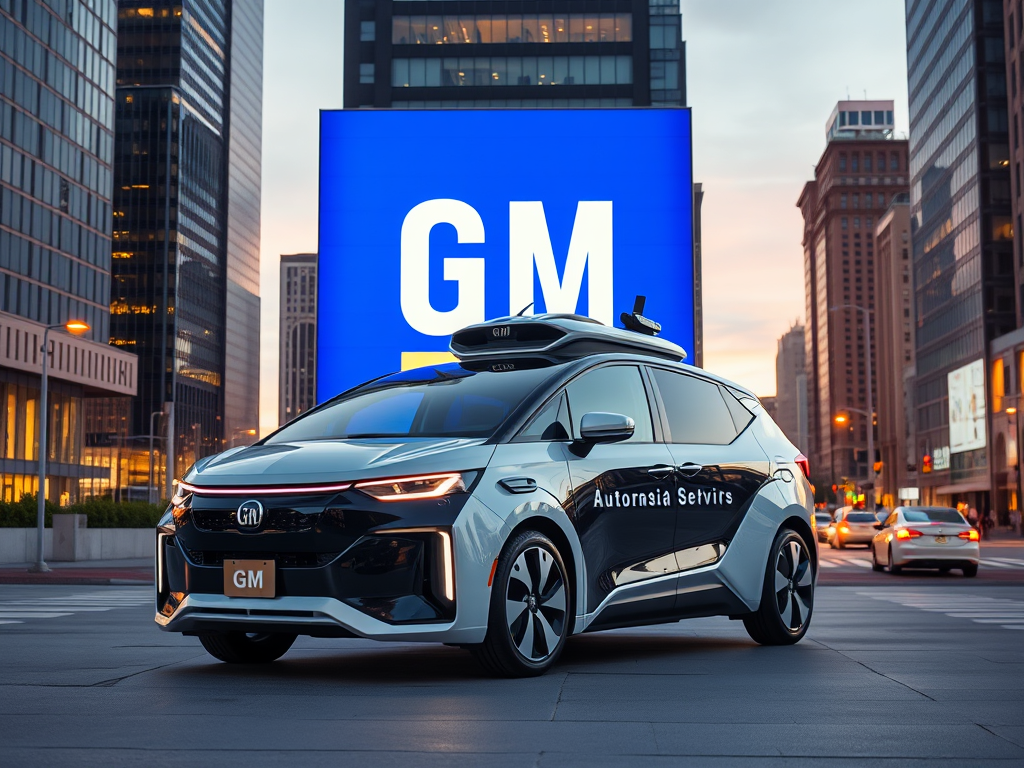

G.M. Will Stop Developing Self-Driving Taxis

General Motors (GM) announced on Tuesday that it would cease the development of a self-driving taxi, bringing an end to a multi-year project that cost the company billions of dollars. This decision leaves the field open for competitors such as Tesla, Amazon, and Waymo.
The automaker revealed it would integrate its Cruise subsidiary, which was handling the self-driving taxi project, into its main operations. This move would allow previously separate teams to work together on developing fully autonomous vehicles for private owners.
This shift marks GM’s exit from a sector some industry insiders believe could eventually be worth hundreds of billions of dollars, provided researchers can overcome significant technological challenges. Visionaries like Tesla’s CEO Elon Musk, along with other Silicon Valley leaders, have long envisioned a future with fleets of driverless cars transporting passengers.https://wordpress.com/
However, GM’s CEO Mary T. Barra suggested the returns were too distant to justify further investment in robotaxi technology, which has already cost the company $10 billion. “You need to understand the costs involved in operating a robotaxi fleet, which isn’t central to our business and is very expensive,” she said in a call with Wall Street analysts.
Instead, GM will focus on advancing technology that enables cars to steer, accelerate, and brake autonomously in specific conditions, with the ultimate aim of creating fully self-driving vehicles without human oversight.
Achieving full autonomy has proven to be a major challenge. Last year, Cruise paused its self-driving taxi service in San Francisco after one of its vehicles collided with and dragged a pedestrian, causing serious injuries. In July, GM announced that Cruise would resume testing self-driving cars with human drivers in the vehicle.
GM was among several companies working on autonomous taxis. Waymo, a subsidiary of Google’s parent company, offers self-driving taxis in San Francisco, Los Angeles, and Phoenix, with plans for expansion to cities like Atlanta, Miami, and Austin, Texas. Tesla, Amazon, and other firms are also preparing to launch similar services.
Like most major automakers, GM is dealing with sluggish demand for cars and facing pressure to invest in new technologies, including electric vehicles, to remain competitive with rising Chinese car manufacturers. Analysts note that some Chinese companies have already surpassed their U.S. and European counterparts in autonomous vehicle technology.
The decision to absorb Cruise into GM’s main operations is expected to save the company $1 billion annually. GM is under financial pressure after revealing last week that it would incur a more than $5 billion hit to its profits due to restructuring its unprofitable operations in China.
William Riggs, a professor at the University of San Francisco who specializes in autonomous vehicles, expressed surprise at GM’s decision. “Cruise had a highly viable product with substantial capital invested, so I’m surprised they’ve chosen to halt its progress,” he said. However, by incorporating Cruise’s technology into its consumer vehicles, GM can “immediately benefit from some of its prior investment while limiting its losses,” Riggs added.
Cruise’s co-founder and former CEO, Kyle Vogt, resigned in November of last year, shortly after the San Francisco incident. In June, the company appointed Marc Whitten, a former executive at Unity, as the new CEO.
Following GM’s announcement, Vogt posted a message on the social media platform X, criticizing the decision. “In case it wasn’t clear before, it’s crystal clear now: GM are a bunch of dummies,” he wrote.
Barra stated that GM had not yet determined how many Cruise employees might be affected by the decision. Last year, Cruise laid off 900 employees out of a total workforce of 3,800.



Leave a Reply