
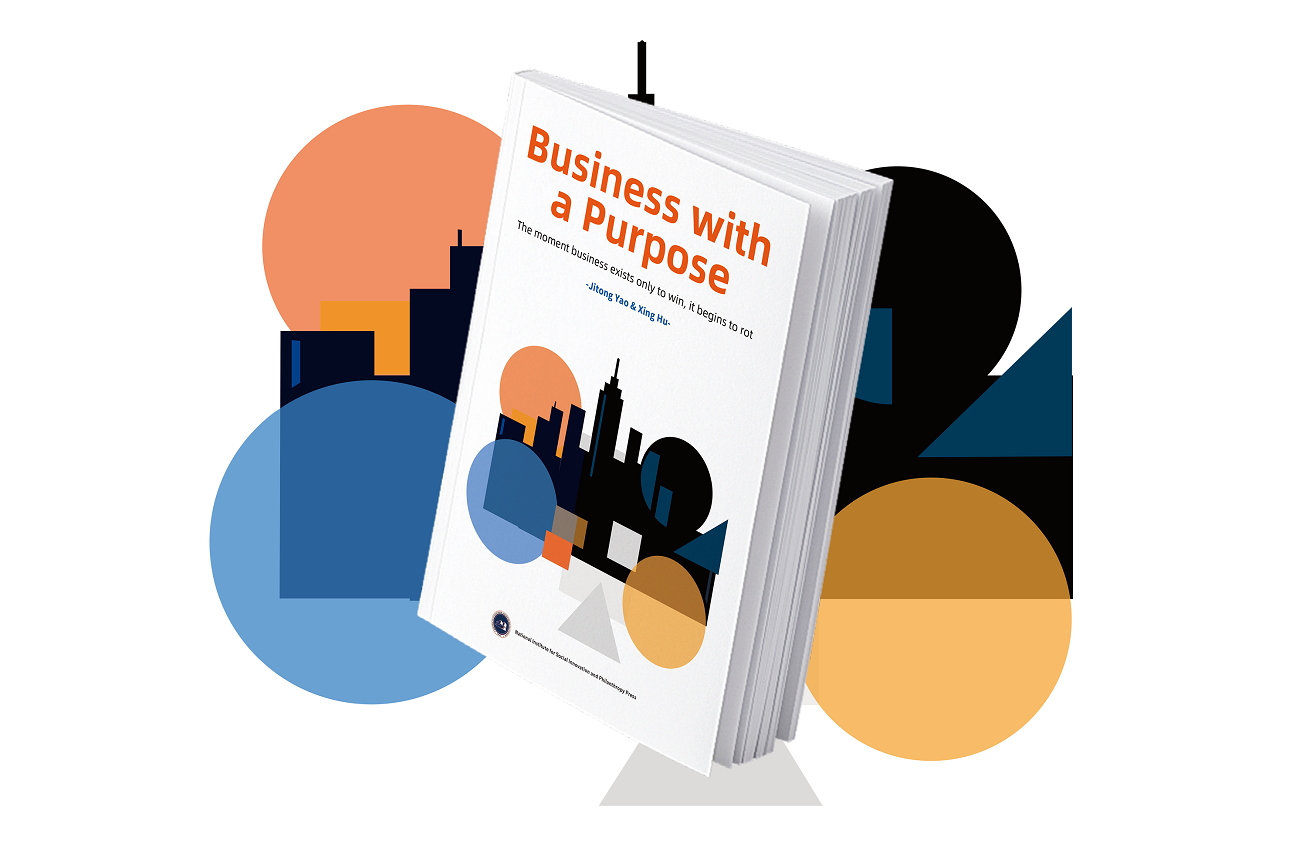
In an era when companies are judged by more than quarterly earnings, Business with a Purpose by Jitong Yao and Xing Hu arrives with a timely and ambitious message: the next generation of business leadership will not be defined by profit alone, but by the ability to build trust, solve real problems and create public value that can last.
The book, published in the United States by National Institute for Social Innovation and Philanthropy Press, presents itself not as another call for corporate goodwill, but as a practical framework for rethinking how companies should operate in a world shaped by fragile trust, social pressure, regulatory change, ESG expectations and long-term uncertainty.
At the center of the book is a clear argument: good intentions are no longer enough. Companies that treat public value as a side project may win temporary praise, but they rarely build durable impact. Yao and Hu argue that purpose must move from the edge of business into the core of strategy, governance, product design, resource allocation and stakeholder relationships.
As one review puts it, Business with a Purpose is “a rare book that makes purpose-driven business feel urgent, clear, and practical.” Its strength lies in turning purpose-driven business from an attractive slogan into a serious framework that entrepreneurs, executives, investors and public-interest leaders can actually discuss, apply and measure.

That is what gives Business with a Purpose its force. The book does not simply ask companies to “do good.” It asks a deeper question: how should organizations be built so that doing good becomes sustainable?
Yao, described in the book as a global young entrepreneur, philanthropist and scholar, brings a practitioner’s perspective shaped by entrepreneurship, investment, education philanthropy and public-interest commercialization. Hu, an Associate Professor in Innovation and Information Management at HKU Business School, brings an academic and systems-oriented lens grounded in operations management, platform economics and emerging technology.
Together, they create a rare combination: a business book that is both idealistic and operational, both values-driven and structurally rigorous.
The book’s promotional materials frame it boldly: not just a book about doing good, but a new way to think about business, trust and long-term value. That description is accurate. Business with a Purpose is less interested in moral slogans than in mechanisms. It treats trust as a strategic asset, public value as a measurable contribution and responsibility as part of long-term competitiveness.

The authors organize their argument around several major ideas. The first is “corporate public-mindedness,” the belief that a company should not treat social responsibility as a donation program or marketing campaign, but as part of its operating logic. A truly public-minded company chooses a real problem, commits to it for the long term and builds that commitment into its products, culture and decisions.
The second is “public-interest commercialization,” a concept that challenges nonprofits and social organizations to move beyond fragile dependence on grants and donations. Yao and Hu argue that mission-driven organizations need sustainable resource engines if they want to scale. In this view, commercial discipline does not weaken public purpose; when designed responsibly, it helps public-interest work survive, grow and replicate.
The third is benefit-oriented infrastructure, including benefit corporations, contribution measurement and systems such as “Benefit Coin.” These sections are among the book’s most forward-looking. The authors argue that social contribution must become visible, verifiable and coordinated if it is to move beyond sentiment. Public value, they suggest, needs its own language of measurement and accountability.
The book is also grounded in cases and practical pathways. It examines healthcare mutual-aid platforms, accessibility-focused companies, social-impact academies, public-interest organizations and cross-sector collaboration among enterprises, NGOs and governments. These examples help turn a broad philosophical question into something more concrete: how can companies build public trust without sacrificing commercial discipline?
For founders, executives and investors, the book’s message is especially relevant. In a world where employees vote with their careers, consumers vote with their attention, regulators vote with rules and capital increasingly prices risk through sustainability and governance, companies can no longer assume that profit alone will protect them. The book argues that long-term business value now depends on mission, trust and resilience.

That makes Business with a Purpose a particularly important read for Silicon Valley and the global innovation economy. Technology companies, AI platforms, venture-backed startups and digital marketplaces all face the same question: growth for what? The companies that endure will not only be those that scale quickly, but those that can explain why their scale deserves public trust.
What makes the book stand out is its refusal to separate purpose from execution. It does not romanticize philanthropy, nor does it dismiss profit. Instead, it offers a more mature business logic: profit and purpose should not be enemies; they should be designed into the same system.
The conclusion of the book captures its larger ambition. Business earns the right to speak about long-termism only when it becomes seriously useful to the world. That is the standard Yao and Hu ask companies to meet.
For readers tired of empty ESG language, performative corporate responsibility and short-lived social-impact campaigns, Business with a Purpose offers a more demanding and more practical alternative. It is a book for leaders who understand that trust is no longer a soft value, but a hard condition for survival.
In that sense, Business with a Purpose is not merely a business book. It is a blueprint for the next era of enterprise — one in which companies are expected not only to win, but to matter.




Leave a Reply