
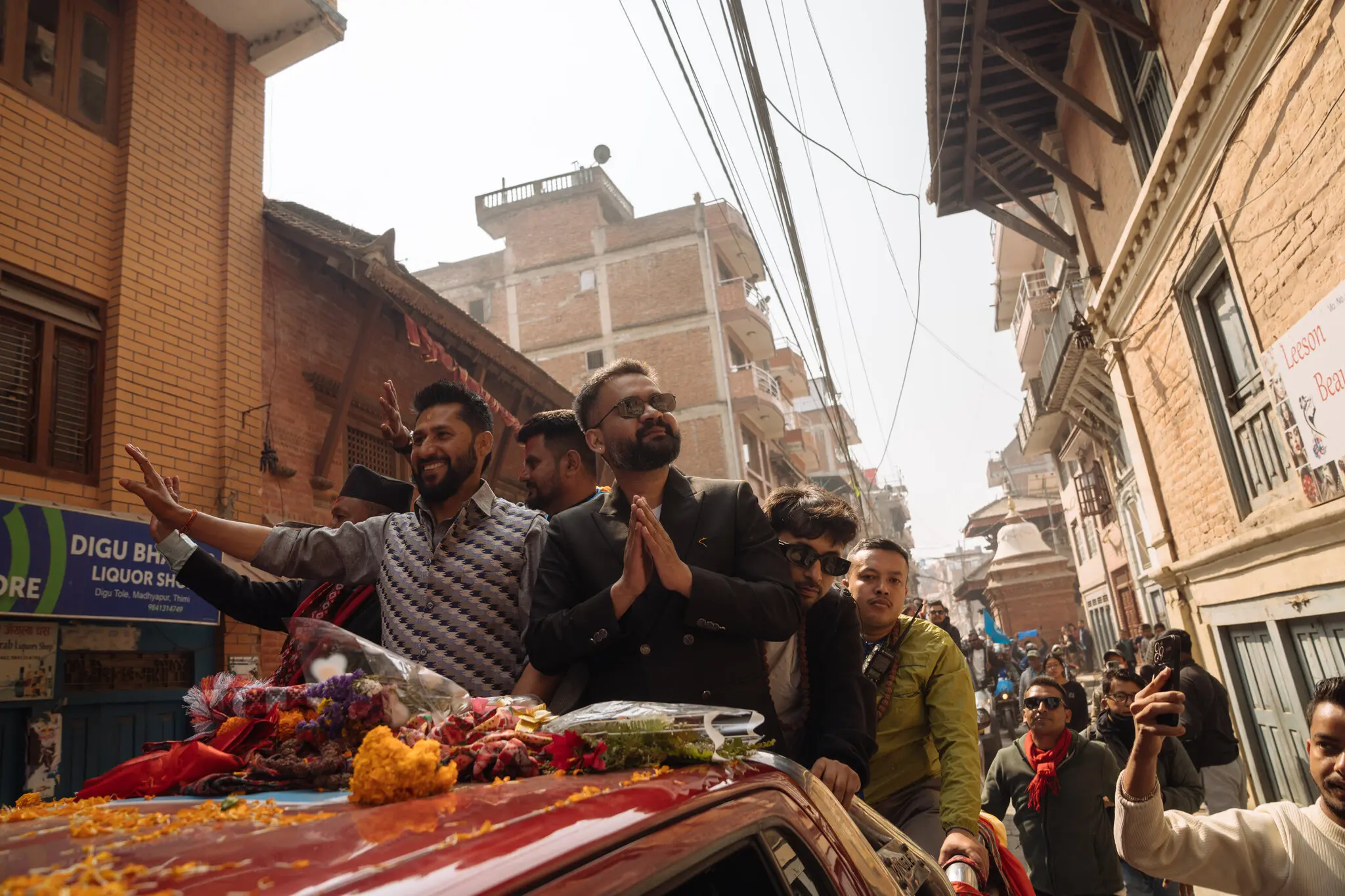
Nepal has witnessed a remarkable political shift as a new generation of voters helped propel a young political movement to a decisive electoral victory. In a powerful demonstration of Gen Z’s growing influence in national politics, Nepali voters have delivered a sweeping parliamentary win to a party led by 35-year-old Balendra Shah, a former rapper who previously served as mayor of the capital city, Kathmandu.
Preliminary results from the national election released on Sunday show Shah’s party securing 100 of the 165 directly elected seats in Nepal’s lower house of parliament. If confirmed, the result would represent one of the most decisive victories in the country’s modern democratic history.
The election, held on Thursday, was the first nationwide vote since a youth-driven protest movement last year forced the collapse of a government widely criticized for corruption and lack of accountability. The political unrest reached a peak in September when security forces opened fire on demonstrators protesting both political impunity and restrictions on social media platforms. Nineteen people were killed during the clashes.
Within hours of the incident, widespread unrest erupted across the country. Protests escalated into violent confrontations, leaving dozens more dead and resulting in the destruction of thousands of buildings through arson attacks. The turmoil ultimately led to the removal of Prime Minister K.P. Sharma Oli from power, marking a dramatic turning point in Nepal’s political landscape and highlighting the growing influence of younger generations.
According to Subhash Sharma, a senior member of Shah’s political organization, the Rastriya Swatantra Party (RSP), the scale of the victory surprised even many supporters. While there had been widespread public demand for change, few expected such a commanding electoral outcome.
Balendra Shah, widely known by his stage name “Balen,” personally challenged the 74-year-old Oli for a parliamentary seat in eastern Nepal. The former musician ultimately defeated the three-time prime minister in a race that symbolized the clash between a rising generation and the country’s traditional political leadership.
The official results released so far only account for the seats filled through direct elections. Nepal’s electoral system also includes proportional representation seats that are distributed according to party vote share. Early counting indicates that the RSP is also performing strongly in that category, although final numbers have not yet been confirmed.
For decades, Nepal’s political system has been dominated by three major parties that frequently formed shifting coalition governments. These alliances often changed partners and priorities, resulting in fragile administrations and limited ideological consistency. In fact, no democratically elected government in Nepal has completed a full five-year term since the country transitioned to a federal democratic system.
Biraj Bhakta Shrestha, an RSP candidate who was overwhelmingly re-elected to represent Kathmandu, said voters were clearly seeking stability, accountability, and a new political direction. According to him, many citizens hope that the current electoral mandate will finally allow the country to pursue economic development while strengthening social harmony.
Founded less than four years ago, the Rastriya Swatantra Party has positioned itself as a modern, reform-oriented political force. Its leadership emphasizes technocratic governance, digital engagement, and stronger connections with civil society. Many of the party’s candidates are significantly younger than those representing the established political parties, reflecting the movement’s generational appeal.
The party’s candidate list also includes several professionals and activists who previously worked alongside Shah during his tenure as mayor of Kathmandu. Their campaign messaging has focused on administrative efficiency, transparency in public spending, and long-delayed infrastructure improvements.
Despite its electoral momentum, the RSP still faces structural challenges in translating its popularity into lasting policy reforms. Nepal’s parliament includes an upper chamber known as the National Assembly, whose members are elected separately from those in the lower house. Currently, the RSP does not hold any seats in that chamber.

As a result, key proposals such as judicial reform and a potential shift toward a directly elected prime minister would require cooperation from other political forces. Achieving those goals may require negotiation and political compromise, an approach that Shah has previously expressed skepticism toward.
During his time as mayor, Shah gained national attention for several visible urban improvement initiatives. His administration focused on reducing waste accumulation in Kathmandu and improving the city’s public education infrastructure. These policies helped build his reputation as a results-driven reformer.
However, some of his policies also generated controversy. Efforts to clean up the capital included removing informal street vendors, many of whom depended on small-scale trading for their livelihoods. Critics argued that the crackdown disproportionately affected the city’s poorest residents. In addition, several informal settlements were demolished as part of urban beautification efforts, raising concerns about housing rights.
Political analysts have also pointed to Shah’s direct and sometimes confrontational communication style. On social media, he has frequently criticized Nepal’s political establishment as well as major global powers including India, China, and the United States. His rhetoric has occasionally been blunt, reflecting his reputation as a leader who prefers decisive action over lengthy negotiations.
During a campaign rally last month, Shah drew attention for controversial remarks about infrastructure delays. Frustrated with contractors accused of slowing road construction projects, he suggested that those responsible should face severe consequences. The statement sparked debate about the balance between strong leadership and democratic consensus.
Within the RSP itself, internal tensions may also emerge in the coming months. Shah only formally joined the party earlier this year, while its founder, Rabi Lamichhane, remains a highly visible figure despite ongoing legal disputes.

Lamichhane, a former television talk show host who entered politics with a strong anti-corruption platform, has faced multiple legal cases, including allegations of fraud. During the height of the Gen Z protest movement last year, he briefly appeared in public demonstrations despite being under detention at the time. After returning to prison for several days, he was later released and successfully retained his parliamentary seat in the latest election.
Even so, many observers believe Shah’s personal popularity played a decisive role in the party’s success. According to RSP officials, his public image as a symbol of political renewal helped mobilize voters who had previously grown disillusioned with traditional parties.
Music also played an unexpected role in the movement’s cultural momentum. One of Shah’s songs, titled “Nepal Smiling,” became an unofficial anthem during the months leading up to the election. The track combines upbeat rhythms with lyrics that criticize corruption, crime, and economic hardship while calling for national renewal.
Despite the enthusiasm surrounding the political shift, voter turnout in Thursday’s election reached just under 60 percent. This figure is considered relatively low for a vote widely framed as a referendum on political change.
Some younger citizens said that although they wanted new voices in government, they felt disconnected from the political process. Others pointed to structural barriers that prevented participation, particularly for the millions of Nepali workers living overseas. Because Nepal does not currently allow absentee voting, many migrant workers were unable to cast ballots.

Nevertheless, participation remained strong in many rural and mountainous regions. In remote parts of western Nepal, families went to extraordinary lengths to ensure elderly relatives could vote.
In Accham District, relatives carried a 107-year-old woman on a wooden chair for more than an hour through mountainous terrain so she could reach a polling station. The scene illustrated the deep commitment many Nepalis still feel toward democratic participation despite political frustrations.
Outside a polling station in Kathmandu, 84-year-old voter Ram Das Manandhar summed up the mood shared by many citizens. Leaning on his cane while waiting to cast his ballot, he said the country needed new leadership and fresh perspectives rather than the same familiar political figures.
The final certified results will determine how large Shah’s parliamentary majority ultimately becomes. Regardless of the exact numbers, the election has already marked a significant generational turning point in Nepal’s political story, signaling the growing influence of young voters eager to reshape the country’s future.




Leave a Reply