
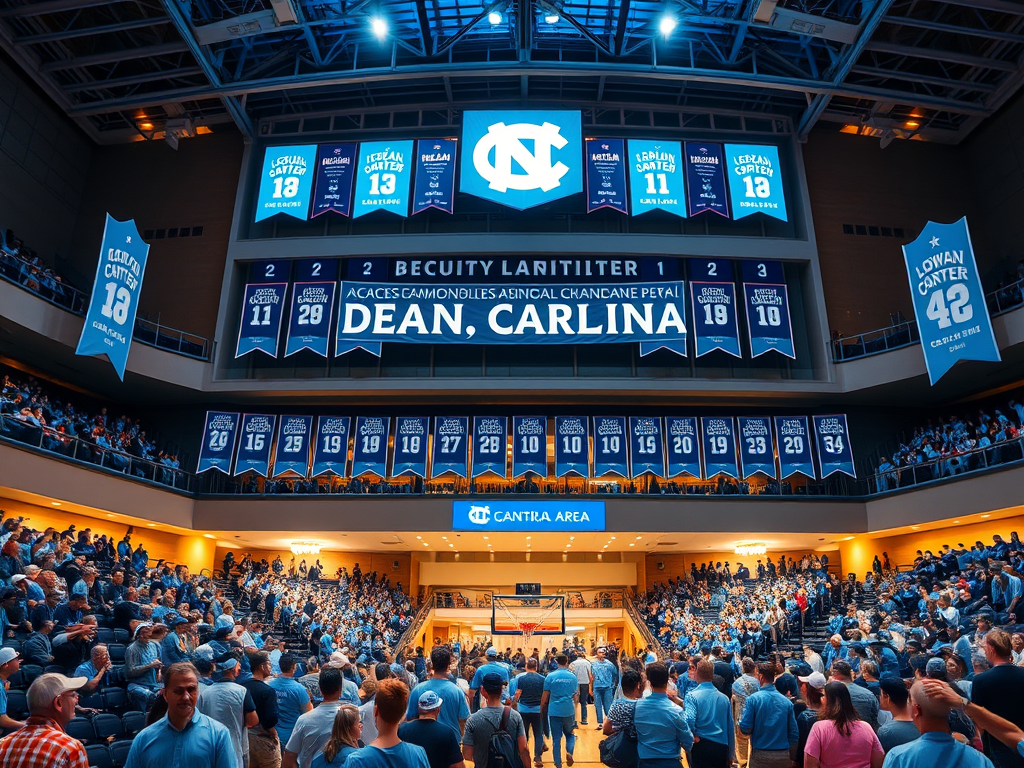

CHAPEL HILL, N.C. — Step inside the Dean E. Smith Center and you’ll notice a familiar ritual. Almost everyone pauses, tilts their head back, and looks toward the rafters.
Six NCAA championship banners hang high above the court, silent reminders of title runs that shaped generations. Across the arena, retired jerseys honor icons whose names are woven into college basketball history: Vince Carter, Antawn Jamison, Rasheed Wallace, and many others. For four decades, the building affectionately known as the “Dean Dome” has stood as both shrine and stage for the North Carolina Tar Heels men’s basketball.
Named after Hall of Fame coach Dean Smith—who famously recruited Michael Jordan and captured two national championships during his tenure—the arena opened in 1986, by which time Jordan was already a rising NBA superstar. Since then, more than 21,000 fans have filled the seats on winter nights, a sea of Carolina blue and argyle sweaters stretching from November through March.
Yet the magic of the Smith Center has never been confined to its walls. It begins outside, with the long walk down the hill toward the entrance. Students, alumni, and grandparents merge into a single current of blue and white. Before tipoff, the student section bounces in unison, the risers behind the basket visibly trembling as music blares and anticipation builds. When unforgettable moments happen—like Seth Trimble drilling a buzzer-beating three-pointer in February to defeat archrival Duke Blue Devils men’s basketball—the building feels less like concrete and steel and more like a living, breathing organism.
But time has taken its toll. After nearly 40 years of use, the Smith Center requires substantial repairs. Engineers have cited the need for a new roof, electrical upgrades, and other infrastructure fixes that could cost at least $150 million just to maintain the current structure. University-commissioned studies, which themselves cost more than $1 million, suggest that preserving the arena in its existing form would do little to modernize it.
The real debate centers on whether patchwork repairs are enough—or whether a transformational overhaul is required. A comprehensive renovation is projected to cost roughly $600 million. Alternatively, university leaders have explored constructing a brand-new arena, possibly at Carolina North, a 230-acre campus expansion about 3.5 miles from the current site.
That possibility has ignited a passionate divide within the Carolina community. Traditionalists argue that the Smith Center is the emotional heart of campus and should remain exactly where it stands. Others, looking at the rapidly evolving business landscape of college athletics, worry that sentimentality could come at a steep financial cost.
Hall of Fame coach Roy Williams, who won three national championships at North Carolina and remains one of the program’s most revered figures, has publicly advocated for staying put. In a widely shared video, Williams said he favors renovating the current building rather than moving off campus, emphasizing that Dean Smith himself wanted the arena embedded within university life.
Supporters have mobilized. An online petition to “Save the Dean Dome,” organized by the Committee for a South Campus Arena, has gathered more than 37,000 signatures. Students distributed flyers before a high-profile Duke matchup, urging fans to demonstrate their support. Former players, including 2017 Final Four Most Outstanding Player Joel Berry II and all-time leading scorer Tyler Hansbrough, voiced frustration over what they perceived as limited consultation during early discussions.
Many alumni felt blindsided by reports that the decision to relocate had essentially been finalized behind closed doors. Critics argued that those who never wore a Carolina uniform could not fully grasp the emotional attachment former players feel toward the building. Dave Hanners, a former player and assistant under Smith, noted that he had yet to encounter a supporter of a northern relocation.
The backlash prompted university leaders to recalibrate. Although initial development plans for Carolina North were approved in January, they did not explicitly include a new basketball arena. Athletic director Bubba Cunningham later acknowledged communication missteps and announced the formation of an advisory council composed of former players. Transparency, administrators say, is now the priority.
When UNC released detailed financial projections for seven potential scenarios, the numbers reframed the discussion. The current Smith Center lacks premium seating and luxury suites common in modern arenas. It operates with a single concourse, and thousands of prime seats are locked into below-market pricing agreements. In an era when athletic departments share revenue with players and compete aggressively in recruiting, those limitations translate into millions in unrealized income.
This financial pressure is compounded by other investments across campus athletics, including the high-profile hiring of NFL legend Bill Belichick to lead the football program. Against that backdrop, leaving potential revenue untapped becomes increasingly difficult to justify.
Three primary options have emerged.
First is a full renovation of the existing Smith Center, estimated at approximately $591 million. While emotionally appealing, such a project would likely require the basketball team to relocate temporarily during construction and would still generate significantly less annual revenue—between $14 million and $22 million less—than a new facility.
Second is constructing a new arena at Carolina North for around $786 million. This option offers the greatest long-term revenue potential, particularly if integrated into a mixed-use development with retail and residential components. However, its 3.5-mile distance from campus raises concerns about accessibility and atmosphere. Former UNC standout Mitch Kupchak reportedly visited the site and questioned whether students would realistically make the trek on foot.
A third alternative has gained traction: building a new arena closer to campus at Odum Village, a former student housing site currently slated for redevelopment. Located roughly a quarter mile from the Smith Center, Odum Village represents a compromise. The projected cost of $703 million sits between renovation and Carolina North, while revenue potential far exceeds that of a remodel. Crucially, construction there could proceed without displacing the team during the build.
University officials have pledged that any new facility would retain the name Dean E. Smith Center, with the court continuing to honor Roy Williams. Symbolism, they understand, matters.
Steve Newmark, who will succeed Cunningham as athletic director, has emphasized balancing emotion with logic and fiscal responsibility. The process, administrators say, will slow down to ensure stakeholder engagement and rebuild trust.
For many observers, this debate reflects broader tensions reshaping college sports. Tradition collides with financial reality. Nostalgia competes with innovation.
Few traditions capture Carolina’s identity more vividly than what happens after a dramatic win over Duke. Following Trimble’s game-winner, thousands of students poured out of the Smith Center and sprinted uphill, streaming through campus toward Franklin Street. Within minutes, the town’s main thoroughfare transformed into a jubilant sea of celebration. Police blocked intersections as crowds swelled, and students leapt over makeshift bonfires in a rite of passage that defines the Tar Heel experience.

That ritual underscores what is truly at stake. The arena is not just a venue; it anchors a cultural ecosystem stretching from dorm rooms to downtown.
Former athletic director Dick Baddour summarized the dilemma succinctly: process matters as much as outcome. Whether UNC chooses renovation, relocation, or compromise, unity will be essential. A project costing between $600 million and $800 million cannot succeed without broad community backing—from players and students to alumni and season ticket holders.
The final decision remains pending. But one lesson is already clear. Even a program that produced Michael Jordan is not immune to the economic currents transforming college athletics. At North Carolina, the challenge is not merely deciding where to build. It is determining how to honor a storied past while securing a sustainable future.




Leave a Reply