
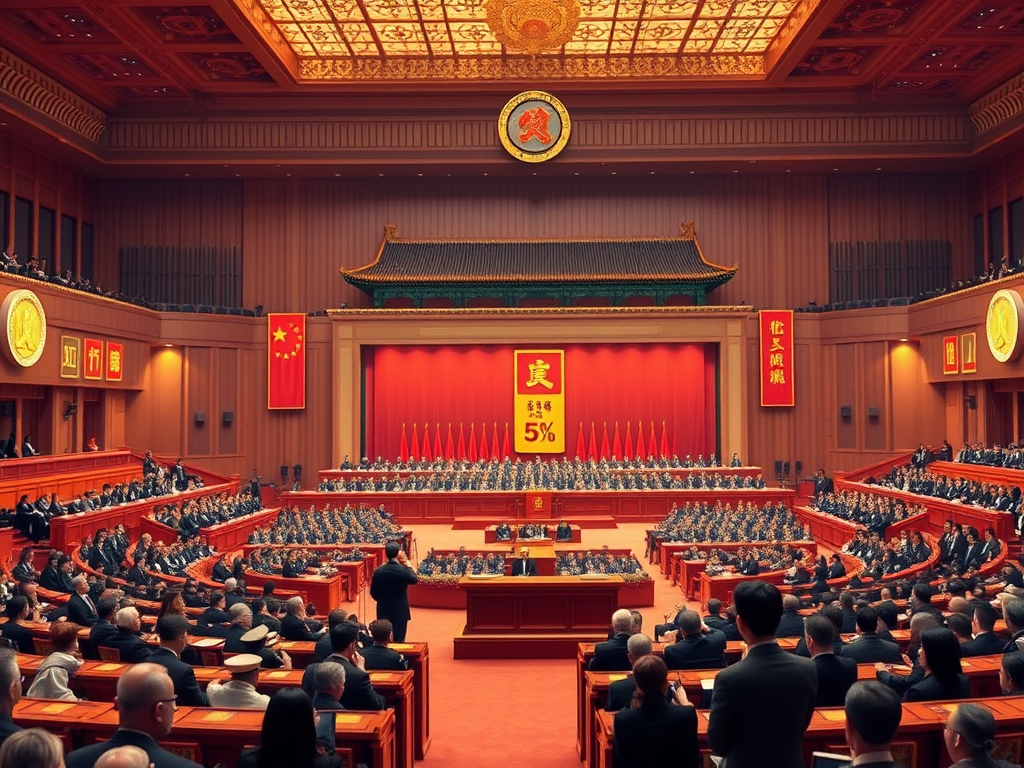

Every March, senior officials in China convene inside the Great Hall of the People in Beijing to present one of the most closely watched numbers in global economics: the country’s annual growth target. The announcement serves as both a policy signal and a political message, offering insight into how the world’s second-largest economy intends to navigate the year ahead.
This year, the leadership set the 2026 growth target at a range of 4.5 percent to 5 percent. It marks the first time in more than thirty years that the official benchmark has dipped below the 5 percent threshold, underscoring a broad recognition that China’s era of breakneck expansion has given way to a more moderate pace of development.
The target was unveiled at the opening session of the National People’s Congress, the annual gathering of China’s legislature, which operates under the leadership of the Communist Party. During this meeting, policymakers outline key economic priorities, fiscal strategies and broader policy goals for the year.
In the weeks leading up to the announcement, analysts and market observers speculated intensely about whether Beijing would finally lower its long-standing 5 percent benchmark. For the past three years, the government had maintained the target at or around that level, even as economic headwinds intensified.
Financial markets track the growth target closely because it reflects the expectations and ambitions of China’s top leadership, including President Xi Jinping. In a political system where policy direction is highly centralized, the annual target offers important clues about the likely scale of stimulus measures, industrial support and fiscal expansion.
China’s economy has been under sustained pressure in recent years. Persistent deflationary trends, elevated youth unemployment and subdued consumer sentiment have weighed on domestic demand. At the same time, tensions with the United States, including a trade war during the administration of former President Donald Trump, have disrupted export flows. Although the two sides are currently observing a fragile truce, tariffs and trade restrictions have forced Chinese exporters to diversify into alternative markets, intensifying global competition.
Despite these obstacles, exports remain a cornerstone of China’s economic performance. In 2025, the country recorded a trade surplus of approximately 1.19 trillion dollars, a historic high. Official data released earlier this year indicated that the economy expanded by 5 percent in 2025, matching the previous year’s growth rate.
However, skepticism persists among some economists regarding the accuracy of official statistics. Independent estimates suggest that actual growth may be significantly lower. Research firm Rhodium Group, for instance, assessed that China’s economy expanded by less than 3 percent last year, highlighting ongoing debates about transparency and data reliability.
Further fueling speculation, several provincial governments and major cities announced 2026 growth targets that were lower than their previous year’s goals. Analysts at Macquarie Group noted that this pattern increased the likelihood that the national target would fall below 5 percent for the first time since 1991. The only recent exception to the annual target-setting practice occurred in 2020, when the government refrained from issuing a specific figure due to the uncertainty caused by the Covid-19 pandemic.
China’s long-term economic trajectory reflects a broader structural transition. Following its opening to foreign investment and global markets in the late twentieth century, the country experienced decades of extraordinary expansion. As the economy matured and climbed to become the second largest in the world, sustaining high growth rates became increasingly difficult. Gains in productivity are harder to achieve once an economy has largely caught up with global technological and industrial standards.
Much of China’s strength lies in its manufacturing sector. Over the past decade, the country has built expansive industrial parks, advanced electric vehicle facilities and large-scale data centers, frequently supported by low-cost financing from state-owned banks. Chinese factories now produce a substantial share of the world’s electric vehicles, solar panels and lithium batteries. In 2025, the domestic automaker BYD surpassed Tesla to become the largest electric vehicle producer globally, illustrating China’s industrial capacity and competitiveness.
Yet an overreliance on manufacturing has also created imbalances. Excess production capacity and intense competition have triggered price wars across multiple industries, squeezing profit margins. This phenomenon, often described within China as “involution,” refers to a cycle in which companies increase output but struggle to generate meaningful returns.
To strengthen the economic outlook, policymakers have emphasized the need to rebalance growth toward domestic consumption and higher-value industries. The leadership has repeatedly highlighted the importance of “high-quality growth,” particularly in advanced technologies such as artificial intelligence.
International institutions, including the International Monetary Fund, have long recommended that China adopt reforms aimed at stimulating consumer spending. These recommendations have gained urgency following a sharp downturn in the property market, which eroded household wealth. Combined with modest wage growth, the housing slump has dampened consumer confidence and encouraged precautionary saving.

China’s limited social safety net further contributes to high household savings rates. Concerns over medical expenses, education costs and retirement security lead many families to save rather than spend. Economists argue that addressing these structural issues requires expanding public services, particularly in urban areas where migrant workers often lack equal access to healthcare and education.
To encourage spending, the government has introduced targeted subsidies, including rebates for household appliances and electric vehicles. Pension payments have been increased, and child-care subsidies have been rolled out in an effort to ease financial pressures on families.
Nevertheless, many analysts believe these measures are insufficient to generate a lasting consumption rebound. Wage growth across large segments of the economy has remained subdued, limiting households’ ability to increase spending. Without stronger income growth and deeper structural reforms, temporary incentives may have only a limited impact.
As one economist observed, sustained consumption ultimately depends on earnings. Without meaningful improvements in household income, efforts to stimulate spending are unlikely to fundamentally alter China’s growth trajectory.




Leave a Reply