
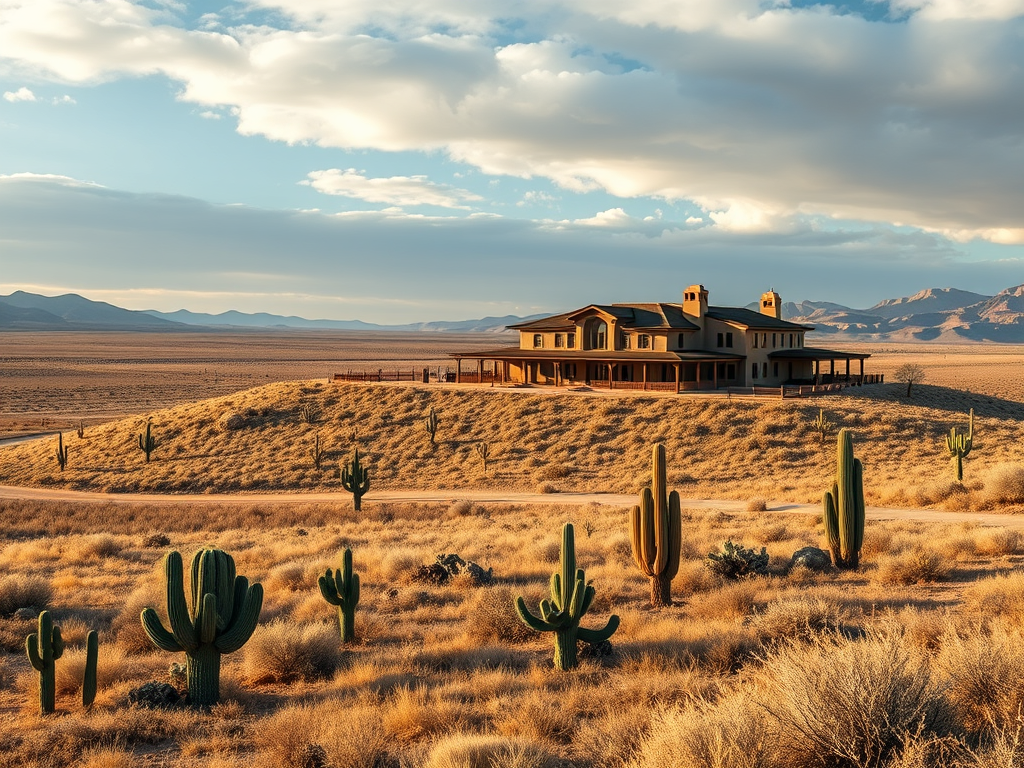
Far from the ocean and thousands of miles from Jeffrey Epstein’s infamous Caribbean island, another of his properties rose quietly from the high desert of northern New Mexico. Unlike Little St. James, this estate was not surrounded by water. Yet its isolation made it feel just as cut off from the outside world.
Perched on a ridge south of Santa Fe, the 30,000-square-foot mansion overlooked vast stretches of rugged land that Epstein called Zorro Ranch. The landscape was defined by wind-swept grass, cholla cactus, and dry arroyos cutting through the earth. In this sparsely populated region, neighbors can be miles apart, and privacy is often treated as a cultural norm.
Several of Epstein’s accusers have said they were transported to the New Mexico ranch. Prominent individuals reportedly visited the property over the years. According to accounts that later surfaced, Epstein even entertained ideas about transforming the ranch into a base for controversial scientific experiments involving genetics.
Despite those allegations, state officials in New Mexico have acknowledged that the ranch never underwent a comprehensive local investigation during the 26 years Epstein owned it. In 2019, as scrutiny intensified nationwide, a state-level inquiry into his activities was effectively transferred to federal prosecutors. According to state leaders and documents that have since been unsealed, that federal effort did not result in sustained follow-through related to the ranch.
Eddy Aragon, a radio host based in Albuquerque who has spent years examining Epstein’s ties to New Mexico, has argued that the ranch received far less attention than other properties linked to the financier. He noted that locations such as Little St. James, along with residences in major cities, became central to public discussion. In contrast, Zorro Ranch remained largely out of the spotlight.
In response to renewed national attention following the Justice Department’s release of additional Epstein-related documents, New Mexico lawmakers recently voted unanimously to establish a bipartisan “truth commission.” The four-member panel, created within the State Legislature, has subpoena authority and is tasked with examining what may have occurred at the ranch. At the same time, the state’s attorney general announced plans to reopen an investigation that had been closed shortly before Epstein’s death in 2019.
Andrea Romero, a state representative from Santa Fe leading the commission, has said the central question is how Epstein was able to operate for decades without meaningful accountability. She and other lawmakers argue that understanding the systemic failures surrounding the ranch is essential to preventing similar abuses in the future.

The effort faces obstacles. Since Epstein’s death, the property has been sold. Its current owner, Don Huffines, a Dallas real estate investor and former Texas state senator, has said he intends to cooperate with law enforcement if approached. However, any investigation may be complicated by the passage of time and changes in ownership.
Recently unsealed materials have added to public concern. Among them was an anonymous tip from an individual claiming to have worked at the ranch. The tip alleged that two abused girls died there and were secretly buried in the surrounding hills. There is no public record confirming whether federal investigators fully examined that claim. The F.B.I. has declined to comment on the matter or to clarify the extent of any searches conducted at the New Mexico property.
Correspondence included in the document release indicated that as late as December 2019, Epstein’s attorneys were communicating with federal prosecutors about investigative steps, and the ranch had not yet been searched at that time.
In 2019, as the criminal case against Epstein intensified, the New Mexico attorney general’s office began interviewing potential witnesses regarding activities within the state. Hector Balderas, who served as attorney general then, later said that federal prosecutors from the Southern District of New York asked the state to halt its independent inquiry and share its findings. According to Balderas, federal authorities believed consolidating control of the investigation would strengthen their case.

However, Balderas has since expressed frustration that more aggressive action was not taken concerning New Mexico assets. In a letter sent about a year later, his office urged federal officials to seize the ranch, asserting that it may have been used to facilitate and conceal child trafficking. He has said he did not receive a response to that request.
The broader historical context of New Mexico adds another layer to the story. The state has long been associated with secrecy. During World War II, the U.S. Army Corps of Engineers selected Los Alamos as the site for the covert Manhattan Project, culminating in the first atomic bomb test near Alamogordo. That culture of isolation and discretion has persisted in some areas, attracting high-profile individuals seeking privacy.
Epstein purchased Zorro Ranch in 1993 from the family of Bruce King, a three-term governor of New Mexico. The acquisition placed him in proximity to the state’s political elite. Over time, modest structures on the land were replaced with an expansive compound that included a private runway, helicopter pad, aircraft hangar, and what was widely believed to be one of the largest private residences in the state.
Security measures were extensive. Barbed-wire fencing marked the perimeter, and surveillance cameras monitored activity. Residents in nearby rural communities observed aircraft traffic and bright lights at night but often knew little about who owned the estate or what took place there. In many parts of New Mexico, a strong respect for personal boundaries discourages curiosity about neighbors, particularly when properties are spread across vast tracts of land.
Geography also played a role. In addition to owning the core acreage, Epstein leased approximately 1,200 acres of adjacent public land, officially for grazing. Stephanie Garcia Richard, New Mexico’s commissioner of public lands, later terminated those leases in 2019. She has suggested that the remoteness of the region may have made it easier for questionable activities to remain hidden.

Observers have also pointed to regulatory differences. Following his 2008 guilty plea in Florida, Epstein did not have to register as a sex offender in New Mexico due to differences in state law at the time, a factor critics say may have contributed to reduced oversight.
Today, the property has been renamed San Rafael Ranch by its new owner. Huffines has said he intends to convert it into a Christian retreat. Construction of a new entrance gate is underway, and the arch above it is planned to bear a biblical inscription welcoming visitors in the name of the Lord.
For many in New Mexico, however, the land’s recent past remains unsettled. Lawmakers behind the truth commission argue that the state must determine whether critical evidence was overlooked or lost and whether local or federal authorities missed opportunities to hold individuals accountable.
Zorro Ranch may never carry the same global notoriety as Epstein’s island in the Caribbean. Yet its sweeping desert vistas and quiet isolation now stand in stark contrast to the troubling allegations tied to its history. As New Mexico reexamines what happened within its borders, the high desert that once shielded secrets is again under scrutiny, this time with a mandate to uncover answers rather than preserve silence.




Leave a Reply