

In 2018, a major diplomatic norm was upended when the United States ambassador to Israel paid an official visit to an Israeli settlement in the West Bank. For decades, American officials had avoided such visits, wary of appearing to legitimize communities that most of the international community regards as unlawful under international law.
Now, another symbolic line is being crossed.
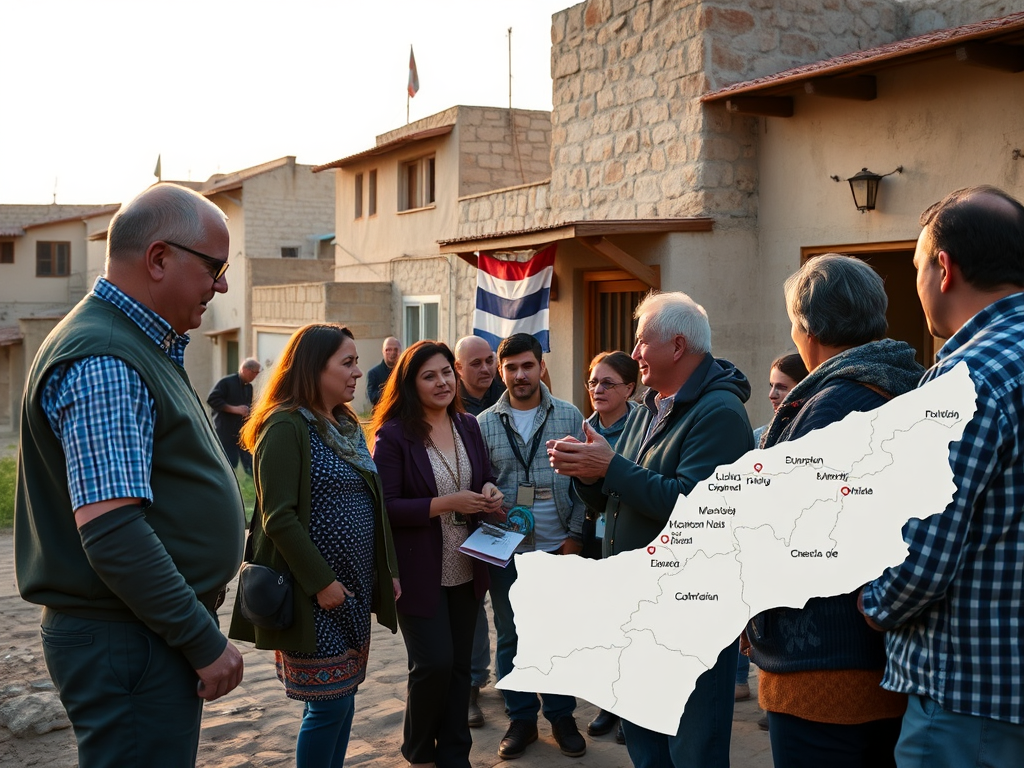
The U.S. Embassy in Jerusalem has announced that it will hold a one-day consular outreach event in Efrat, a rapidly expanding Jewish settlement in the West Bank, to provide passport services to American citizens. Embassy officials also indicated that similar services will soon be offered in Beitar Illit, an ultra-Orthodox settlement. According to the embassy, this will mark the first time American consular services are delivered inside an Israeli settlement.
Consular pop-up services are not new. In the past, the embassy has organized similar one-day events in Palestinian towns such as Ramallah and Taybeh. Additional outreach programs are planned in Israeli cities including Haifa, Beit Shemesh and Netanya. However, until now, such services had not been extended to settlements beyond the Green Line.
An embassy spokesperson emphasized that the decision does not signal any shift in official U.S. policy. Yet reactions from across the political spectrum suggest that many observers interpret it differently.
On Israel’s political right, the move was welcomed as a significant development. Foreign Minister Gideon Saar described the decision as important, while Yuli Edelstein, a lawmaker who lives in a settlement and formerly served as speaker of the Knesset, praised it as a meaningful and positive step.
Edelstein argued that the embassy’s action strengthens international acknowledgment of Israel’s claim to what he referred to as Judea and Samaria, the biblical terms for the West Bank. He went further, suggesting that Israel should ultimately apply formal sovereignty over the territory.
Palestinian leaders and groups strongly condemned the announcement. Hamas labeled the move a dangerous precedent and said it amounted to practical recognition of the legitimacy of settlements and of Israel’s continued control over the West Bank.
The settlements are Jewish residential communities established on land captured by Israel during the 1967 war. Much of the international community envisions this territory as forming the core of a future Palestinian state under a two-state solution.
Most countries maintain that the settlements violate international law. The prevailing legal interpretation holds that an occupying power may not transfer parts of its civilian population into occupied territory, nor may it appropriate land there unless required for security needs or for the benefit of the local population.
In Ramallah, the Palestinian Colonization and Wall Resistance Commission said the embassy’s decision contravenes the principle that illegal situations should not be recognized. The commission argued that by providing services in a settlement, the United States was reinforcing what it described as a “settlement reality,” thereby undermining long-standing American commitments to a negotiated two-state outcome. It also suggested the move grants the settlements additional political protection.
Criticism has also come from Israeli legal experts and figures on the left. Michael Sfard, a prominent human rights attorney specializing in international law, said that extending consular services to Efrat residents sends a clear political message. He questioned the practical justification for the move, noting that Efrat is a relatively small community of nearly 13,000 residents located only about eight miles south of Jerusalem, where the U.S. Embassy is based.
According to Sfard, residents of Efrat already rely on Jerusalem for most of their services and amenities. In his view, holding a consular event there cannot be interpreted as a matter of logistical convenience but rather as an implicit endorsement of the settlement’s legitimacy.
Liberal critics in Israel and the United States also pointed out what they see as a contradiction between this step and President Donald Trump’s public statements opposing formal Israeli annexation of the West Bank. They further note that Ambassador Mike Huckabee has long been associated with support for annexation policies.
Nadav Tamir, executive director of the Israeli branch of J Street, a liberal pro-Israel advocacy organization, argued that while Washington’s attention remains focused on Gaza, developments in the West Bank are proceeding with less scrutiny. In his view, the extension of consular services to settlements represents what he called a gradual or creeping recognition of Israeli sovereignty in the territory.

Tamir suggested that because the administration has publicly rejected outright annexation, smaller measures that stop short of formal declarations may be seen as politically safer. These steps, he argued, cumulatively reshape realities on the ground without provoking the same level of international backlash.
Daniel C. Kurtzer, who previously served as U.S. ambassador to Israel under both Republican and Democratic administrations, offered a broader historical perspective. He said that holding consular events in settlements reflects an ongoing pattern of American tolerance toward what he described as accelerating annexationist policies in the occupied territories.
Kurtzer pointed to the 2019 statement by the Trump administration that Israeli settlements are not inherently inconsistent with international law, as well as the closure of a long-standing U.S. consulate in Jerusalem that had traditionally handled Palestinian affairs. In his assessment, such actions undercut claims that Washington opposes annexation, and instead signal a steady erosion of the distinction between Israel and the territories it captured in 1967.
The White House did not immediately comment on the embassy’s latest decision. Nonetheless, the controversy underscores how even administrative or logistical measures can carry profound symbolic weight in one of the world’s most enduring and sensitive conflicts.




Leave a Reply