
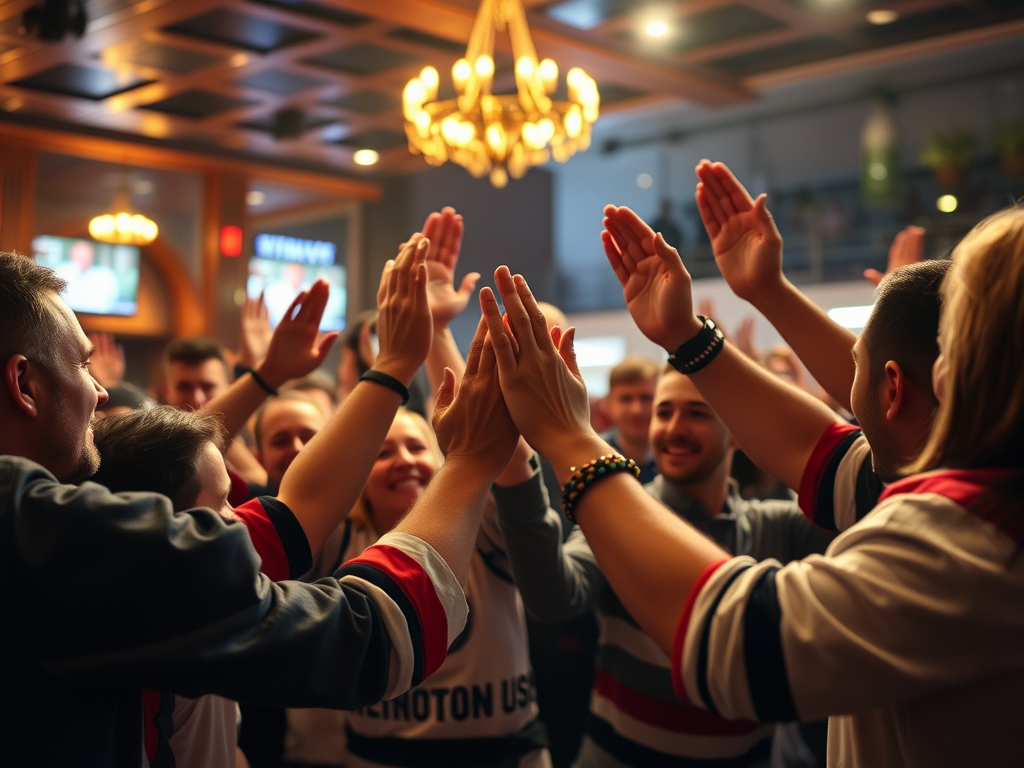

For a few remarkable hours on Sunday afternoon, the United States felt less fractured. In a country often defined by ideological fault lines and cultural standoffs, the noise briefly receded. Inside crowded sports bars and living rooms across the nation, strangers exchanged high-fives. Parents hugged their children. Political debates paused. For three tense periods of hockey and a cathartic overtime, Americans were united by something simple and powerful: a shared hope.
When Team USA captured Olympic gold in men’s hockey for the first time since the “Miracle on Ice” at the 1980 Winter Olympics, it felt like history repeating itself in the best way. The victory evoked memories of that improbable triumph over the Soviet Union, a moment that transcended sport and became national lore. This time, too, the win seemed to belong to everyone.
But by Monday morning, the mood had shifted.
In the hours following their victory, the players accepted a congratulatory phone call from Donald Trump. During the exchange, some team members were heard laughing at a crude joke about the women’s national hockey team — a moment that landed poorly with many Americans who had been celebrating alongside them just the night before. Soon after, images circulated of the players celebrating in their locker room with Kash Patel, who has faced scrutiny over alleged misuse of taxpayer funds related to travel and sporting events.
The post-victory glow continued in Miami, where several players partied after returning from Italy. Then came another announcement: members of the team intended to appear in the House Chamber during the president’s State of the Union address. In another era, such gestures might have been considered routine — ceremonial nods to champions who brought pride to the country. Championship teams have long visited Washington, taken calls from presidents, and posed for photographs in corridors of power.
But America is not operating in a neutral political environment. And its presidency is not politically neutral either. In today’s climate, symbolism is rarely incidental. Proximity to power — especially polarizing power — carries implications, whether those involved intend it or not.
The hockey team did not create the nation’s divisions. Nor did they necessarily set out to align their victory with any partisan agenda. Their defeat of a formidable Canadian squad remains a remarkable athletic accomplishment. Nothing about their off-ice choices diminishes the skill, discipline, and resilience that led them to gold. Yet timing matters. Context matters. And when the players stepped quickly into highly charged political spaces, they inevitably narrowed what had briefly felt universal.
It would be easy to blame the atmosphere — to argue that everything in modern America is politicized, that joy is fleeting because outrage is always waiting. Those forces are real. Still, these athletes are adults who operate on one of the world’s most visible stages. With visibility comes responsibility. When a team represents the United States on the Olympic stage, its actions resonate far beyond the rink.
This dynamic applies not only to hockey but to every major sports franchise and national team. Celebrations are expected. Recognition is deserved. But the identity of those offering praise — and the reasons behind it — matter. Presidents have always welcomed champions. Yet few modern leaders understand optics as instinctively as Trump. Standing beside winners offers political advantages. It projects strength. It associates leadership with excellence. It softens controversies and reframes abrasive rhetoric as relatable locker-room humor.
In those moments immediately after a championship, athletes hold rare influence. Their popularity peaks. Their symbolism expands. They have a chance to reinforce unity. That influence can be used carefully — or surrendered casually.
No one can erase the gold medal hanging around Team USA’s necks. No one can take away the emotion of that Sunday afternoon, when millions felt connected through a single contest. For a brief time, the players quieted a divided nation. But unity is fragile, and it does not sustain itself automatically.
The issue is not that the team deliberately sought to divide. Rather, it is that in contemporary America, association itself sends a message. Even unintended symbolism shapes public perception. Within 48 hours, the story surrounding their triumph began to orbit partisan debates. What had felt like a shared national celebration became filtered through political loyalties.
Moments of collective pride are increasingly rare. The men’s hockey team created one. That achievement — perhaps even more than the medal itself — was a gift. Yet the aftermath diluted its reach.
The lesson is not that athletes must avoid politics altogether or refuse invitations from elected officials. Sports and politics have long intersected. From medal ceremonies to White House visits, the overlap is embedded in American tradition. The lesson is about awareness. Lawmakers benefit from standing beside champions. They absorb some of the glow of victory. The symbolism works in their favor.
While players are savoring triumph, political leaders are calculating optics. A dominant national team represents more than athletic excellence. It embodies aspiration, discipline, and patriotism. Those qualities can be framed as inclusive and unifying — or as symbols of dominance and partisan identity.
When most of the team appears together in Washington, it signals cohesion. In a locker room, that unity is a virtue. On a political stage, it can look different. Some players reportedly chose to stay away, perhaps sensing the optics. Others decided to attend, likely viewing it as tradition rather than endorsement. Yet public perception does not always distinguish between intent and effect.
The cost of such imagery will not show up in statistics or record books. Years from now, fans will remember the overtime goal more vividly than any political appearance. But in the present, where every image is amplified and dissected, the association has consequences. The gold medal remains historic. The atmosphere around it has changed.
Representing the American flag carries obligations beyond winning. It involves reflecting the country at its best — resilience, teamwork, humility, and a belief in shared purpose. Athletic greatness is measured not only by control of the puck, but by judgment off the ice.
Team USA demonstrated extraordinary mastery in competition. Their performance in the rink will inspire future players for generations. Yet the modern American sports landscape demands more than physical excellence. It requires awareness of how quickly triumph can be folded into broader political narratives.
For one luminous afternoon, the nation felt unified. That unity was as valuable as the medal itself. The challenge now — for this team and for others that follow — is to recognize that in a polarized era, every celebration carries weight.




Leave a Reply