
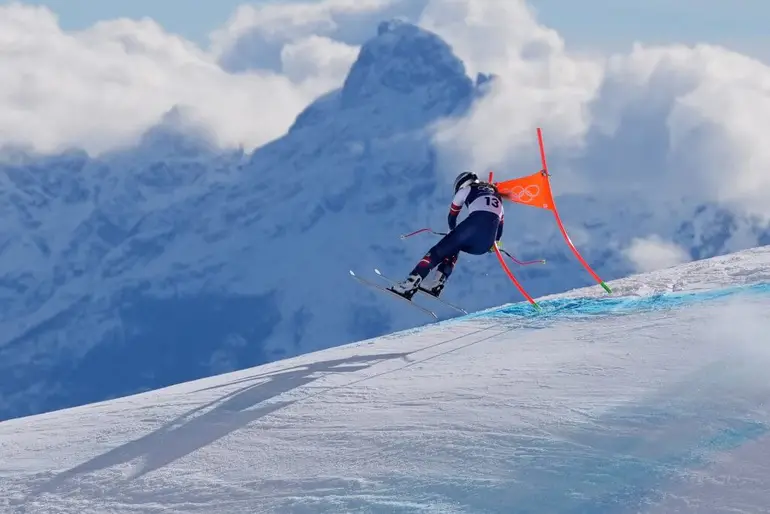
CORTINA D’AMPEZZO, Italy — Lindsey Vonn insisted she would stand at the Olympic downhill starting gate despite tearing the key ligament in her knee just nine days earlier. True to her word, she did.
Yet the comeback that had captivated the skiing world ended in heartbreak on Sunday, when the American legend crashed violently on the iconic Olympia delle Tofane course. U.S. Ski & Snowboard later confirmed that Vonn had been injured but was in stable condition, while multiple reports indicated she underwent surgery for a fractured leg and was recovering in hospital.
Starting in the 13th position, Vonn launched off a jump with her usual aggression. Midair, however, she clipped a gate, twisting her body sideways before slamming into the icy surface. She tumbled down the slope in a spray of snow, her skis spinning wildly until she came to a stop. For several tense moments, she lay motionless as medical staff raced up the mountain.
At the finish area below, thousands of spectators fell silent. Seconds earlier, the crowd had erupted as she burst from the start house. The cheers may have been louder for the Italian skiers, but few doubted that Vonn commanded the attention of the entire stadium.
The incident unfolded in just over 13 seconds. Soon after, the thump of a rescue helicopter echoed across the valley as medics treated Vonn mid-course. The aircraft airlifted her off the mountain, flying low over the finish area to a standing ovation. Officials paused the race for roughly 20 minutes.
Watching from the broadcast booth, Vonn’s sister, Karin Kildow, struggled to hold back emotion. She described how frightening it was to see stretchers deployed on the slope and how desperately she hoped her sister was safe.
“She gave everything,” Kildow said, “and that makes moments like this even harder to witness.”
While the day ended in despair for Vonn, it became a historic moment for her teammate Breezy Johnson, who captured gold — the first American downhill victory at the Olympics since Vonn’s own triumph in 2010. Johnson said she felt both pride and sorrow, adding that her “heart aches” for Vonn while feeling honored to follow in her footsteps.
Johnson later revealed that Vonn’s coach told her Vonn was cheering from the helicopter, even in the midst of her injury.
For more than twenty years, Vonn defined fearless speed skiing. Her relentless, risk-taking style made her the most decorated downhill racer in history, but it also brought a string of brutal crashes that eventually forced her initial retirement six years ago.
Simply reaching the starting gate in Cortina was extraordinary. Just over a week earlier, Vonn had ruptured her left ACL in one of her final pre-Olympic races — an injury that typically sidelines athletes for months. Many assumed it had ended her medal hopes before they even began.
But Vonn is not like most athletes. At 41, she remains driven by an almost magnetic pull toward speed, thriving on the razor-thin line between control and chaos as she hurtles down steep, icy slopes at nearly 80 miles per hour.
The crash marked a devastating conclusion to one of the most compelling storylines of the early Games, while also adding another dramatic chapter to Vonn’s remarkable legacy. She has won 84 World Cup races — including two downhills this season — along with eight world championship medals and three Olympic medals. Only Mikaela Shiffrin and Sweden’s Ingemar Stenmark have more World Cup victories.

FIS president Johan Eliasch called the incident tragic but said it underscored the nature of ski racing. He thanked Vonn for her immense contribution to the sport and wished her a swift recovery.
Before the accident, Vonn had been scheduled to compete not only in downhill, but also in the team combined and super-G events. Those races were still ahead at the time of her crash.
In the days leading up to Sunday, Vonn appeared almost superhuman. She completed two training runs, looking especially strong on the second. Her coach, Aksel Lund Svindal, noted that she seemed hesitant to land on both skis, subtly favoring her right knee — the one partially replaced in surgery in 2024. Still, he remained optimistic about her readiness.
Instead, she left the mountain by helicopter for the second time in just over a week.
The emotional swing was felt deeply by the rest of the American team. Jacqueline Wiles described a painful mix of feelings at the top of the course as she watched Johnson’s thrilling gold-medal run followed immediately by Vonn’s crash.

Wiles ultimately finished fourth, agonizingly close to the podium. Bella Wright, who placed 21st, said she was still shaken long after crossing the finish line. She spoke of the years of rehabilitation Vonn endured and how difficult it was to see her suffer again.
“She deserves more,” Wright said simply.
But alpine skiing, like most elite sports, offers no guarantees. Dedication and grit create opportunity, not certainty. Sometimes the difference between glory and disaster is a tiny bump in the snow or a fraction of a second in the air.
Svindal had said days earlier that Vonn would be mentally and physically ready when it mattered. By all appearances, she was — until she wasn’t.
On Sunday, the Olympia delle Tofane, a mountain synonymous with triumph and tragedy, delivered both in the same breath: a golden victory for one American and a devastating fall for another, reminding the world why this sport can be as cruel as it is beautiful.




Leave a Reply