
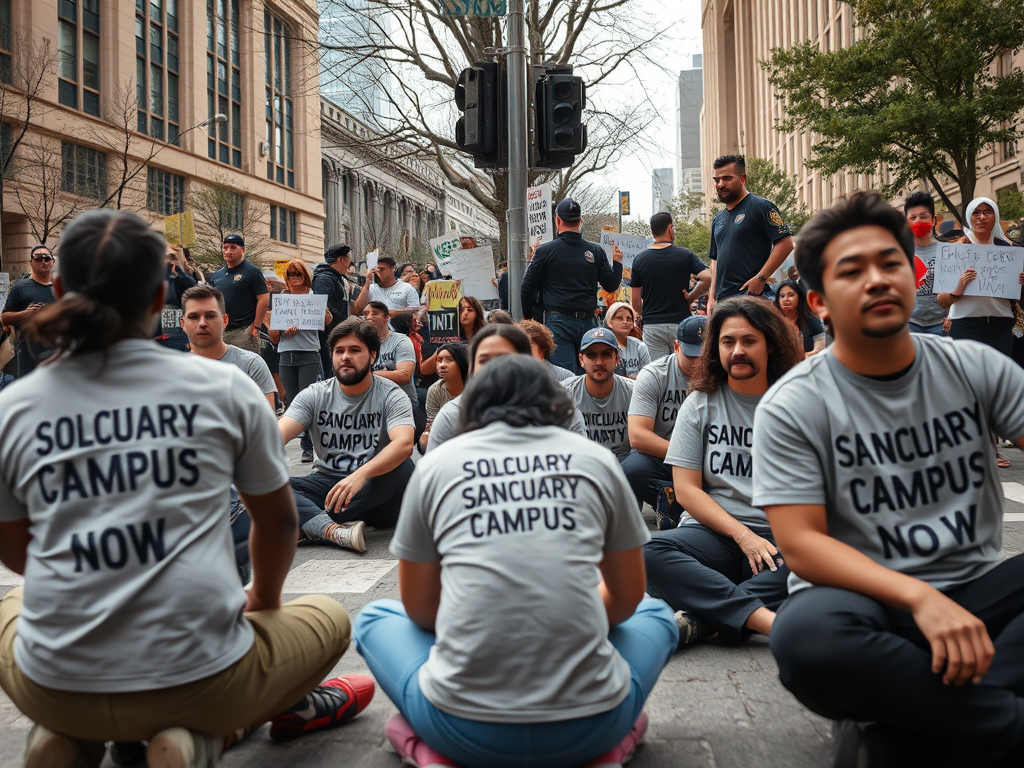
On Thursday afternoon, a group of Columbia University faculty members, staff and students were detained by police after staging a sit-in that brought traffic on Broadway to a standstill for nearly an hour. The demonstrators were protesting the Trump administration’s aggressive immigration enforcement policies and calling on Columbia to offer stronger protections for its international students.
The protesters, dressed in matching shirts reading “Sanctuary Campus Now,” sat down in a crosswalk and refused to move despite repeated warnings from law enforcement. Shortly before 4 p.m., officers began making arrests in a controlled and measured manner, a noticeably calmer approach compared with the heavy police presence that had surrounded Columbia during previous rounds of campus demonstrations over the past two years.
Among those detained was Mila Rosenthal, a 58-year-old adjunct professor of international and public affairs, who said she chose to be arrested as an act of civil resistance.
Before being taken into custody, she pointed to recent Immigration and Customs Enforcement operations in Minneapolis, describing them as deeply alarming. She argued that Columbia had the power to take a firmer stance in protecting its community rather than remaining neutral.
Rosenthal emphasized that a significant portion of Columbia’s student body comes from outside the United States, and that many of these students are living in fear amid the current political climate. She said that regardless of visa status, the environment has become increasingly frightening for international students.
The demonstration drew roughly 150 participants at its peak and was partly organized by a faculty and staff coalition known as CU Stands Up. The group has been holding weekly vigils outside the university’s gates for about 40 weeks to oppose federal immigration actions. This week, organizers decided to intensify their tactics in response to recent violence in Minneapolis and other parts of the country.
By Thursday evening, police had not officially released detailed information about the charges against those arrested. According to protest organizers, participants were cited for refusing to disperse and obstructing traffic before being released within a few hours, with a court appearance scheduled for February 23.
Jennifer S. Hirsch, a professor at Columbia’s Mailman School of Public Health who was also detained, criticized the university for not taking a stronger position in earlier cases involving student activists. She argued that Columbia’s response to previous arrests had encouraged more aggressive government actions.

After a prolonged period of protests beginning in 2023 and continuing into early 2025, Columbia’s campus has been relatively quiet in recent months. The university tightened its protest policies and restricted public access to its main campus. However, tensions remain over Columbia’s negotiations with the federal government regarding research funding and lingering questions about the extent of its cooperation with immigration authorities during past arrests.
Rina Isaac, a 20-year-old junior who attended the protest, said many of her international friends are anxious about simply walking around the city with their documents. She stressed that all students deserve to feel safe and welcomed on campus.
Columbia officials have maintained that the university does everything within legal limits to protect its students and does not work directly with federal immigration enforcement agencies.
A university spokesperson reiterated that no Columbia leader or trustee has ever requested ICE’s presence on or near campus, describing claims to the contrary as inaccurate.





Leave a Reply