
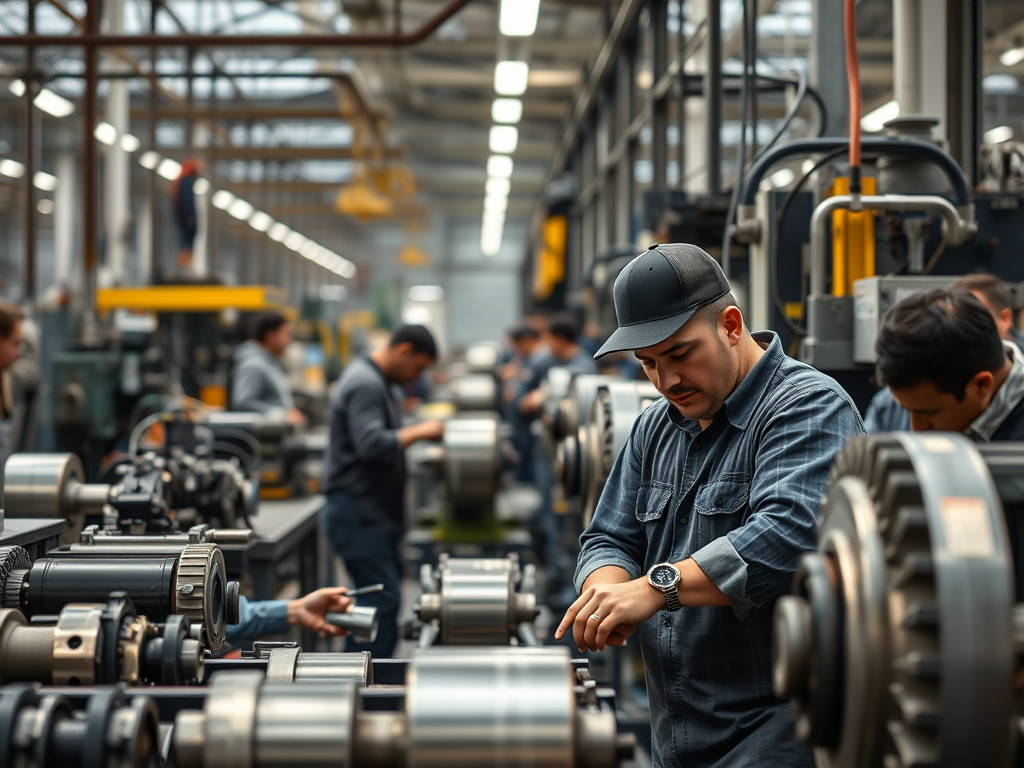

President Trump has spent years arguing that tariffs would revive American manufacturing. Even as factory employment slipped in recent months, he repeatedly told voters that the benefits would arrive with patience, as investment and jobs gradually returned to U.S. soil.
Now, more than a year into his second term, evidence of a sweeping turnaround remains limited. While a small number of manufacturers are enjoying stronger protection from foreign competition, the majority are grappling with higher costs. Many are paying steeper taxes on imported parts and materials, unsure whether current trade barriers will last long enough to justify rebuilding supply chains.
The manufacturing sector as a whole sits in an uneasy middle ground. It is neither in free fall nor experiencing a surge. Over the past year, factory payrolls have shrunk by roughly 68,000 jobs, leaving manufacturing at about 8 percent of total U.S. employment. At the same time, overall output has edged upward. Business surveys show persistent pessimism, and although spending on factory construction has declined since the final months of the Biden administration, it remains close to historic highs.
This uneven picture reflects what many economists have long argued: tariffs can shield certain industries, but they often do so at a substantial cost.
“What you end up with is a patchwork outcome,” said Bradley Saunders, a North America economist at Capital Economics. “Tariffs tend to produce a wide range of unintended consequences.”
Some business owners believe they are on the winning side of this trade strategy. Drew Greenblatt, who runs Marlin Steel Wire Products in Baltimore, manufactures metal baskets and racks used by food processors and aerospace firms. After years of competing with cheaper Chinese imports, he became a vocal supporter of tariffs. Today, he says the policy is finally delivering results. His company recently purchased the most expensive machine in its history, a TruMatic 3000 punch laser, designed to boost efficiency and output.
“Companies don’t spend that kind of money unless they expect to grow their workforce,” Mr. Greenblatt said. Marlin Steel employs about 130 people, and he plans to hire at least 20 more over the coming year. Increased production will also mean significantly higher steel purchases, benefiting suppliers upstream.
For many other manufacturers, however, tariffs have brought more harm than help. Lou DeCuzzi, owner of DRR USA in Brunswick, Ohio, builds electric and gas-powered all-terrain vehicles. Critical components such as batteries are sourced from Taiwan, South Korea, and Vietnam because comparable parts are not made domestically. Last year, working with Cleveland State University, Mr. DeCuzzi developed an export strategy targeting hotels and resorts overseas that wanted environmentally friendly transport vehicles.
At the start of the year, business was booming. Expansion plans included adding a second facility and hiring additional staff. Then new tariffs disrupted pricing assumptions, and retaliatory duties from other countries further complicated exports.
“Once the tariff war began, everything became unpredictable,” Mr. DeCuzzi said. Overseas sales collapsed, wiping out foreign demand for half a year. Expansion plans were shelved, and the company is now relying on domestic buyers to make up for lost revenue.
A Decade of Doubts About Globalization
Over the past ten years, skepticism toward globalization has grown across the political spectrum. Policymakers on both the left and right increasingly view tariffs as a way to defend strategically important industries. President Biden kept many of the trade barriers introduced during Mr. Trump’s first term and paired them with subsidies aimed at sectors such as semiconductors and battery manufacturing.
Mr. Trump’s second-term trade policy has taken a far broader and more aggressive approach. Motivated in part by revenue generation, his administration imposed tariffs on nearly every country and across a wide array of goods, including products that the United States no longer produces in meaningful quantities. In many cases, the heaviest duties fall on intermediate inputs like steel and machinery, raising costs for domestic manufacturers that depend on them.
Jamieson Greer, the administration’s chief trade negotiator, acknowledged in a recent interview that it is difficult to design tariffs that do not hurt companies reliant on imported materials. Still, he argued that the disruption highlights what he sees as excessive dependence on foreign supply chains.
“Some level of friction is inevitable,” Mr. Greer said. “The goal is to take a longer-term view.”
So far, signs of a manufacturing boom remain elusive. Juan Arias, who leads industrial analytics at the real estate data firm CoStar, tracks online searches for factory space nationwide. Interest was rising steadily until last April, when sweeping tariffs were announced. Search activity then dropped sharply.
“The mood had been improving,” Mr. Arias said. “Then suddenly companies realized they couldn’t confidently calculate input costs anymore, and expansion plans stalled.”

Producers of raw materials, particularly steel, have fared better. The administration reinstated a 25 percent tariff on foreign steel in February and raised it to 50 percent by June. Over the past year, both steel output and prices have risen modestly, for imported and domestic products alike.
Lourenco Goncalves, chief executive of Cleveland-Cliffs, called the steel tariffs long overdue and essential. His company has sold more steel to U.S. automakers over the past year, though he noted that manufacturers are relocating production back to the United States at a slower pace than he would prefer.
In his view, the administration’s message is straightforward: produce domestically and tariffs disappear.
For automakers, the reality is more complicated. Vehicles and auto parts are among the most heavily taxed products, and production has declined in recent months. Jeff Aznavorian, president of Clips & Clamps Industries, supplies fasteners used in U.S.-made cars. Rising steel and copper prices have forced him to raise prices, and while automakers have inquired about reshoring parts production, none of those discussions resulted in orders.
At the same time, carmakers are delaying new models due to uncertainty surrounding the U.S.-Mexico-Canada Agreement, which is up for renewal this year. Mr. Trump has threatened to withdraw from the pact, which currently allows many auto parts to cross borders duty-free.
“When companies don’t know whether the trade framework will survive, they freeze investment,” Mr. Aznavorian said.
Some suppliers have already been pushed out of business. United Piston Ring in Wisconsin announced it would shut down and lay off 60 workers, citing worsening market conditions. Others are quietly reducing staff through attrition.
Industries that have avoided tariffs altogether are doing relatively well. Aerospace manufacturers, pharmaceutical companies, and much of the semiconductor and electronics sector have received exemptions. Technology firms benefited after industry leaders pledged to expand U.S. production.
Chuck Robbins, chief executive of Cisco Systems and chair of Business Roundtable, said the impact of tariffs varies widely by sector. Supply chain structure, global competitiveness, and the presence or absence of exemptions all play critical roles.

Beyond trade policy, fiscal decisions have also shaped outcomes. Increased defense spending has supported aerospace manufacturing, while the rollback of clean energy subsidies has led to canceled projects and slowed momentum in that sector. Deregulation efforts have reduced compliance costs, which some businesses welcome.
Small manufacturers, however, face greater strain than larger firms. With fewer resources to absorb higher costs or negotiate prices, they are often hit hardest. In some cases, foreign competitors appear to be absorbing tariffs rather than passing them on.
Eric Hagopian, who runs a 35-employee toolmaking company in Massachusetts, hoped tariffs would level the playing field against rivals in China and India. Instead, foreign prices have remained surprisingly low.
“Imports haven’t gone up the way they should have,” he said, adding that stronger enforcement might make a difference.
An Uncertain Path Forward
A manufacturing rebound in 2026 is still possible. Many executives hope tariff policy will stabilize, allowing long-delayed investments to proceed. A pending Supreme Court ruling on the administration’s authority to impose tariffs under national security provisions could limit future actions.
Manufacturers are also encouraged by renewed tax incentives for research, development, and capital equipment, which could spur productivity gains. Some industry leaders argue that supply chain security concerns after the pandemic are creating a durable shift toward domestic production.
“This isn’t a boom tied to one president,” said Scott Paul, president of the Alliance for American Manufacturing. “It’s becoming the new baseline for the sector.”
New factories continue to rise across the country, particularly in semiconductors, buoyed by subsidies approved during the previous administration. Still, high interest rates and rising energy costs, driven in part by data center expansion, are dampening enthusiasm for new projects.
Perhaps the greatest challenge is uncertainty itself. With public support for tariffs weakening amid persistent inflation, manufacturers face the risk that policies could be abruptly reversed. Studies suggest that only stable, long-term trade barriers lead to meaningful job growth, while temporary measures deliver pain without payoff.
“That’s why the costs show up quickly, while the benefits, if they come at all, take years,” said Stephan Whitaker, an economist at the Federal Reserve Bank of Cleveland. “Long-term clarity is what ultimately determines whether manufacturing truly gains ground.”




Leave a Reply