
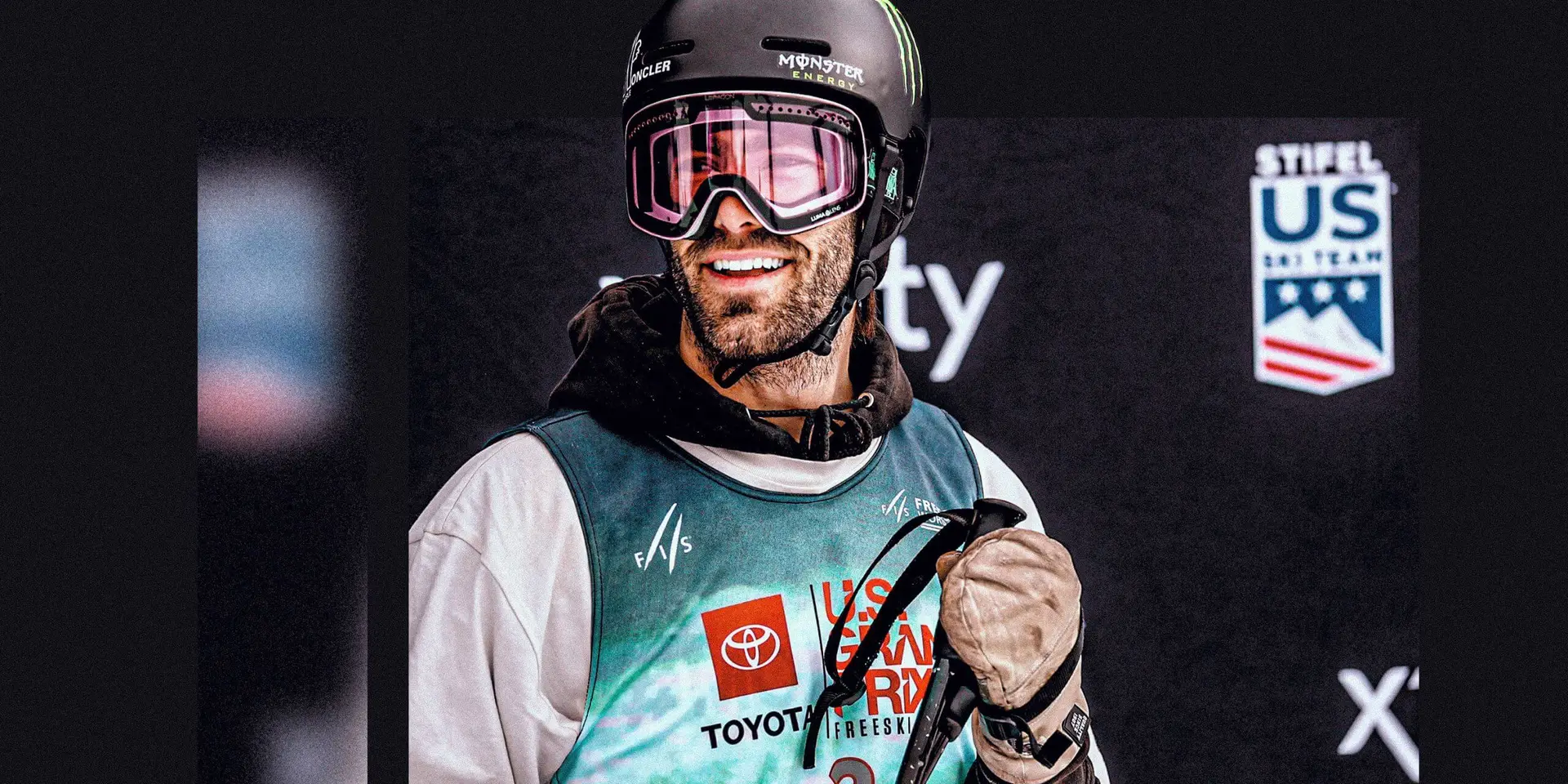
Alex Hall knows exactly what should scare him. Anyone who makes a living hurtling off mountains at 40 miles per hour, spinning multiple times thirty feet above the ground, and landing backward on narrow skis knows it too. One mistake could shatter bones across his body.
Yet, fear left Hall long ago, just as it does for many elite skiers. He thrives on risk, spending winters chasing it—from sliding down icy handrails in the Midwest to tackling unmarked ramps at the Olympic Games. Early in his career, though, his challenge wasn’t the danger; it was the pressure to perform. He feared failing. Hall felt it was his duty to please the judges, to ski routines they expected, to check all the boxes.
“The more I tried to satisfy everyone else, the emptier I felt,” Hall recalls. The structure never fit.
Raised by two college professors in Switzerland, Hall learned to ski on the small hill behind his Zurich home. Nights were for extra runs under a homemade light, and he welded old street poles into rails to practice tricks. On trampolines, he invented moves and tested them on snow, falling countless times. He didn’t have a formal coach until he was 16.
For Hall, skiing became pure expression—a way to explore creativity. But turning professional made it feel like a job, merely copying competitors’ moves instead of creating his own. Eventually, he decided to break free. He returned to tinkering, experimenting, and improvising—skiing with the freedom of a child. That choice transformed his career.

“Now it doesn’t feel like work,” Hall says. “It never should have.”
At 27, Hall is one of Team USA’s brightest prospects heading into the Winter Olympics in Italy. His life blends professional achievement with an almost countercultural independence. He skis for personal fulfillment rather than medals or fame. Off the competition circuit, he and his friends scour Google Earth for rails, slopes, and uncharted terrain, traveling by van, filming every run, and crashing in motels along the way.
He is the defending Olympic champion in freeski slopestyle, yet his gold medal rests quietly in a sock drawer at home. Hall may well be the world’s most accomplished ski bum.
“I get most of my inspiration from him,” says Hunter Hess, a seven-time World Cup podium finisher and Hall’s close friend. “For Alex, it’s not about sponsors, money, or pretending. He’s genuine, and everyone knows it—maybe even he doesn’t realize it himself.”
“Alex is a different breed,” adds videographer Owen Dahlberg, who travels with Hall and Hess. “He just loves skiing, hanging with friends, and having fun.”
Hall measures success not by trophies but by enjoyment. It’s a rare outlook in professional sports, and even rarer for a world-class athlete to admit.
“I ski outside the box,” Hall says. “I don’t do it for anyone else.”
His Beijing medal seldom leaves its drawer. Even when his parents suggested securing it, Hall shrugged. Sponsors like Moncler and modeling stints for Vogue don’t define him. Instead, his element is Dahlberg’s Chevy van, cluttered with chairs, ski boots, and empty beer cans—a mobile hub for creativity. Their first film, “MAGMA,” became a sensation in the underground ski world, amassing hundreds of thousands of views, with sequels and sponsorships following.
Hall embraces both competition and freedom. While other skiers rest during the holidays, he and his friends chase fresh powder across North America, logging endless hours of footage and skiing wherever snow falls.

“We’ll go anywhere with six inches of snow,” Hall says. Sessions can stretch ten hours, with tricks attempted hundreds of times until perfected. Even on breaks, Hall seeks out new rails, benches, and slopes—he can’t sit still.
It was during one such adventure, 11 months before the 2022 Beijing Olympics, that Hall first tried the move that would earn him Olympic gold: a right double-cork 1080 bring-back, a complex mid-air maneuver requiring perfect timing and control. Initially, he avoided it at the Winter X Games to prevent risking his podium spot. In Beijing, he decided to ski entirely on his terms.
Faced with an unmarked middle ramp on the slopestyle course, Hall gambled, executing the trick flawlessly and securing gold on his first run. His subsequent performances mattered little; the risk had paid off.
“That was the skier I’ve always been,” he says. He attempted a similar Big Air trick, failed, finished eighth, and smiled—proud of the effort rather than the outcome.
Today, Hall is among the U.S.’s most decorated freeskiers, boasting 14 Winter X Games medals, seven of them gold, and the first successful 2160 in competition—six rotations in midair.
Over a decade, Hall has come to fear only one thing more than physical danger: stagnation. He must move, tinker, and follow his instincts. First comes Italy and his third Olympics.
“I’m not trying to defend my gold,” Hall says of Beijing. “I got to do it once. If I get the chance again, it’d be amazing.”
Another medal, quietly stored, wouldn’t hurt.




Leave a Reply