
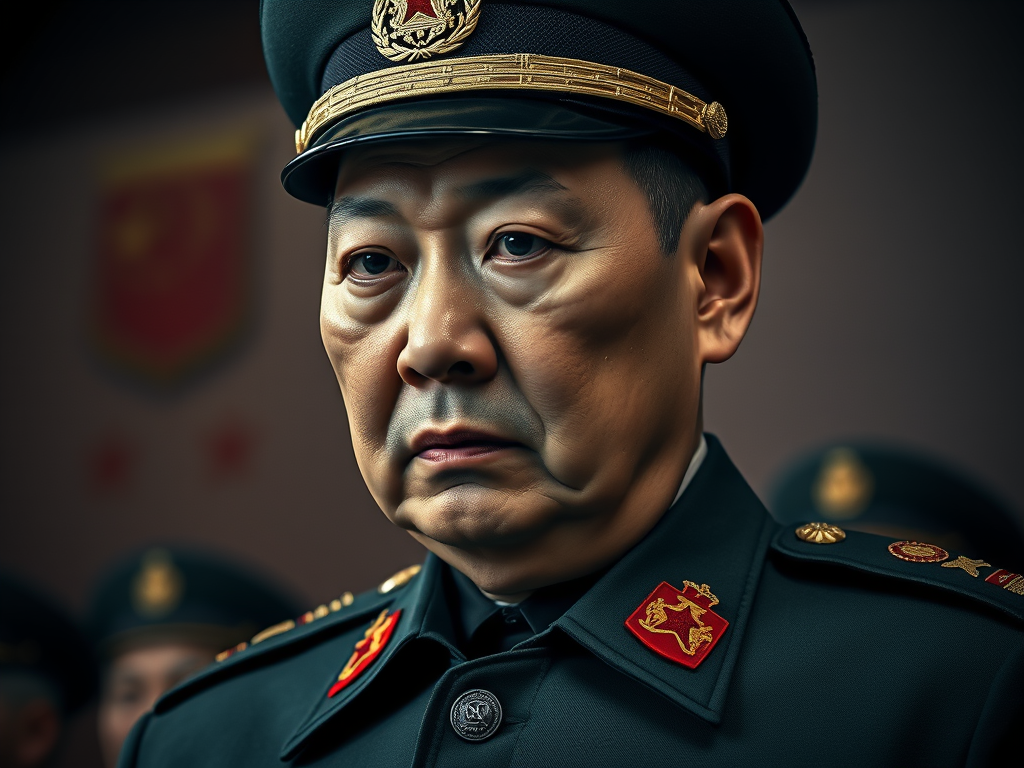

China’s military leadership has been shaken by an unprecedented development: one of the country’s most powerful generals, second only to President Xi Jinping in the command structure of the armed forces, has been placed under formal investigation. On Saturday, China’s Ministry of National Defense announced that General Zhang Youxia is being investigated for “serious violations of discipline and the law,” marking the most dramatic escalation yet in Xi’s long-running campaign to purge the upper ranks of the People’s Liberation Army.
Zhang Youxia serves as a vice chairman of the Central Military Commission, the Communist Party body that exercises ultimate control over China’s military. The Defense Ministry also confirmed that another senior figure, General Liu Zhenli, head of the Joint Staff Department, is under investigation as well. Officials did not disclose the specific allegations against either general, a common practice in such cases.
In China’s political system, public confirmation of an investigation into a senior official almost always signals a definitive fall from power. Acquittals are virtually unheard of. For this reason, Zhang’s removal is widely seen as the most severe step so far in Xi Jinping’s effort to eliminate corruption and enforce loyalty within the military. What makes the case especially striking is Zhang’s long-standing personal connection with Xi, which had previously led many observers to believe he was insulated from political danger.
Analysts describe the move as historically significant. Christopher K. Johnson, a former CIA analyst who closely tracks elite Chinese politics, said the investigation represents an unprecedented dismantling of China’s military high command. In his view, targeting someone at Zhang’s level signals that no position is untouchable.
With Zhang and Liu effectively sidelined, the Central Military Commission has been reduced to just two active members: Xi Jinping himself, who serves as chairman, and General Zhang Shengmin, the official responsible for overseeing disciplinary inspections and previous military purges. Of the six generals Xi appointed to the commission in 2022, only one now remains in place.
Johnson, who now leads a political risk consultancy, argues that Xi has concluded that corruption and disloyalty within the armed forces run too deep to be corrected from within. Rather than relying on the existing leadership to reform itself, Xi appears determined to sweep it away and promote a new generation of officers whom he believes are untainted.
According to Johnson, this strategy reflects a willingness to cut deeply across generational lines. Even the investigation of Zhang Youxia, a figure often described as a childhood acquaintance of Xi, suggests that personal history no longer offers protection. In Johnson’s assessment, Xi’s anti-corruption drive has reached a stage where there are effectively no limits.
Speculation about Zhang’s fate had been circulating for days before the official announcement. Observers noticed that both Zhang and Liu were absent from a recent Communist Party meeting, a detail that often foreshadows disciplinary action. Still, Zhang had disappeared from public view on previous occasions without consequence, and it is common for senior officials to remain out of sight for months before an investigation is formally acknowledged.
The speed with which the authorities confirmed Zhang’s removal appears deliberate. Su Tzu-yun, a specialist on the People’s Liberation Army at Taiwan’s Institute for National Defense and Security Research, said the rapid announcement was likely intended to limit political fallout and contain uncertainty. Nonetheless, he warned that the decision could deal a serious blow to morale within the military, given Zhang’s reputation as a seemingly invulnerable figure.
Beyond morale, the investigations raise practical concerns. Zhang Youxia and Liu Zhenli were the two senior commanders most directly involved in day-to-day operational planning and oversight. Their simultaneous removal creates a leadership vacuum at the very top of China’s military structure. Shanshan Mei, a political scientist at the RAND Corporation who studies China’s armed forces, noted that there is currently no senior official with comparable operational experience overseeing training, exercises, or combat readiness.
According to Mei, the impact of these removals is likely to be profound and long-lasting. She suggested that additional investigations could follow, further deepening the disruption within the command structure.
At 75 years old, Zhang Youxia had long appeared protected from Xi’s widening crackdown. The two men share a personal history that stretches back decades: their fathers were both veterans of Mao Zedong’s revolutionary wars and knew each other personally. Xi also allowed Zhang to remain in office well past the informal retirement age of around 70, reinforcing the perception that he enjoyed exceptional trust.
However, Su Tzu-yun believes that Xi’s growing concerns about loyalty and control ultimately outweighed any personal attachment. In his view, the investigation reflects Xi’s deep sense of insecurity regarding the reliability of his commanders. That insecurity, Su argues, has become a driving force behind the relentless purging of senior military figures.
Since 2023, waves of high-ranking officers, defense industry executives, and commanders from key branches of the armed forces have been removed or placed under investigation. In some cases, officials have simply vanished from public view without explanation, fueling speculation and anxiety within the system.
The initial focus of this campaign was China’s Rocket Force, which controls the country’s nuclear arsenal and a significant portion of its conventional missile capabilities. Subsequent probes expanded to include naval officers, regional commanders, and members of the Central Military Commission itself.
Ironically, many of those targeted had been promoted by Xi after he came to power in 2012, when he vowed to eradicate entrenched corruption within the military. Over time, however, Xi appears to have concluded that even his own protégés were not immune to longstanding practices such as bribery for promotions or procurement contracts.

The cumulative effect of these investigations became starkly visible at a Communist Party Central Committee meeting last year. Of the 44 uniformed officers appointed to the committee in 2022, roughly two-thirds had either been purged or were no longer publicly visible. This calculation was made by Neil Thomas, a researcher at the Asia Society who tracks elite Chinese politics.
From Xi’s perspective, the sweeping shake-up may ultimately produce a military that is more disciplined, loyal, and capable of executing his strategic priorities. These include increasing pressure on Taiwan, the self-governing island that Beijing claims as its own but which rejects Chinese sovereignty.
In the near to medium term, however, the purges may have the opposite effect. Analysts warn that the loss of experienced commanders and the climate of fear created by constant investigations could undermine combat readiness and decision-making. For years to come, Xi may find it difficult to fully trust that his military leadership is prepared for real-world conflict.
As Su Tzu-yun put it, the situation presents a fundamental dilemma. While removing corrupt officials may strengthen the institution in the long run, clearing out so many senior officers at once also strips the military of invaluable experience. Rebuilding effective command structures under these conditions is neither quick nor easy.
Zhang Youxia’s personal background underscores what is being lost. He was among the few remaining Chinese generals with direct combat experience, having served as a frontline officer during China’s last major war, a prolonged border conflict with Vietnam that began in 1979. Over the years, he rose through the ranks to lead the General Armaments Department, which oversees weapons procurement, before being elevated to the Central Military Commission in 2017.
Before Zhang’s dismissal was announced, former CIA analyst John Culver noted that Zhang’s combat background set him apart from most of his peers and likely added to his prestige in Xi’s eyes. Few senior officers today can claim similar battlefield experience.
Yet that same career path may also have contributed to Zhang’s downfall. The General Armaments Department has long been regarded as a hotbed of corruption due to its control over lucrative defense contracts. Several other generals who advanced through the department have been purged in recent years, including former defense minister Li Shangfu.
Looking ahead, analysts believe Xi will need considerable time to cultivate a new generation of officers he deems trustworthy, while also replenishing the depleted ranks of the Central Military Commission. Su estimates that rebuilding effective chains of command could take five years or more. As a result, he argues, the likelihood of a near-term military move against Taiwan may have diminished.
In the end, the investigation of Zhang Youxia sends a clear message: in Xi Jinping’s China, even the most powerful and well-connected figures are expendable in the pursuit of absolute control over the armed forces.




Leave a Reply