
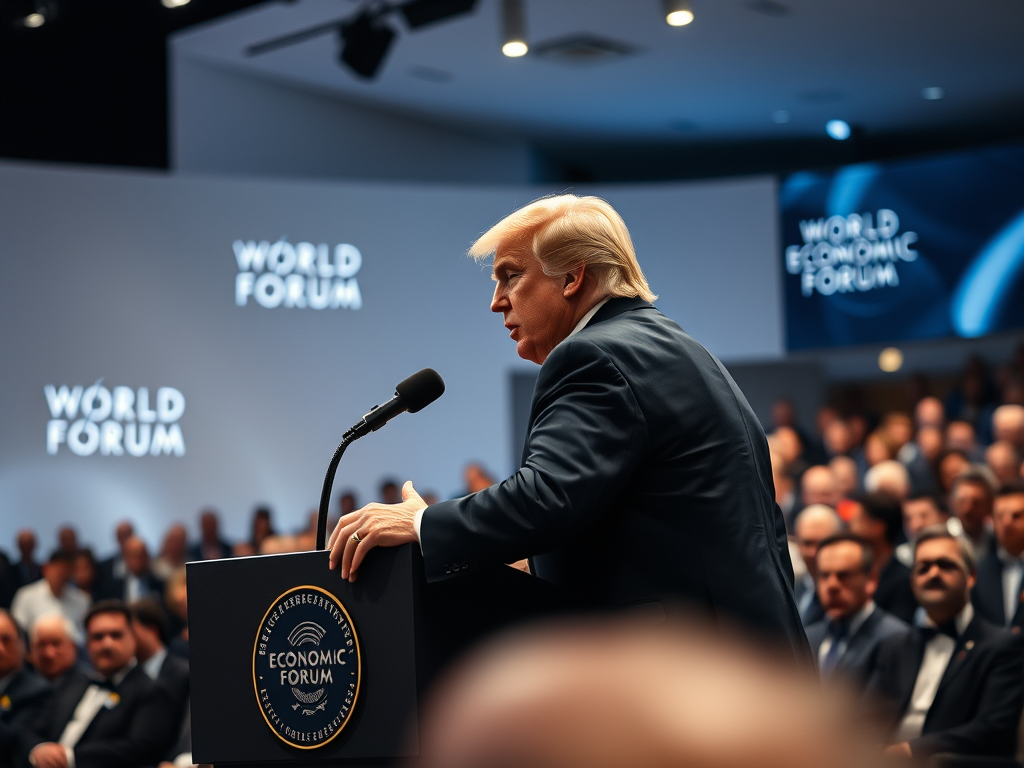

In a lengthy and often meandering speech marked by bravado, grievance, and self-praise, President Donald Trump delivered what many observers interpreted as a symbolic farewell to the U.S.-led liberal democratic order established after World War II.
Speaking at the World Economic Forum in Davos on Wednesday, a venue long associated with champions of globalization, Mr. Trump made clear that the United States would no longer unconditionally open its markets or provide military protection to European allies he accused of taking advantage of American generosity. He reaffirmed his commitment to aggressive trade policies, portraying tariffs not as punishment but as an entry fee to the vast U.S. consumer market of more than 300 million people.
According to Mr. Trump, the United States has shouldered a disproportionate burden in sustaining the global economy. He argued that other nations had benefited at America’s expense, insisting that the era of unilateral generosity was over.
Later that same day, however, the president appeared to soften one of his most provocative positions. In a social media post, he said he would no longer pursue tariffs as a means to pressure Denmark over control of Greenland, at least while diplomatic discussions continued between U.S. and European officials. While the statement temporarily eased tensions surrounding the island’s sovereignty, it did little to undo the broader implications of his earlier remarks, which amounted to a direct challenge to the foundations of the postwar global economic system.
The setting added an extra layer of symbolism. The auditorium where Mr. Trump spoke was the same place where, nine years earlier, Chinese President Xi Jinping addressed the Davos audience and presented China as a defender of international cooperation and globalization. Mr. Xi’s 2017 speech, delivered just days before Mr. Trump’s first inauguration, was widely seen as an attempt to discourage the trade conflict that would soon follow.

At the time, Mr. Xi warned against protectionism, comparing it to isolating oneself in a dark room that blocks not only wind and rain, but also light and fresh air. He argued that trade wars inevitably produce only losers.
China’s effort to position itself as a responsible global leader was met with skepticism then, and that skepticism persists today. Critics point to Beijing’s long-standing industrial subsidies, its repression of political dissent and independent media, and its military pressure on Taiwan and neighboring countries. Even China’s closest partners rarely describe it as a model of fairness or transparency.
Still, over the past decade, China has consistently presented itself as committed, at least in rhetoric, to principles that Mr. Trump has increasingly rejected. These include participation in multilateral institutions, belief in the economic benefits of global trade, and acknowledgment that even major powers cannot operate effectively in isolation.
Mr. Trump’s extended appearance before the global elite in Davos unintentionally reinforced this contrast, even as concerns remain about a world in which Beijing plays a more influential role.
According to Eswar Prasad, an international trade expert at Cornell University, China is eager to present itself as the steady, responsible actor while the United States projects unpredictability and hostility. Whether the rest of the world is prepared to fully embrace China, however, remains uncertain.

In several respects, Europe and China appear aligned at a time when Washington has turned toward economic nationalism. Both publicly support rules-based international trade, despite frequent accusations that China violates those rules in practice. Both also recognize climate change as a scientific reality and continue to invest heavily in efforts to address it.
China has emerged as a global leader in clean energy technologies, including solar panels, wind turbines, electric vehicles, and advanced batteries. Europe, although it has faced recent political and economic setbacks, continues to pursue ambitious targets for reducing carbon emissions. These policies drew sharp criticism from Mr. Trump during his speech, as he praised the United States for expanding fossil fuel production.
He dismissed Europe’s climate policies as reckless and mocked renewable energy initiatives, claiming they had led to economic and energy instability. He also suggested that China was profiting by selling renewable technology to Europe while relying on coal at home.
In reality, China has significantly expanded its renewable energy capacity in recent years, even as it works to gradually reduce its heavy dependence on coal.
Despite shared interests, Europe and China remain economic competitors, particularly in the automotive sector. With major manufacturing bases in countries like Germany and China’s growing dominance in electric vehicles and battery production, rivalry between the two economic powers is likely to persist.

Ukraine represents the most significant obstacle to closer cooperation, according to Adam Tooze, an economic historian at Columbia University. China’s refusal to condemn Russia’s invasion has made deeper alignment politically impossible for European governments, where President Vladimir Putin is widely viewed as a serious threat.
Absent the war in Ukraine, Dr. Tooze argues, Europe might otherwise find China a natural partner in a more integrated Eurasian economic framework.
Mr. Trump’s appearance in Davos was closely watched across Europe, particularly in light of his earlier remarks suggesting the United States might seek to take control of Greenland, a territory belonging to Denmark, a NATO ally.
Even the suggestion of such a dispute raised concerns about the credibility of the NATO alliance. In his speech, Mr. Trump repeated his long-standing complaint that NATO functions largely as a U.S.-funded security arrangement.
He described Greenland as strategically valuable despite its harsh climate and remote location, framing American interest in the island as modest compared to decades of U.S. defense commitments to Europe.
The day before the speech, U.S. Commerce Secretary Howard Lutnick declared during a Davos panel that the global trading system, largely shaped by American leadership, belonged to the past. In his view, globalization had failed both the United States and the broader Western world.
Offering a sharply different perspective, Canadian Prime Minister Mark Carney warned of a dangerous rupture in the international order. He described a new era in which great-power competition operates with few constraints, creating a more volatile and unforgiving global environment.

Mr. Trump, for his part, underscored his willingness to use tariffs indiscriminately, whether against allies or adversaries.
In an unscripted anecdote, he recalled how he decided last year to impose heavy tariffs on Swiss imports in an effort to reduce the U.S. trade deficit. He initially chose a 30 percent rate, he said, before speaking with Swiss President Karin Keller-Sutter.
During their conversation, he recounted, she repeatedly argued that Switzerland was too small to bear such penalties. Her objections, he said, prompted him to raise the tariffs even higher, to 39 percent.
He later met with representatives from Rolex, the Swiss luxury watchmaker, after which he agreed to lower the tariffs to 15 percent. Even then, he warned that the reduced rate might not be permanent.
The episode served as a final reminder of Mr. Trump’s transactional approach to trade policy and his readiness to wield economic power as leverage, regardless of diplomatic relationships.




Leave a Reply