
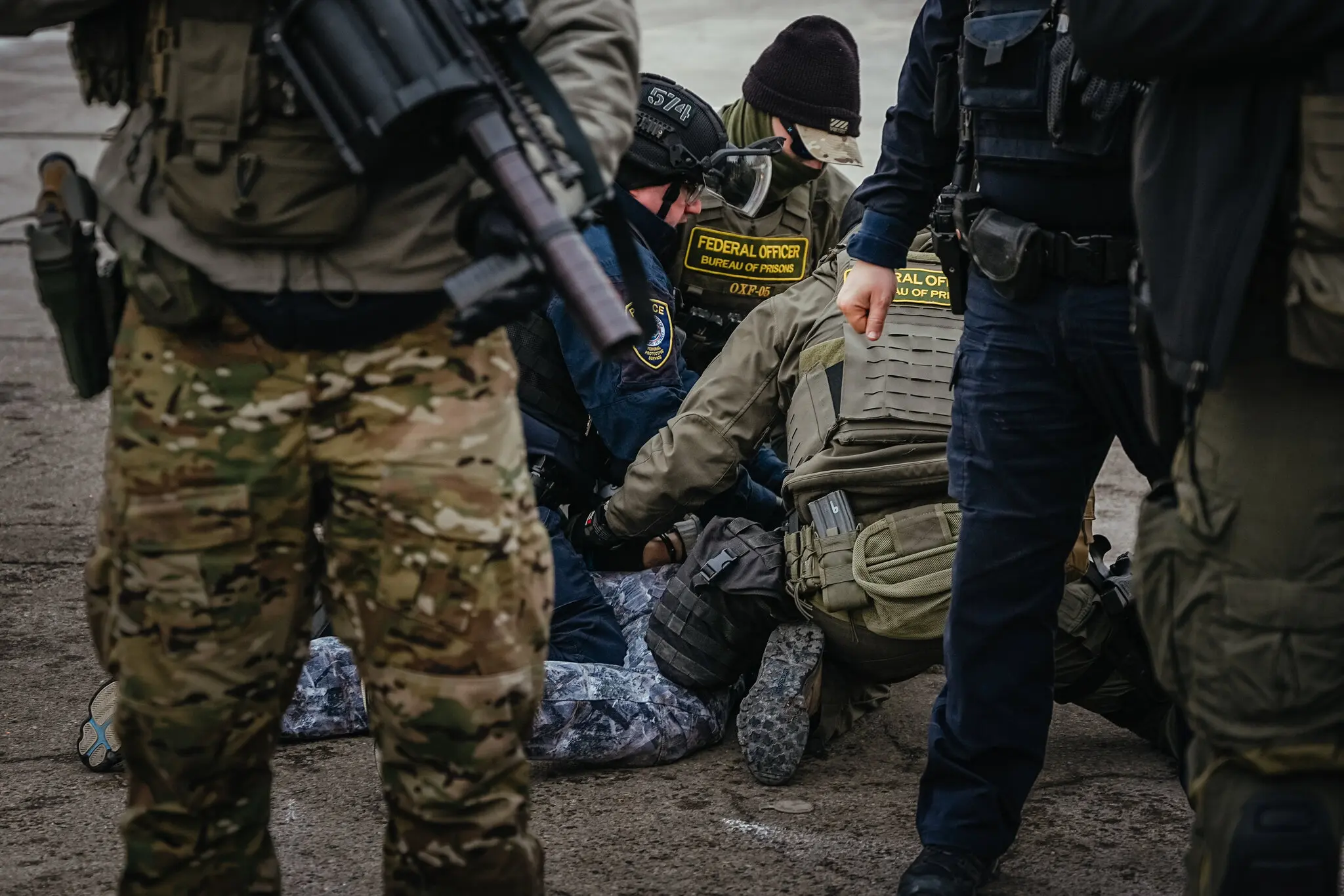
A federal judge in Minneapolis has issued an unusually detailed ruling describing what she found to be a troubling pattern of misconduct by Immigration and Customs Enforcement officers, ordering federal immigration agents to stop using excessive force against protesters during operations in the city.
The ruling outlines a series of incidents that, taken together, painted a stark picture of how immigration enforcement has unfolded on the streets of Minneapolis. According to court records, a woman detained during a protest had her bra removed, her wedding ring cut off, and some of her clothing never returned. Other protesters were subjected to what the judge described as unnecessary use of pepper spray. In another incident, a married couple said their vehicle was surrounded by federal agents who pointed semiautomatic weapons at them from close range.
The judge concluded that these were not isolated events, but part of a broader pattern that threatened constitutional rights, particularly the right to peacefully assemble and observe law enforcement activity.
Legal scholars noted that, on the surface, the judge’s order may appear routine. It does not introduce new legal standards but instead directs federal agents to comply with long-established constitutional protections, including the First Amendment right to protest peacefully.
Yet many experts emphasized that the ruling stands out for its depth and clarity.
Michele Goodwin, a law professor at Georgetown University, described the decision as extraordinary. She pointed out that the judge carefully reviewed dozens of sworn declarations and video recordings from both sides before determining that the conduct was serious enough to warrant a preliminary injunction.
Protests against the presence of federal immigration agents in Minneapolis have been ongoing for weeks. Calls for the federal government to withdraw ICE officers from the city intensified after the fatal shooting of Renee Good on January 7. Ms. Good was killed by Jonathan Ross, an ICE officer, an event that further inflamed public outrage and drew national attention.
In late December, the American Civil Liberties Union filed a lawsuit on behalf of several protesters, arguing that federal agents had violated their rights to free speech, peaceful assembly, and protection from unreasonable searches and seizures. The lawsuit sought court intervention to prevent further abuses.
Importantly, the judge’s ruling did not rely solely on the shooting of Ms. Good. Instead, it focused on earlier encounters between ICE agents and protesters that received less public attention at the time. These incidents were documented through sworn statements and video evidence submitted by both plaintiffs and the federal government.
Several legal and criminal justice experts said the behavior described in the ruling evoked disturbing historical parallels. Ms. Goodwin and others compared the tactics used by ICE agents during what the government calls Operation Metro Surge to the violent responses by law enforcement against civil rights protesters in Birmingham, Alabama, in 1963.
David Rudovsky, a law professor at the University of Pennsylvania, said the similarities were hard to ignore. He noted that the images and testimony brought to mind an era when Southern law enforcement used dogs, fire hoses, and intimidation to suppress peaceful demonstrations.
The photographs from Birmingham shocked the world decades ago. Today, experts say, the aggressive actions of federal agents in Minneapolis have raised similar alarm, particularly in the wake of Ms. Good’s death. At stake, they argue, are the same constitutional principles that defined earlier struggles for civil rights.
Homeland Security Secretary Kristi Noem strongly criticized the judge’s findings. In a Sunday interview on Face the Nation, she called the ruling ridiculous and placed responsibility on the protesters themselves. She insisted that chemical agents are used only when violence occurs and when officers believe such measures are necessary to maintain public safety.
Secretary Noem also downplayed the impact of the court’s order, saying it would not alter how her agency operates. According to her, the ruling simply instructs ICE to continue doing what it claims it has already been doing. Her department was expected to appeal the decision.
The Minneapolis case is part of a broader wave of legal challenges across the United States. Civil rights and immigrant advocacy organizations have filed lawsuits in states including California and Illinois, as well as in Washington, D.C., seeking to limit the tactics used by federal agents during immigration enforcement actions.

In Illinois, where immigration agents were deployed in large numbers last year, a federal judge previously issued a sweeping injunction that restricted how agents could use force and interact with protesters. However, that ruling was later blocked by an appellate court, which said it went too far in prescribing how federal agents should conduct their duties.
These legal battles are unfolding against the backdrop of the Trump administration’s renewed push for deportations, a central promise of President Trump’s campaign that helped secure his return to office. Supporters of the crackdown argue that immigration enforcement should proceed without interference, even in the face of public protests. In Minnesota, however, opposition has been vocal and persistent.
Judge Katherine Menendez, who was appointed to the U.S. District Court for the District of Minnesota by President Joseph R. Biden, issued an 83-page decision stating that the record showed a clear pattern of conduct that chilled the First Amendment rights of protesters and observers.
She noted that neither side requested a formal evidentiary hearing, even though the court offered one. In weighing the evidence, Judge Menendez said she gave substantial weight to the sworn declarations submitted by the plaintiffs. She also observed that the ICE agents directly involved in the confrontations did not submit sworn statements of their own.
Instead, the government relied heavily on testimony from David Easterwood, the head of ICE Enforcement and Removal Operations in Minneapolis. Mr. Easterwood acknowledged that he was not present during the incidents in question and based his testimony on information provided to him through reports and inquiries. Because of this, Judge Menendez said she assigned his statements considerably less weight.
One of the incidents highlighted in the ruling involved the arrest of Abdikadir Noor, a 43-year-old U.S. citizen of Somali descent. According to the judge, video evidence suggested that agents arrested Mr. Noor not because he posed a threat, but because they were frustrated with protesters in general.

The ruling quoted one agent as saying, “Let’s get this guy,” before officers grabbed Mr. Noor and threw him to the ground. ICE claimed that Mr. Noor was leading an agitated crowd, but video footage showed him pushing another protester away from officers and raising his arm to signal others to stay back.
Mr. Noor was detained, taken to a federal building, shackled, and placed in a holding cell before being released. He was one of six plaintiffs named in the lawsuit brought by the ACLU and volunteer attorneys.
Geoffrey Alpert, a criminology professor at the University of South Carolina, said the conduct described in the ruling represents an unprecedented level of misconduct. After studying police behavior for more than four decades, he said he had never seen anything comparable.
Dr. Alpert pointed specifically to the treatment of Susan Tincher, another plaintiff in the case. Ms. Tincher said she drove to her Minneapolis neighborhood after learning that ICE agents had surrounded a nearby home. Standing about six feet away, she heard agents order her to get back before someone said, “Take her down.”
Within seconds, several agents allegedly tackled her, forced her face down into the snow, and handcuffed her. Witnesses said she did not resist or threaten officers. She was taken to a federal building, where agents removed some of her clothing, cut off her wedding ring, and shackled her. Although she was told she would be charged with obstructing a federal officer, no charges were ever filed.
Judge Menendez rejected ICE’s claim that Ms. Tincher attempted to breach the perimeter or push an officer aside.
The ruling also described multiple instances in which ICE agents deployed pepper spray against protesters and bystanders without warning. Alan Crenshaw, a Minneapolis resident, said he witnessed agents violently slam a young Black man against a wall inside a restaurant, even as the man screamed in pain and insisted he was a U.S. citizen. Outside, the man was pushed into the snow, handcuffed, and placed into a vehicle.

As crowds gathered, Mr. Crenshaw said agents sprayed multiple people without provocation. In one instance, officers drove past slowly, opened a car door, and sprayed a bystander. Another unmarked vehicle later sprayed Mr. Crenshaw directly in the face.
Experts emphasized that such actions, if accurately described, violate basic standards of law enforcement conduct. Arresting peaceful protesters and using chemical agents against nonviolent individuals, they said, are practices that should never occur.
Finally, the judge addressed ICE’s interactions with vehicles that appeared to be following federal agents. She cited roughly a dozen incidents in which agents stopped residents without sufficient legal justification. Tactics included blocking roads, braking suddenly, and activating emergency lights to force vehicles to pull over.
One such incident involved retired Minneapolis residents John Biestman and Janet Lee, who said they followed an ICE vehicle at a safe distance. When they turned into a park, four unmarked vehicles surrounded them. Agents emerged, pointed semiautomatic weapons at their car, and demanded they roll down the windows.
Judge Menendez concluded that the couple had a strong likelihood of proving their rights were violated. As one legal expert noted, following another vehicle without breaking traffic laws is not illegal.
According to court documents, when the couple told agents they were U.S. citizens, one officer responded that it did not matter. Another reportedly compared the situation to Germany in 1938.
For Judge Menendez, these accounts collectively demonstrated a pattern of behavior that could not be ignored, leading her to order federal immigration agents to immediately change how they operate around protesters in Minneapolis.




Leave a Reply