
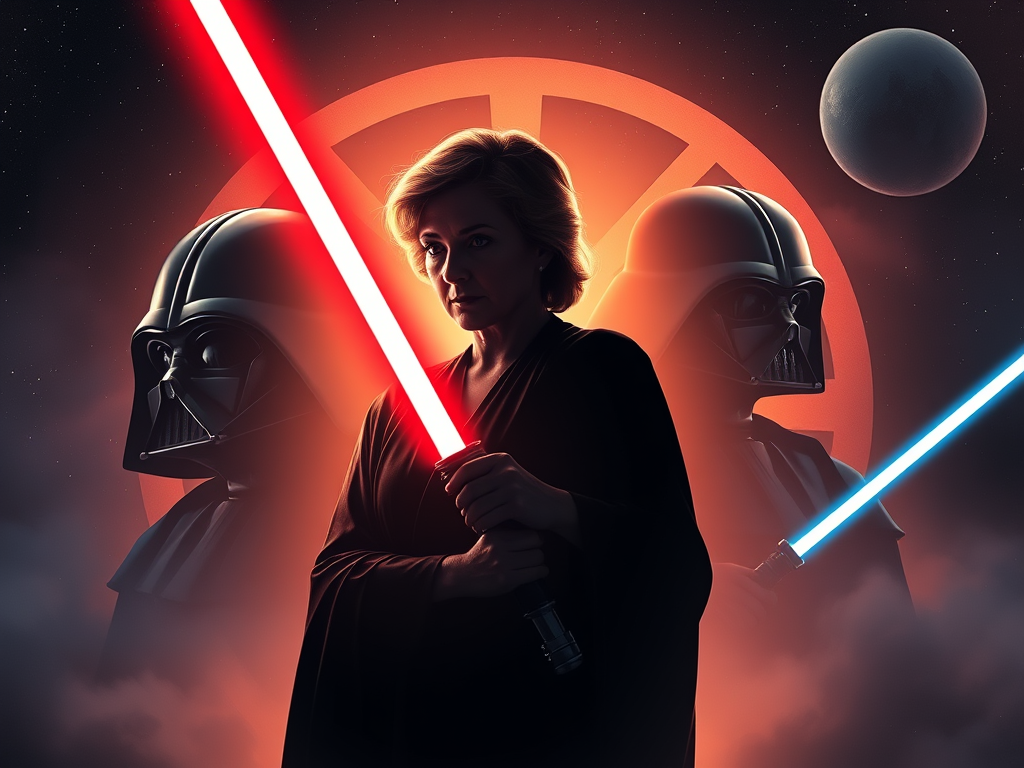

Disney announced on Thursday a major leadership transition at Lucasfilm, confirming that Kathleen Kennedy will step down as president of the studio after nearly 14 years at the helm. Her tenure has been one of the most consequential periods in Lucasfilm’s history, defined by blockbuster successes, creative risks, intense fan scrutiny, and ongoing cultural debates surrounding the “Star Wars” franchise.
Taking over leadership immediately will be Dave Filoni and Lynwen Brennan, both longtime Lucasfilm executives. Filoni, currently the studio’s chief creative officer, will assume the title of president while continuing in his creative role. Brennan, who oversees business affairs and operations, will become co-president. Kennedy, now 72, will shift her focus back to producing, returning to a career that began in the early 1980s and includes some of Hollywood’s most iconic films. She remains attached as a lead producer on two upcoming “Star Wars” movies.
Disney executives marked Kennedy’s departure with unusually generous praise, even by industry standards. Chief executive Robert A. Iger described her as a visionary leader, while Alan Bergman, co-chairman of Disney Entertainment, commended her for steering one of the most valuable and scrutinized franchises in modern entertainment. The warm send-off underscores how central Kennedy has been to Disney’s stewardship of Lucasfilm since the company acquired the studio.
Running Lucasfilm has never been a simple task. The studio’s films and television series are among the most expensive productions in the industry, heavily dependent on advanced visual effects and long development cycles. That cost structure places Lucasfilm under constant pressure from investors, analysts, and the media. At the same time, the “Star Wars” fan community is both enormous and notoriously divided. While deeply passionate, parts of the fan base have proven resistant to change, particularly when it comes to diversity in casting and storytelling, areas that Kennedy actively promoted during her leadership.
Over the years, online debates surrounding new “Star Wars” projects have frequently escalated into culture-war disputes. Racist and misogynistic commentary has often dominated discussions, overshadowing more constructive conversations about storytelling and craft. Kennedy’s efforts to broaden representation within the franchise earned praise from many viewers, but also made her a frequent target of criticism and satire.
Originally, Kennedy was expected to hand over leadership of Lucasfilm in 2024. However, she agreed to extend her contract as the studio navigated a critical transitional phase. At the time, Lucasfilm was developing “Star Wars: Starfighter,” a high-profile film directed by Shawn Levy that aims to push the franchise beyond the long-running Skywalker saga. The studio was also dealing with the fallout from “The Acolyte,” a costly Disney+ series that drew criticism from segments of the audience, particularly for its diverse cast. Disney ultimately canceled the show after one season, citing insufficient viewership.
By appointing Filoni and Brennan, Disney is signaling confidence in continuity rather than disruption. Both successors are deeply embedded in Lucasfilm’s culture and history, suggesting that the company believes the studio is fundamentally on the right track. The decision can also be read as a reassurance to longtime fans that the core identity of “Star Wars” will be preserved.
Dave Filoni, 51, is a distinctive figure within Lucasfilm, known for his western-style hats and his deep enthusiasm for the franchise’s mythology. He has spent more than two decades at the studio and is widely respected among devoted “Star Wars” fans. Much of that trust stems from his close mentorship under George Lucas, the creator of “Star Wars.” Filoni has played a key role as a writer and producer on several of Lucasfilm’s most successful animated and live-action series, including “The Clone Wars,” “Star Wars Rebels,” “The Mandalorian,” and “Ahsoka.” His elevation to president is likely to be welcomed by fans who value a strong connection to the franchise’s roots.
Lynwen Brennan brings a different but equally important skill set to the leadership team. A native of Wales, Brennan has worked at Lucasfilm for 27 years. She began her career at Industrial Light & Magic, the visual effects powerhouse founded by George Lucas, before moving into broader operational roles. In recent years, she has overseen Lucasfilm’s gaming, publishing, and consumer products divisions, areas that are crucial to the franchise’s long-term profitability and global reach.
Kennedy herself took control of Lucasfilm in 2012, shortly before George Lucas sold the company to Disney for $4 billion. At the time, expectations were enormous. Disney was eager to demonstrate a return on its investment, and Kennedy was tasked with rapidly relaunching “Star Wars” for a new generation. She delivered quickly, overseeing a sequel trilogy that generated nearly $5 billion in global box office revenue. The first installment, “The Force Awakens,” became a cultural phenomenon, while standalone films such as “Rogue One” crossed the $1 billion mark worldwide.
Kennedy also helped redefine how “Star Wars” could thrive beyond movie theaters. Working with filmmakers like Jon Favreau, she supported the creation of “The Mandalorian,” which debuted alongside Disney’s streaming service and became an immediate hit. The series played a major role in establishing Disney+ as a serious competitor in the streaming market. Another standout achievement was “Andor,” a darker, more politically complex series released in 2022 that earned widespread critical acclaim.

Despite these accomplishments, Kennedy’s time at Lucasfilm was not without controversy. She became a focal point for fan frustration during periods of creative uncertainty. Several high-profile directors departed projects mid-development due to disagreements over tone or direction. Multiple “Star Wars” films were announced with great fanfare, only to be quietly canceled later, fueling skepticism and disappointment within the audience. The underperformance of “Solo” in 2018 marked a turning point, prompting Disney to slow down its theatrical release schedule for the franchise.
At the same time, Kennedy’s push to make “Star Wars” more inclusive sparked polarized reactions. While many fans welcomed broader representation, others reacted negatively. In popular culture, this backlash even found its way into satire, cementing Kennedy’s reputation as one of the most debated figures in modern franchise filmmaking.
In recent years, Lucasfilm appears to have regained a sense of stability. The franchise is set to return to theaters in May with “The Mandalorian and Grogu,” its first theatrical release since 2019. Directed by Jon Favreau, the film is expected to reinvigorate interest in “Star Wars” merchandise and signal a renewed cinematic direction. Looking further ahead, “Starfighter,” starring Ryan Gosling, is scheduled for release in May 2027, aligning with the 50th anniversary of the original “Star Wars” film.
As Kennedy steps away from day-to-day leadership, her legacy remains complex but undeniably significant. She guided Lucasfilm through a transformative era, balancing commercial demands, creative ambition, and social change under relentless public scrutiny. With Filoni and Brennan now in charge, Lucasfilm enters a new chapter, one shaped by continuity, fan trust, and the enduring challenge of keeping a legendary galaxy far, far away relevant for decades to come.




Leave a Reply