
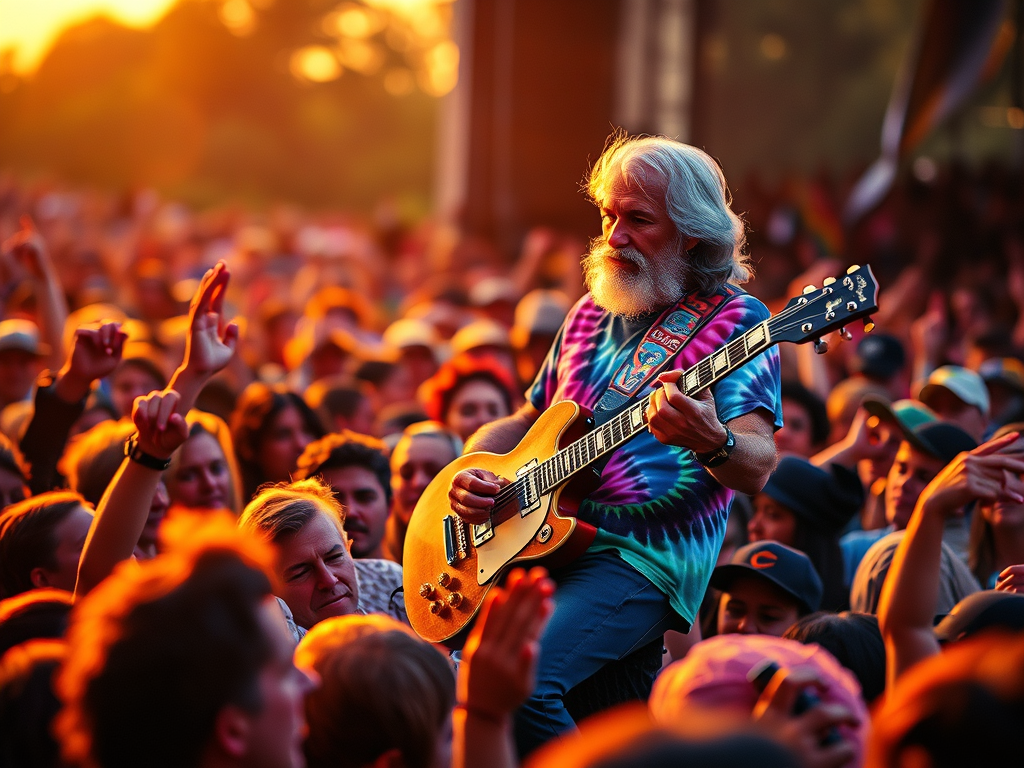

If Grateful Dead fans have mastered the art of farewell, it is only because they have been asked to practice it again and again over nearly six decades.
The first major goodbye came in 1995, when Jerry Garcia passed away at the age of 53. Two decades later, fans faced another emotional parting during a run of concerts that marked the final performances of the band’s four remaining core members together: Mickey Hart, Bill Kreutzmann, Phil Lesh, and Bob Weir. In 2023, Dead and Company announced what was billed as a “final tour,” prompting yet another round of goodbyes. Even that was not the end. The group returned once more in 2024 for three special shows celebrating the 60th anniversary of the Grateful Dead’s founding.

That same year, the community mourned the death of bassist Phil Lesh at 84, along with the end of his long-running side project, Phil Lesh and Friends. And now, with Bob Weir’s death on Saturday at the age of 78, fans have been asked to say farewell once again.
“The voices are gone,” said Dennis McNally, the Grateful Dead’s former publicist and biographer, referring to Weir, who after Garcia was the band’s most prolific songwriter and vocalist.
Yet even amid the grief, there was another story unfolding. On Tuesday night in Brooklyn, hundreds of people gathered at Brooklyn Bowl for a free tribute concert that felt less like a wake and more like a reaffirmation.
“Bob Weir is here,” announced Sarah Elaz, bassist for the evening’s house band, Bushwick’s Dead, as the musicians took the stage. They launched into “Sugar Magnolia,” one of Weir’s best-known songs and a track the Grateful Dead famously played at midnight every New Year’s Eve.
The declaration captured something essential about the Grateful Dead phenomenon. Even as the original members pass away, with only Hart and Kreutzmann still alive among the core group, the music and the culture continue. Few bands in modern history have transformed so completely from a functioning act into an enduring idea and a shared repertoire.

This would have seemed unlikely three decades ago, when Garcia’s death appeared to mark a definitive ending. Garcia was not only the band’s musical anchor but also a symbol of an entire countercultural movement. Yet in the years since, the steady release of archival recordings, the rise of sanctioned successor bands, nonstop touring tribute acts, and the arrival of younger fans have ensured that the music never truly stopped.
“My parents always described the Grateful Dead world as an old oak tree,” said Grahame Lesh, Phil Lesh’s son, in a recent interview. “The roots are the American musical traditions the band absorbed and blended together. The band members were the trunk. And everyone who carries it forward now — the musicians who played with them later, the cover bands in every city — those are the branches and leaves.”
No one embodied that philosophy more than Bob Weir himself. He was just 17 years old when he helped form the Grateful Dead in the San Francisco Bay Area in 1965. After Garcia’s death brought the original band to an end, Weir remained deeply committed to keeping the music alive through various successor projects that included other original members.
That commitment reached a new level in 2015, when Weir co-founded Dead and Company. The group included Hart and, at times, Kreutzmann, but it also introduced new musicians, most notably John Mayer, who stepped into Garcia’s musical role. Dead and Company quickly became a phenomenon of its own, drawing massive crowds and introducing a new generation to the Dead’s songs, mythology, and improvisational spirit.

At Brooklyn Bowl, the crowd skewed younger than one might expect for a tribute to a band founded in the 1960s. For many attendees, the night was as much about honoring Dead and Company as it was about remembering the original Grateful Dead.
“He is my Jerry,” said Sara Dennis, 32, referring to Weir. “If Bob hadn’t been open-minded enough to bring in someone like John Mayer, I don’t think people my age would have connected with this music in the same way.”
Ashley Duncan, 30, attended the show as a guest of her boyfriend, who she said was deeply shaken by Weir’s death. “I wouldn’t say they idolized him,” she said of her boyfriend and his fellow Deadhead friends. “It felt more like losing someone close, like a friend.”
The tone of the evening reflected that sentiment. Rather than somber or mournful, the concert felt celebratory, even joyful.
Reggae artist Matisyahu joined the band for “Estimated Prophet,” navigating the song’s unusual 7/4 time signature. Guitarist Robert Randolph brought a soul-infused intensity to “Samson and Delilah.” After “Truckin’” closed the second set — complete with its iconic line, “What a long, strange trip it’s been” — Brooklyn Bowl owner Peter Shapiro and others handed out roses to the audience. After a brief moment of silence, the flowers were tossed into the air.

Despite the loss of yet another foundational figure, the story of the Grateful Dead is far from over. The coming year is set to include more official releases of archival concert recordings, with two already announced. Across the country, dozens, if not hundreds, of cover bands continue to perform the music nightly. While Phil Lesh and Friends has come to an end, Grahame Lesh and Friends has several upcoming shows scheduled.
Chris Ferretti, 54, embodied the archetypal Deadhead. A former owner of a brown-and-beige Volkswagen bus, he arrived at Brooklyn Bowl dressed as a psychedelic version of Uncle Sam, a visual nod to the Dead’s song “U.S. Blues.” He does not count the tribute concert among the 504 performances he has attended by the Grateful Dead and its official successor bands, but he was grateful to be there, surrounded by fans half his age.
“That’s the magic of the Dead,” Ferretti said. “You’re never the oldest person in the room, and you’re never the youngest.”
For a band that has said goodbye so many times, the Grateful Dead continues to find new ways to say hello.




Leave a Reply