
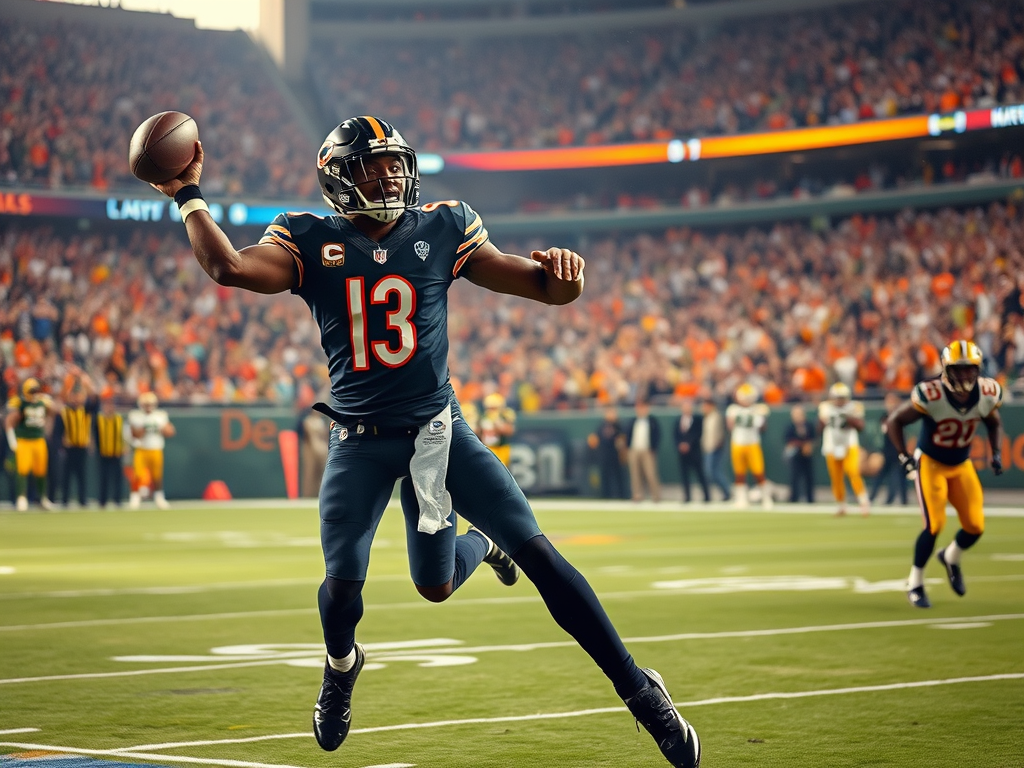

CHICAGO — Late Saturday night, Caleb Williams walked back into the Chicago Bears’ locker room wearing a foam cheese-grater hat, a playful nod to the rivalry that had just produced another unforgettable chapter. He paused at DJ Moore’s locker, leaned down, and gave Moore’s two-year-old son, Denniston Oliver, a fist bump. The toddler had a matching foam hat on his head. He may not understand it now, but his father and the Bears’ quarterback had just left a permanent mark on the NFL’s oldest feud.
They did it in the most dramatic way possible. Again.
Three weeks after Williams and Moore connected on a 46-yard touchdown in overtime to win a regular-season thriller, the same duo struck once more. With 1:43 left on the clock, Williams found Moore for a 25-yard touchdown on the Bears’ final possession, sealing a 31–27 playoff victory over the Green Bay Packers at Soldier Field.
The stadium erupted instantly. It was the kind of moment that felt unreal, the sort of finish that leaves fans staring at each other in disbelief, wondering if what they just witnessed actually happened.
Once again, it was Williams at the center of it all. The confident quarterback who arrived in Chicago less than two years ago promising to change the Bears’ story delivered another signature ending. In the final five minutes, he threw two touchdown passes and added a critical two-point conversion, turning chaos into triumph.
“When the lights are bright,” Moore said afterward, “he’s brighter than the lights out there.”
This time, the decisive touchdown came from a perfectly designed call. The Bears faked a wide receiver screen to rookie Luther Burden III, drawing in the Packers’ defense and especially cornerback Carrington Valentine. Green Bay took the bait. Moore slipped free down the left sideline, and Williams calmly delivered the ball to one of the most open targets imaginable.
As Burden watched the defense swarm toward him, he knew immediately what was happening.
“We got them,” he said with a grin. “I knew it was a touchdown.”
Moore felt the same way as Valentine chased helplessly behind him.
“We practiced that play a few times,” Moore said. “It unfolded exactly the same way.”
Williams credited head coach Ben Johnson for the call.
“As soon as we lined up,” Williams said, “I could tell from their body language that it was going to work. I just had a feeling that was the moment.”
It was the final exclamation point on an incredible comeback. The Bears erased an 18-point halftime deficit to earn their first playoff win in 15 years, the largest postseason comeback in franchise history. And they did it against Green Bay, the rival that had spent decades tormenting Chicago.
The irony was impossible to miss.
In the days leading up to the game, the Packers had openly talked about revenge for their Week 16 overtime loss in Chicago, a game that cost them the NFC North title. They returned to Soldier Field determined to make a statement. The Bears heard every word and used it as motivation.
“They wanted us,” Williams said. “That’s what I heard. They wanted it, and they got it.”
Still, Chicago made things far more difficult than necessary. The first half was messy and tense. The Bears fell behind 21–3 and struggled to find any rhythm. At halftime, Johnson challenged his players to imagine something historic.
“The only option,” Williams said, “was to go out there and be legendary. Execute. Have each other’s backs. Go win the game.”
When it was over, Moore tried to process everything he had experienced.
“It felt like a movie,” he said.
And it truly did. The snow that turned Soldier Field into a swirling white globe. The pregame confrontation at midfield, with both teams crowding around the orange “C” and exchanging words. The presence of Bears legends Brian Urlacher and Devin Hester on the sideline. Everything felt scripted for drama.
“At halftime,” Moore said, “we just had to regroup and go play Bears football.”
For much of the night, Williams was more clutch than clean. By halftime, he had only 78 passing yards and a passer rating under 36. He threw as many incompletions as completions in his playoff debut and tossed two interceptions on failed fourth-down attempts. His frustration was visible, and the mood felt ominous.
Even the most optimistic Bears fans endured a stretch where it seemed inevitable that the season would end in disappointment, yet again at the hands of Green Bay.
Then everything changed.
The Packers, dominant in the first half with 231 yards and 7.2 yards per play, suddenly stalled. They opened the second half with four straight punts and managed just one first down during that span. Belief crept back onto the Bears’ sideline. When the fourth quarter arrived, Williams caught fire.
He threw for 183 of his 361 yards in the final quarter alone, as Chicago scored 25 points.
“He went into Iceman mode,” Burden said. “He knows what’s on the line. We go as far as he takes us.”
Johnson could feel it too.
“He just started feeling it,” the coach said.
Before Moore’s go-ahead score, Williams led a touchdown drive capped by an 8-yard pass to Olamide Zaccheaus, followed by a two-point conversion to rookie tight end Colston Loveland. The defining moment of that drive came on fourth-and-8, when Williams hit Rome Odunze for 27 yards, one of nine completions of 20 yards or more.
As the pocket collapsed and linebacker Isaiah McDuffie forced him to his left, Williams launched an off-balance throw 36 yards downfield into a tight window near the sideline.
“I saw the space as I dropped back,” Williams explained. “And on fourth down, you’ve got to give your guy a chance. Rome made an incredible catch.”
Safety Kevin Byard called it one of the best throws he had seen all season.
“I don’t even think his feet were on the ground,” Byard said. “On fourth down, with the game on the line, he drops a perfect ball. When we need him, he’s always there. You look around like, did that really just happen?”
Byard smiled as he finished the thought.
“Once he made that throw to Rome, I knew we were going to win. It was just a matter of time.”
At that moment, the Bears were still down by 11 with more than five minutes left. Yet their calmest leader was already certain.
For decades, Chicago fans had endured the memories. Aaron Rodgers celebrating a 2010 NFC Championship win at Soldier Field. The fourth-down strike to Randall Cobb in 2013. The 2018 season opener comeback punctuated by a 75-yard touchdown. The infamous 2021 moment when Rodgers declared his ownership of the rivalry.
But Saturday night belonged to someone new.
Chicago woke up realizing it wasn’t a dream. The comeback was real. And the Bears now have their own closer, a fearless young quarterback who has beaten Green Bay three times in his last four meetings, each with a late game-winning drive.
This time, he did it in the playoffs. Against history. Against expectations. And in a way that will be remembered forever.
The night before the game, Williams told his teammates that players earn their paychecks in the regular season, but they build their legacies in the postseason. On Saturday, he began writing his.
“We’re here,” Williams said afterward. “And we’re going to be here for a while.”




Leave a Reply