
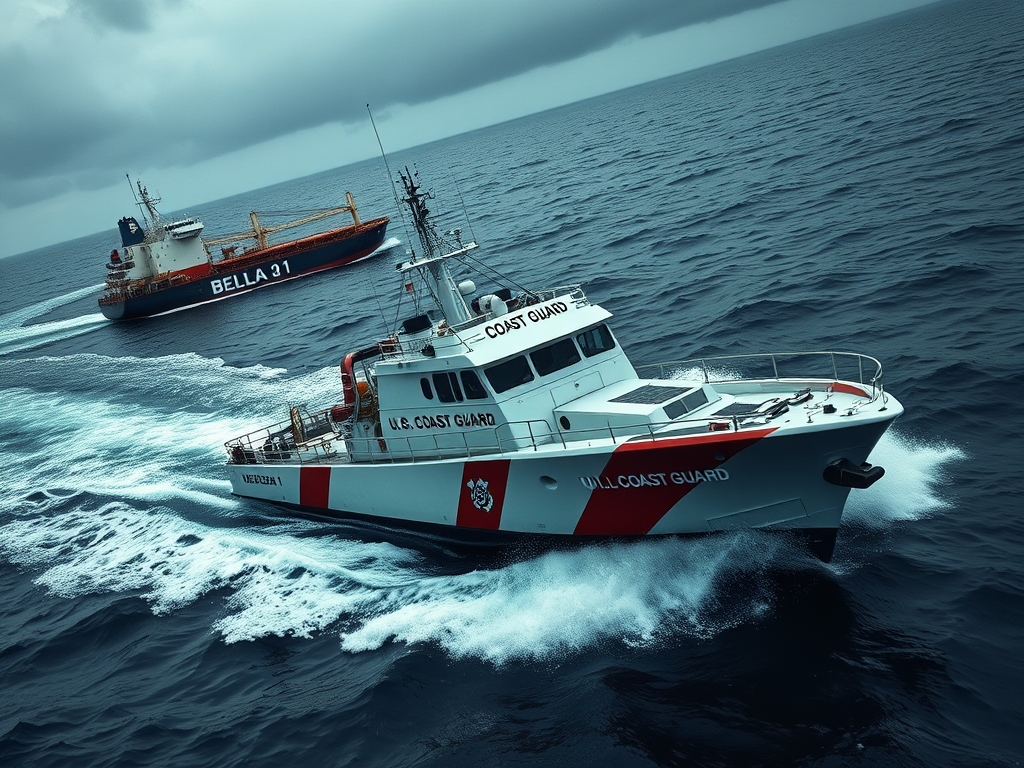

The U.S. Coast Guard attempted on Saturday to stop an oil tanker connected to Venezuela that was moving away from the Caribbean Sea, according to three U.S. officials familiar with the operation. The officials spoke anonymously due to the sensitivity of the mission. The interception effort came only days after President Donald Trump publicly vowed to intensify enforcement against vessels involved in Venezuela’s sanctioned oil trade.
The tanker, known as the Bella 1, was heading toward Venezuela to load oil but was empty at the time, according to ship-tracking data and one U.S. official. When approached by American forces, the vessel changed course and headed northeast into the Atlantic Ocean. The Bella 1 has been under U.S. sanctions since last year for transporting Iranian oil, which U.S. authorities say helps fund terrorist activities.
Officials said that when the Coast Guard encountered the Bella 1 late Saturday, the tanker was not displaying a valid national flag. Under international maritime law, ships without recognized registration are considered stateless and can be legally boarded in international waters.
Two officials said U.S. authorities had secured a seizure warrant from a federal magistrate judge, allowing them to take control of the ship. The warrant was based on the tanker’s earlier involvement in Iranian oil shipments rather than its connection to Venezuela. Despite the warrant, the Bella 1 refused to comply and continued sailing, prompting what one official described as an active pursuit.
By Sunday morning, the vessel began transmitting repeated distress signals to nearby ships. Radio communications reviewed by reporters showed the tanker moving more than 300 miles northeast of Antigua and Barbuda. By Sunday evening, the Bella 1 had sent more than 75 alerts, drawing attention from maritime observers.
The Coast Guard had greater success earlier that same day, boarding another tanker. In addition, U.S. authorities seized a third vessel on December 10, which is now docked at a port in Texas.
These actions represent a notable escalation in President Trump’s pressure campaign against Venezuelan President Nicolás Maduro. The situation has raised concerns about potential military confrontation, particularly after Mr. Maduro ordered Venezuelan naval vessels to escort certain oil tankers departing from the country. According to officials and tracking data, the Bella 1 had not yet entered Venezuelan waters and was not under naval protection.
President Trump has accused Mr. Maduro of contributing to the flow of fentanyl into the United States and of illegally profiting from oil assets linked to American companies, though he has not publicly provided evidence. Oil exports are the backbone of Venezuela’s economy, and U.S. seizures appear aimed at cutting off this critical source of revenue.
Earlier on Saturday, the Coast Guard also boarded another tanker, the Centuries, which had recently loaded Venezuelan oil and was traveling eastward. Two individuals within Venezuela’s oil industry said the cargo belonged to a China-based oil trader.
Unlike the Bella 1, U.S. authorities did not have a warrant to seize the Centuries. The ship was sailing under a Panamanian flag, and a U.S. official said the Coast Guard was investigating whether that registration was legitimate. It remains unclear how long the vessel might be detained.
On Tuesday, President Trump suggested additional seizures were imminent, announcing what he called a “complete blockade” on sanctioned oil tankers traveling to and from Venezuela. However, the Centuries does not appear on the Treasury Department’s public list of sanctioned entities.
These developments have fueled uncertainty about the administration’s broader strategy. A true blockade would be considered an act of war, yet most vessels continue to move freely in and out of Venezuelan ports. As a result, analysts say the current operations more closely resemble law enforcement actions than a military blockade.
Homeland Security Secretary Kristi Noem wrote on social media Saturday that the Coast Guard had “apprehended” a tanker previously docked in Venezuela, apparently referring to the Centuries. She stated that the United States would continue to pursue the illegal movement of sanctioned oil used to finance narcoterrorism and warned those involved that they would be stopped.
Ms. Noem also shared a video that appeared to show U.S. personnel descending from a helicopter onto a ship’s deck during the operation.
The White House declined to comment on the boarding of the Centuries and did not immediately respond to questions about the attempt to intercept the Bella 1.
Venezuela’s government condemned the boarding, accusing the United States of stealing and hijacking a private vessel carrying Venezuelan oil and forcibly disappearing its crew.
The tankers targeted by U.S. authorities are part of what experts describe as a “ghost fleet,” vessels that transport oil from countries such as Iran, Venezuela, and Russia in violation of international sanctions. Industry analysts estimate that these ships account for up to one-fifth of the global tanker fleet. Such vessels frequently disguise their destinations and submit falsified documentation.
According to satellite imagery and ship-tracking analysis, the Bella 1 previously engaged in signal manipulation known as spoofing, a technique that transmits false location data. In August, the tanker loaded oil at Iran’s Kharg Island export terminal before transferring the cargo to another ship off the coast of Oman. It later sailed to the Caribbean, where it was intercepted.
Internal data from Venezuela’s state oil company shows that the Bella 1 was scheduled to load one million barrels of Venezuelan crude in November. The oil was reportedly purchased by a company linked to Ramón Carretero, a Panamanian businessman sanctioned by the United States this month for financial ties to the Maduro family.
Officials in the Trump administration have said the boarding operations are designed to weaken Mr. Maduro’s financial resources. While much of Venezuela’s oil is shipped to China, often through complex resale arrangements involving Cuba, some exports are still permitted to reach the United States under special licenses.
Both Democratic and Republican administrations have long opposed Mr. Maduro, labeling him a dictator and accusing his government of corruption and human rights violations.
President Trump has repeatedly claimed that Venezuela’s oil revenues support activities such as drug trafficking and human trafficking, though he has not released public evidence to support those assertions.
In recent months, the United States has significantly expanded its military presence in the Caribbean. Since September, U.S. forces have reportedly killed more than 100 people in attacks on boats accused of smuggling drugs. However, legal experts argue that many of those operations may violate international law, noting that much of the cocaine passing through Venezuela is destined for Europe, not the United States.
Venezuelan officials have accused Washington of seeking control over the country’s vast oil reserves, among the largest in the world. President Trump and senior advisers have openly expressed interest in gaining influence over that supply.
Tensions escalated further on December 10, when U.S. agents seized another tanker, the Skipper, which was carrying Venezuelan oil. The ship was flying a false flag and had been sanctioned for previous involvement in Iranian oil transport. After being boarded, the crew sailed the vessel to Galveston, Texas, under Coast Guard supervision.
U.S. officials said the oil aboard the Skipper has not yet been seized, as doing so would require a separate legal process and evidence that the cargo was linked to terrorist financing.
Following that incident, Mr. Maduro ordered naval escorts for oil tankers leaving Venezuelan ports. Satellite images later showed the Centuries traveling east while accompanied by several vessels believed to belong to the Venezuelan Navy, though those ships were not present during the U.S. boarding on Saturday.
The Centuries was carrying between 1.8 million and two million barrels of Venezuelan oil and has also been linked to signal spoofing. Unlike some other vessels, it has no known ties to Iran and has spent recent voyages transporting Venezuelan crude and fuel oil to Asia.
According to individuals familiar with U.S. discussions, authorities are monitoring additional tankers with suspected Iranian connections and may attempt further seizures. The risk of interception appears to be deterring some ships, with tracking data showing several tankers reversing course before reaching Venezuela.




Leave a Reply