

American Airlines Flight 27 was flying hundreds of miles over the Pacific Ocean earlier this month on its route from Los Angeles to Tokyo when a passenger suddenly experienced a serious medical emergency.
The captain quickly contacted Mike Doran, a dispatcher based in Texas. Mr. Doran arranged a consultation with a physician employed by American Airlines. After reviewing the situation, the decision was made to divert the aircraft. The plane altered its course and flew more than two additional hours to San Francisco so the passenger could receive immediate medical attention.
While the aircraft was en route to San Francisco, Mr. Doran and his colleagues began addressing the ripple effects of the diversion. The flight crew would need legally required rest, stranded passengers would require hotels and meals, catering plans would have to be redone, and the aircraft’s future flight schedule would need adjustments.
Handling situations like this is a daily reality at American Airlines’ operations control center, where hundreds of employees oversee the airline’s vast global network. These command centers are critical to keeping the aviation system running, yet their work remains largely unseen by the public, unlike airport security lines or air traffic control delays that often make headlines.
Even minor disruptions can trigger major consequences for airlines, affecting aircraft availability, crew schedules, and customer travel plans. To prepare, airlines develop detailed contingency plans and maintain spare aircraft, crews, and parts. This preparation is especially vital during peak travel periods like Thanksgiving, Christmas, and the winter months, when weather can quickly shut down airports.
However, preparation alone is not enough. Execution matters just as much. According to aviation consultant Michael Boyd of Boyd Group International, operations control centers exist to ensure resources are used in the most effective way possible when unexpected problems arise.

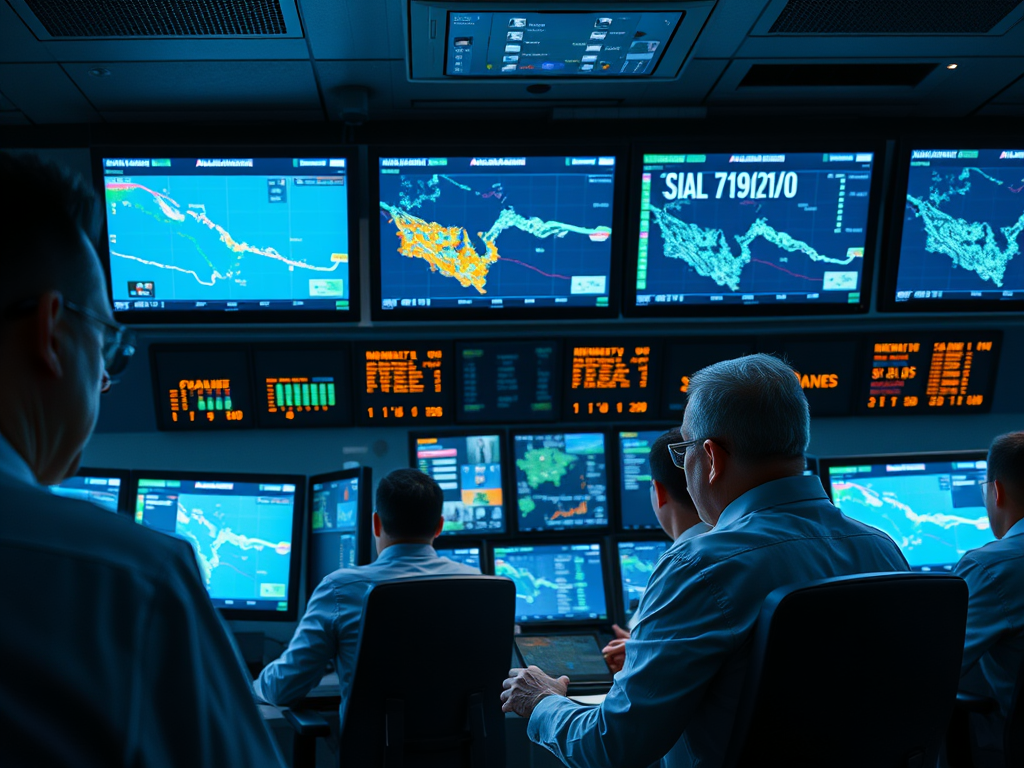
American Airlines’ Integrated Operations Center is located at its headquarters in Fort Worth, near Dallas Fort Worth International Airport. Most of the work happens on the second floor of a specially reinforced building designed to withstand powerful tornadoes. Inside, employees monitor dozens of screens displaying flight schedules, mechanical issues, weather systems, airport closures, security concerns, and even global political developments.
Despite the high stakes, the space is intentionally quiet. Sound-dampening technology in the walls and ceiling keeps noise levels low, allowing staff to stay focused. The responsibility is immense: American Airlines carries more than 600,000 passengers each day, relying on pilots, flight attendants, ground crews, and support staff to serve over 350 airports worldwide.
Jessica Tyler, vice president overseeing the operations center, noted that even on days when all flights operate as scheduled, countless behind-the-scenes problems still have to be resolved to make that possible.
The work of the operations center is especially important as American Airlines tries to close the financial gap with its largest competitors, Delta Air Lines and United Airlines. Since 2022, those two carriers have captured the majority of profits in the U.S. airline industry.
An airline’s profitability is closely tied to how reliably it transports passengers. In this area, American has room for improvement. Federal data shows that during the first nine months of the year, about 72 percent of American’s flights arrived on time or close to schedule. United posted a 77 percent rate, while Delta reached 79 percent. Flight cancellations also tell a similar story, with American canceling roughly 2 percent of flights compared with less than 1 percent for its two rivals.
Roughly 1,700 employees staff American’s operations center around the clock, every day of the year. Their roles include flight dispatchers, crew schedulers, maintenance controllers, meteorologists, IT specialists, and security personnel. On a typical day, several hundred people work together on the second floor, organized into 11 teams based on aircraft type, region, or both.
One of those managers, Ricardo Eva, oversees operations for Airbus A321 aircraft flying into and out of Dallas-Fort Worth, one of American’s largest hubs. On December 4, the day after Flight 27 diverted to San Francisco, 124 Airbus A321 jets were scheduled to operate.
That morning, Mr. Eva received news of another medical emergency, this time on Flight 2535. The aircraft had already left the gate in San Diego but was forced to return so a passenger could be taken off for medical reasons.
Mr. Eva immediately alerted his colleagues. Jennifer Irwin, who manages customer service issues for the team, contacted ground staff. Crew coordinator Phil Stam checked whether the flight attendants would still be able to operate their next assignment. Betty Hernandez, responsible for aircraft availability, ensured a backup plane was ready if necessary. Ms. Hernandez described the process as juggling moving pieces under constant pressure.

In this case, the response worked smoothly. The passenger was rebooked, and Flight 2535 arrived in Dallas less than an hour behind schedule. Overall, December 4 was a relatively calm day. Out of more than 6,500 American Airlines flights planned, only 13 were canceled.
Canceling a flight is usually avoided whenever possible, explained David Seymour, the airline’s chief operating officer, because one cancellation can disrupt crews, aircraft rotations, and maintenance schedules across the network. The goal, he said, is to preserve the integrity of the entire system.
The operations center also maintains close communication with external partners. Staff are in constant contact with the Federal Aviation Administration’s air traffic control units. When flight restrictions were imposed at certain airports during a federal government shutdown in November, American coordinated closely with the FAA to limit disruptions.
The airline also works with partner carriers that can assist during emergencies, as well as cruise lines that depend on timely flight connections for passengers.
When cancellations cannot be avoided, technology helps limit the damage. According to Ms. Tyler, automated systems can reassign about three-quarters of affected passengers to new flights within 12 minutes.
Some situations, however, require rapid improvisation. The day after Thanksgiving, Airbus announced that thousands of its aircraft needed an urgent software update, including hundreds operated by American Airlines.

In response, American substituted Boeing aircraft where possible, rebooked passengers using digital tools, and scheduled technicians to complete the updates. The situation generated so many pilot inquiries that the operations center established a dedicated hotline to distribute information efficiently. Despite the pressure, all required updates were completed before the regulatory deadline set by European authorities.
The following week was comparatively quiet, marked only by the two medical emergencies that required swift action.
As Mr. Doran reflected, passengers rely on these behind-the-scenes decisions for life’s most meaningful moments. Whether they are traveling for vacations, weddings, funerals, or cruises, every flight matters. The work is demanding, he said, but the reward comes from safely moving thousands of people to where they need to be, day after day.




Leave a Reply