
One morning last month, Adam Gonzalez, an attorney working for a nonprofit organization in Chicago, drove to his son’s day care as usual. As he approached the building, something immediately caught his attention. Two vehicles were stopped directly in front of the entrance, obstructing access to the school.
Concerned about the safety of bringing his 17-month-old son into an uncertain situation, Gonzalez locked his car and walked closer on foot. His anxiety intensified when he realized the individuals near the vehicles were wearing tactical gear associated with Immigration and Customs Enforcement. Acting on instinct, he began recording with his phone. Inside one of the cars, he noticed a teacher from the Spanish immersion preschool seated in the back.
As Gonzalez drew nearer, he decided to stop filming and step back. Recent news reports about aggressive enforcement tactics, including the use of tear gas, flashed through his mind. Although he is a U.S. citizen, he feared that officers might still question him or escalate the encounter. Once the vehicles departed, he brought his son inside, but the experience left him deeply unsettled and questioning whether the school, Rayito de Sol, remained a safe place for his child.
He later reflected on the emotional toll of the incident, saying it was difficult to concentrate at work while worrying that his toddler could be exposed to an immigration raid. He questioned how such scenes could become normalized, especially in places meant to protect and nurture children.
Since returning to office, President Trump has advanced a sweeping deportation initiative aimed at intensifying immigration enforcement nationwide. Federal officers have spread across major cities, carrying out targeted operations, making arrests near workplaces, and detaining individuals during routine immigration appointments. Officials have framed these efforts as a way to remove what they describe as the most dangerous offenders.
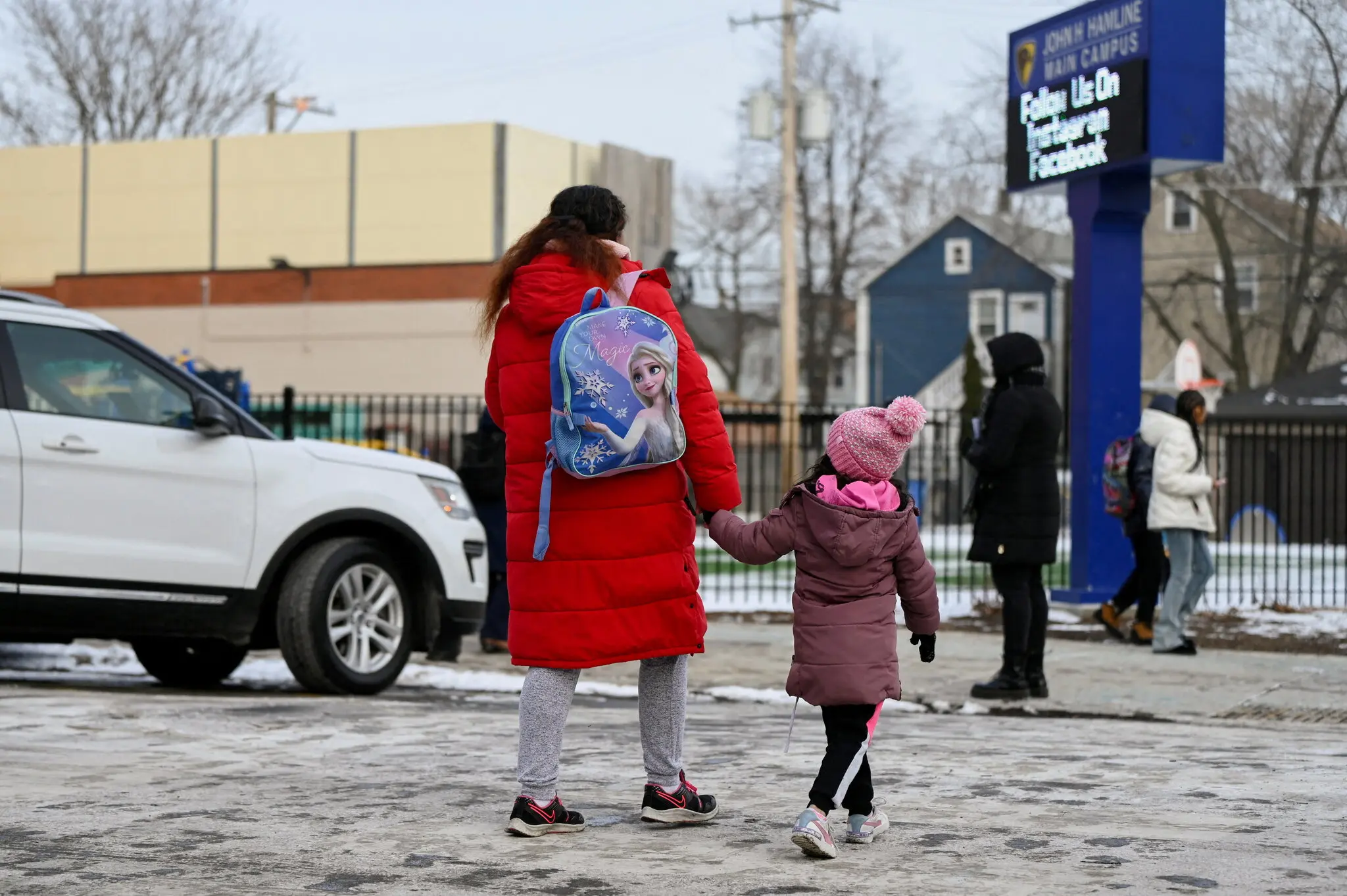
However, some of these actions have taken place near schools, both public and private, sparking anger and anxiety in many communities. Parents say they are increasingly fearful about taking their children to school, worried about the possibility of detention or their children witnessing traumatic scenes. Educators report that enforcement activity in close proximity to campuses has disrupted learning and undermined students’ sense of safety.
In recent months, families in Maryland and Washington, D.C., have observed ICE agents pursuing and arresting individuals close to school grounds. In San Diego, school administrators reported that a father was detained while waiting near an elementary school to pick up his child.
Chicago has seen similar incidents. Teachers there said elementary students were playing outside when ICE officers deployed tear gas in the surrounding area. In Portland, Maine, federal officials confirmed that a parent was arrested after dropping off a child at school, noting that the individual had previously faced domestic violence charges.
These events have drawn criticism from lawmakers. In October, eight Democratic senators, led by Illinois Senator Tammy Duckworth, sent a letter urging the administration to halt civil immigration enforcement within 1,000 feet of school property.
Federal officials have repeatedly stated that schools are not targets of immigration enforcement. A spokesperson for the Department of Homeland Security said ICE does not go to schools to arrest children. She added that only in rare situations involving immediate threats to student safety could an arrest occur near a school, emphasizing that such scenarios had not taken place.
Shortly after President Trump’s inauguration, the Department of Homeland Security revoked guidance from the previous administration that had restricted immigration enforcement in so-called sensitive locations, including schools, churches, and hospitals.
Some allies of the administration have defended the change, arguing that limiting enforcement locations reduces effectiveness. A former acting deputy secretary of homeland security said operations near sensitive areas represent only a small portion of overall enforcement efforts. He added that if deportation initiatives are to be efficient, no reasonable location should be excluded.
Critics counter that arrests near schools are fostering widespread fear. School leaders in several areas say attendance has dropped following nearby ICE activity, prompting schools to expand counseling services and wellness programs. In some communities, parents have begun volunteering to monitor school grounds during drop-off and pickup times.
At the Chicago preschool, a video recorded by a parent showed officers removing a teacher, Diana Santillana Galeano, from the entrance on November 5. Federal officials later said the day care itself was not targeted and that the arrest occurred in a vestibule rather than inside the school. They also stated that officers had attempted a traffic stop before she entered the building.

According to homeland security officials, Santillana Galeano crossed the southern border unlawfully in 2023 and was accused of paying smugglers to bring her children into the United States. Her attorneys disputed that claim, stating she had been released from detention and did not use smugglers. The school declined to comment on the incident.
Maia Reed, whose four-year-old daughter attends the school, said she arrived that morning to find parents and teachers in tears. Her daughter clung to her leg and asked why everyone was upset. Although the officers had already left, another parent showed Reed a video of the arrest. She soon decided to take her daughter home.
In the weeks that followed, Reed said her daughter began having nightmares about people being taken away. She also questioned whether she should continue speaking Spanish and became reluctant to return to school. Reed said her daughter frequently asked whether her teacher would still be there, a question she found painful because she did not know the answer.
At DC Bilingual Public Charter School, parents and staff reported multiple ICE-related incidents nearby in recent months. On September 25, two men were arrested on a street near the playground during dismissal, according to the school’s chief executive. She described seeing several officers and two men in handcuffs as parents and children passed by.
Homeland security officials later said the arrest followed a vehicle stop conducted with the assistance of ICE, involving a man who had entered the country illegally in 2023. Some students observed the scene from inside the school before being moved away by teachers.
Afterward, students asked whether officers would come for them, and parents called to say fear was keeping their families at home. Although the arrested individuals were not connected to the school, the community serves many Latino families, and administrators said the men looked like any other member of their neighborhood.
School leaders increased counseling and wellness checks but said it was difficult to reassure students amid ongoing uncertainty. Maintaining a sense of safety and belonging, they said, had become a daily challenge.
Similar concerns emerged in San Diego. The principal of Linda Vista Elementary recalled being informed that a parent had been detained just before dismissal. The parent’s car was found abandoned nearby, and the child waited inside the school until another family member arrived.

In the days following that incident, some families kept their children home out of fear related to immigration status. The principal said there was no justification for enforcement actions near school campuses, arguing that targeted arrests could occur elsewhere without disrupting the school environment.
Student groups have also responded. In Silver Spring, Maryland, parents witnessed arrests near Eastern Middle School during morning drop-off in September. Federal officials said the individuals fled a vehicle stop near the school, creating a dangerous situation.
An 18-year-old high school senior involved in a student advocacy group said her organization has expanded training sessions to educate students about their rights. She admitted that fear has become part of daily life for many students, even within school walls.
She emphasized that schools should be places of safety and protection, and no student, she said, should be afraid simply to show up for class.




Leave a Reply