
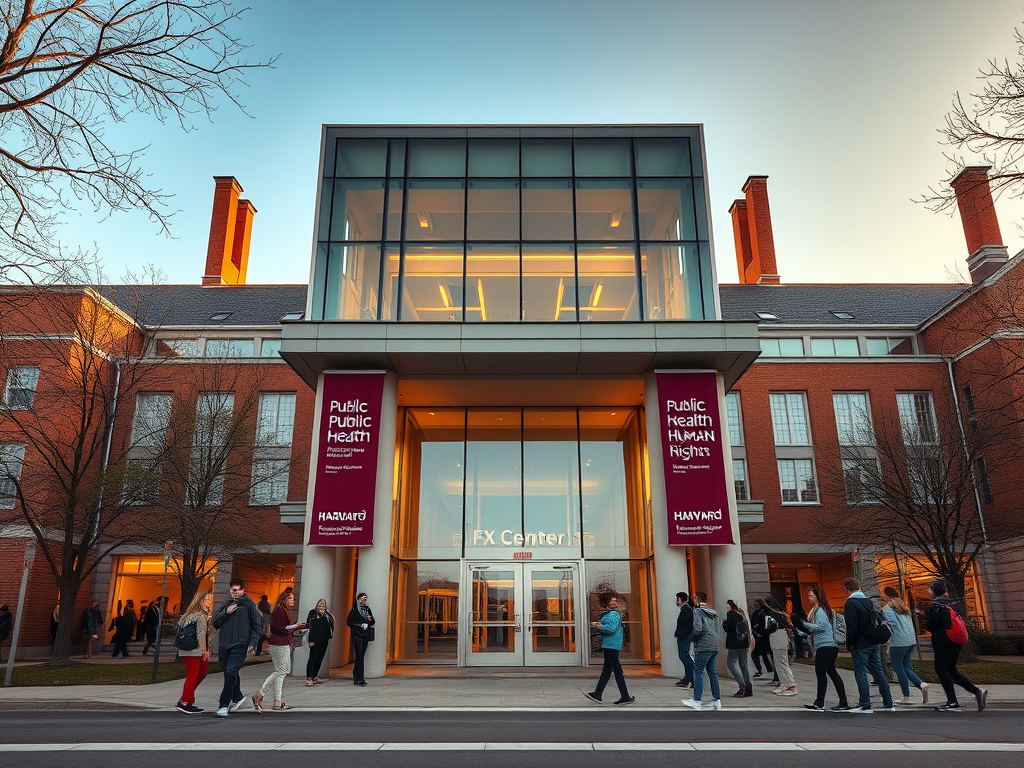

Harvard University’s T.H. Chan School of Public Health is moving forward with a leadership transition at one of its most prominent research centers, a decision that has stirred debate on campus and drawn renewed attention amid ongoing political pressure on the university.
Mary T. Bassett, who has served for seven years as director of the François-Xavier Bagnoud Center for Health and Human Rights, commonly known as the FXB Center, will step down from her role. The change was announced earlier this week by Andrea Baccarelli, dean of the T.H. Chan School of Public Health, in a written message to faculty, students, and staff.
The FXB Center, which focuses on the intersection of public health and human rights, came under heightened scrutiny last year. A report released in the spring by Harvard’s internal task force on antisemitism and anti-Israeli bias cited the center for what it described as a disproportionate emphasis on Palestinian perspectives in its courses and invited lectures. According to the report, Israeli viewpoints were rarely presented, except through voices that were strongly critical of the Israeli government.
In his announcement, Dr. Baccarelli acknowledged what he described as the center’s “high-impact work” during Dr. Bassett’s tenure. However, the message did not offer a detailed explanation for why the leadership change was being made. The lack of clarity has fueled concern among some faculty members and students, many of whom view the move as politically motivated rather than purely academic.
The controversy surrounding the FXB Center intensified earlier this year when it became part of a broader campaign by the Trump administration aimed at Harvard University. Federal officials accused the university of failing to adequately address antisemitism on campus and began targeting specific programs and centers as part of that effort.
In an April letter to Harvard, the Trump administration demanded that the university bring in an external expert to conduct an audit of the FXB Center for potential antisemitism, along with several other academic initiatives. The letter went further, calling on Harvard to make sweeping changes to its hiring and admissions practices, dismantle diversity, equity, and inclusion programs, and revise its student discipline policies. Harvard rejected the demands and instead chose to file a lawsuit against the administration, arguing that the requests infringed on academic freedom and institutional autonomy.
Against this backdrop, Dr. Baccarelli indicated that the FXB Center is in the process of redefining its mission. Rather than covering a wide range of global human rights and health issues, the center will narrow its focus to children’s health. According to the dean, particular attention will be given to early childhood development, a period he described as one of heightened vulnerability. The center aims to apply its human rights framework to this area, which Harvard considers a critical priority for public health research.
To guide the center during this transition, Kari C. Nadeau, a pediatrician and chair of Harvard’s Department of Environmental Health, has been appointed interim director. Dr. Baccarelli expressed confidence that her background and expertise would help steer the center as it shifts its academic direction.
News of Dr. Bassett’s departure was first reported by The Harvard Crimson and quickly prompted backlash from within the Harvard community and beyond. By the end of the week, more than 1,500 people had signed a petition calling for her reinstatement. The petition argues that removing Dr. Bassett sends what it describes as a “chilling message” to scholars, particularly those engaged in research on racial justice and Palestine-related issues, suggesting that such work may no longer be welcome at the university.
Faculty organizations have also voiced alarm. The executive committee of Harvard’s chapter of the American Association of University Professors issued a statement warning that Dr. Bassett’s removal fits into what it sees as a troubling pattern. The group cited the recent dismissal of leaders at Harvard’s Center for Middle East Studies in March, along with other leadership changes that it says were driven by pressure from external critics. According to the committee, these actions raise serious concerns about the future of academic freedom at the institution.
Despite stepping down as director, Dr. Bassett will remain at Harvard as a professor in the Department of Social and Behavioral Sciences, according to the dean’s statement. As of Friday, she had not publicly commented on the decision.
The leadership shift at the FXB Center comes at a sensitive moment for Harvard, as the university and the Trump administration continue negotiations aimed at resolving their broader dispute. The conflict has included financial penalties, public criticism, and prolonged legal battles that have placed the university under intense national scrutiny.
For many observers, the situation surrounding the FXB Center has become a symbol of the larger tensions facing higher education institutions in the United States. Universities are increasingly caught between political forces, public opinion, and their own commitments to academic independence. As Harvard moves forward with changes at the FXB Center, the debate over how far outside influence should reach into academic decision-making is likely to continue, both on campus and across the country.




Leave a Reply