
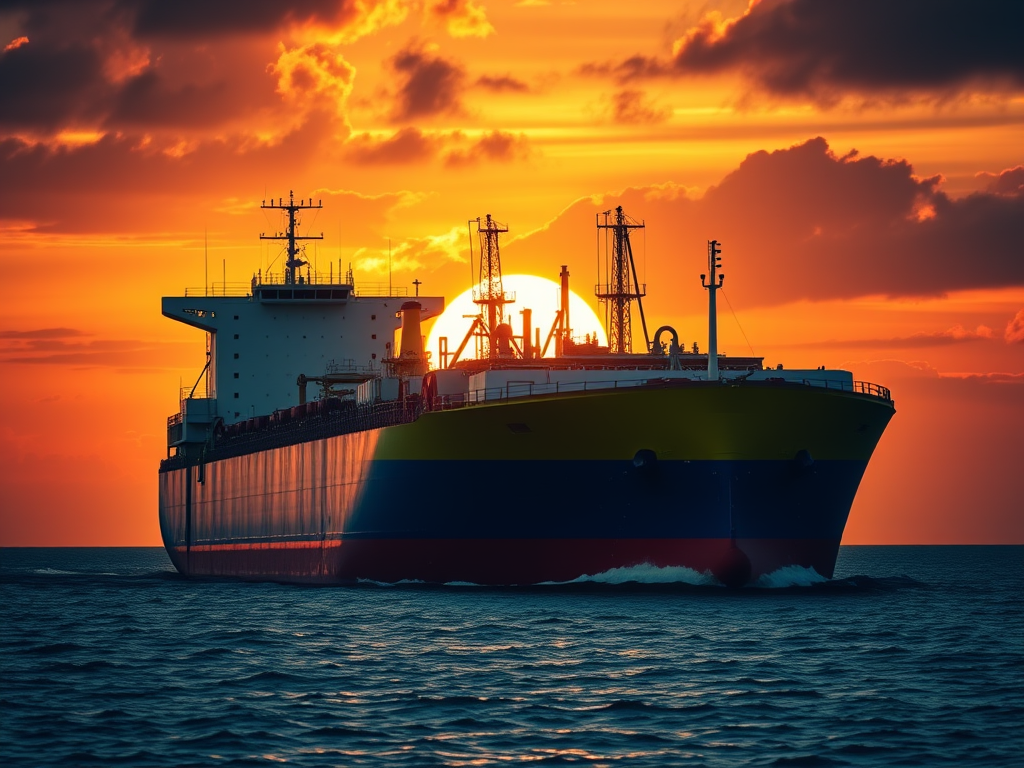

The United States announced a fresh round of sanctions on Thursday targeting Venezuela’s oil industry and members of President Nicolás Maduro’s extended family, while simultaneously moving to prevent the release of tens of millions of dollars’ worth of crude oil from a tanker recently seized by American forces.
Venezuela’s economy is deeply reliant on petroleum exports, and years of U.S. sanctions have forced the Maduro administration to rely on covert shipping networks and intermediaries to sell crude. The latest sanctions specifically focus on six shipping firms and three nephews of Maduro’s wife, expanding Washington’s pressure on the regime’s inner circle.
According to White House press secretary Karoline Leavitt, the Trump administration is also pursuing legal authority to confiscate the oil aboard the Skipper — a large tanker intercepted by U.S. forces in international waters near Venezuela on Wednesday. Although authorities have already secured a warrant to seize the vessel due to its past involvement in smuggling Iranian oil, they have yet to obtain authorization for the cargo currently on board, which originated from a Venezuelan state-owned company. Leavitt emphasized that the government would follow established legal procedures before claiming the oil.
Together, the sanctions and the takeover of the Skipper represent a significant escalation in President Trump’s strategy to undermine Maduro’s rule. Trump has repeatedly accused the Venezuelan leader of overseeing a “narcoterrorist” network and has authorized a series of lethal military actions against vessels he claims — without publicly presenting evidence — are connected to drug trafficking. Several current and former U.S. officials believe the growing military presence in the region points toward a broader aim of regime change.
Later in the day, Trump linked the tanker operation to immigration concerns, asserting that Venezuela had “allowed millions of people to come into our country.” He also warned that the campaign could soon extend further inland within Venezuela.

The impact of these moves is expected to reduce the number of vessels willing to load oil in Venezuelan ports, adding to the country’s isolation and financial strain. Despite the political significance of the decision, global oil markets showed little reaction, with U.S. crude prices holding steady around $58 per barrel. Venezuela’s diminished production — less than 1 percent of global supply — limits the market effect of any disruption.
New information about the seized vessel surfaced on Thursday, including details about its crew, which is predominantly Russian, according to a U.S. official who was not authorized to comment publicly. American authorities have requested that the current crew sail the tanker to the United States, though a replacement crew is prepared if needed.
The Skipper has a storage capacity of two million barrels and had been filled nearly to that limit at a Venezuelan port roughly a month ago, according to data from Kpler, a global oil-tracking firm. Francisco Rodríguez, an economist at the University of Denver, estimated the cargo’s value at around $78 million.
Satellite images and photographic analysis conducted by The New York Times suggest that the Skipper attempted to conceal its movements, consistent with the covert operations typical of vessels involved in oil smuggling. On December 6, it reportedly conducted a ship-to-ship transfer near Curaçao, offloading approximately 50,000 barrels of crude to another tanker, the Neptune 6, which is now en route to Cuba, according to Kpler analyst Homayoun Falakshahi.
The U.S. intervention at sea is unusual, but the Skipper has been monitored by American agencies for years as part of a global “ghost fleet” used by Venezuela and Iran to bypass sanctions. Data from TankerTrackers.com and Kpler show the ship has transported oil for both countries across multiple regions. In 2022, when the vessel operated under a different name, the U.S. Treasury Department sanctioned it for carrying illicit Iranian oil, noting that proceeds from such operations help finance terrorism. That sanction status formed the legal foundation for Wednesday’s seizure.

Leavitt confirmed that the Justice Department had secured a warrant based on the Skipper’s history of transporting black-market oil for Iran. Nonetheless, U.S. officials have been clear that the broader objective is to tighten pressure on Venezuela, and they have signaled that additional tankers transporting Venezuelan crude could be targeted.
The sanctions imposed Thursday expand that pressure further. Two of the newly sanctioned nephews of Maduro’s wife were previously arrested in Haiti in 2015 while finalizing a plan to move cocaine into the United States. Referred to by the Treasury Department as “narco-nephews,” they were convicted in 2016 but later granted clemency in 2022 by former President Joseph R. Biden Jr. After returning to Venezuela, U.S. officials say, they resumed drug trafficking activities.
The U.S. also blacklisted six shipping firms — Myra Marine Limited, Arctic Voyager Incorporated, Poweroy Investment Limited, Ready Great Limited, Sino Marine Services Limited, and Full Happy Limited — all of which operate vessels linked to the transport of Venezuelan crude. While the companies’ ships have been blocked from conducting international business, U.S. officials have not indicated whether additional seizures are planned.




Leave a Reply