
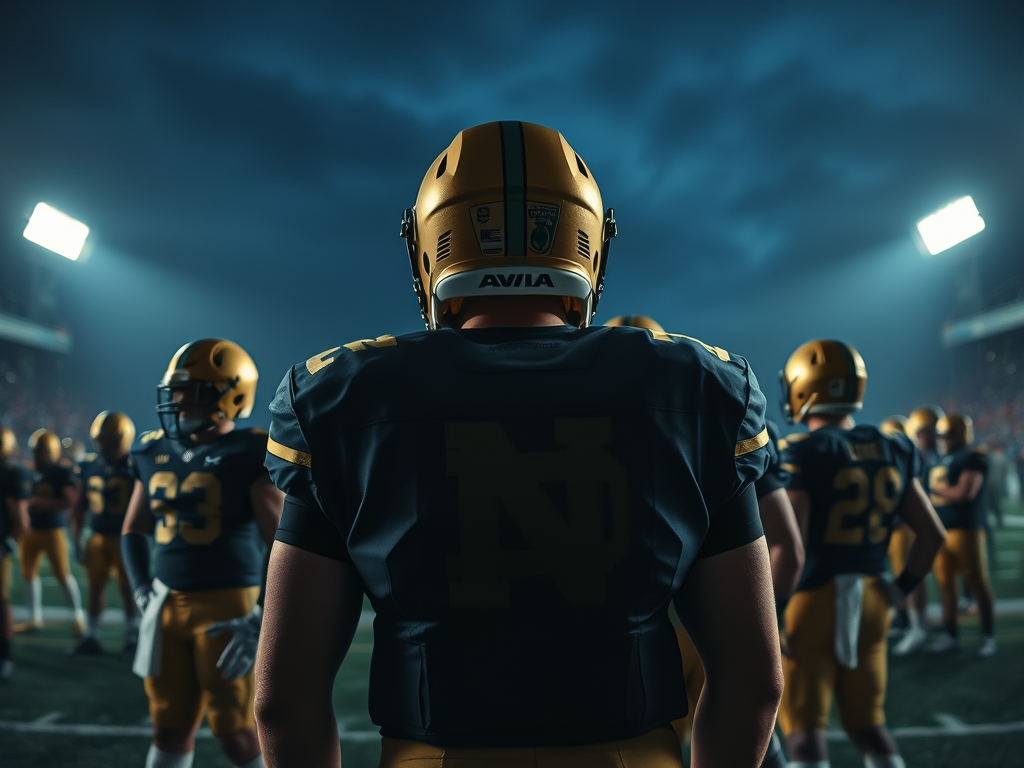

Less than four hours after Notre Dame learned it had been left out of the College Football Playoff, the university released a late-night announcement: the team would not participate in any postseason bowl game. With that single decision, a season that only a day earlier still held national title hopes came to an abrupt end following the team’s decisive win over Stanford during Thanksgiving weekend.
The choice brings the college career of running back Jeremiyah Love to a close. Love, who emerged as one of Notre Dame’s most promising offensive talents, was unlikely to appear in a lower-tier bowl game anyway. Had the Irish continued, they would have landed in the ACC’s group of non-CFP bowls, a tier that includes the Pop-Tarts Bowl, Holiday Bowl, and Gator Bowl. Instead, the program will forgo all postseason options, giving up the winter practice sessions that most college coaches view as crucial development time for young players.
Notre Dame has remained silent since the CFP committee’s decision to award the final at-large playoff positions to Alabama and Miami. That choice left Notre Dame as the first team out of the four-team field, despite entering the weekend widely seen as a strong candidate. For a brief period, speculation circulated that the Irish were preparing to accept an invitation to face BYU in the Pop-Tarts Bowl. Those reports turned out to be unfounded; according to those familiar with the situation, Notre Dame never formally accepted any bowl offer.
What remains unclear is who within the program ultimately pushed for the decision to decline postseason play. Athletic director Pete Bevacqua told Yahoo! Sports that, in the immediate aftermath of the CFP exclusion, the team’s leadership had not yet discussed the possibility of a bowl bid. His early comments suggested a program still processing the emotional weight of being left out, rather than one actively considering next steps.
This marks the first time since the 1996 season that Notre Dame has voluntarily bypassed a bowl game. That year, following an 8-3 finish and the departure of legendary head coach Lou Holtz, the program declined postseason invitations as it transitioned into a new era. The current decision carries a similar sense of internal recalibration, though under very different circumstances.
In the hours after the CFP announcement, Bevacqua expressed deep disappointment on behalf of the team. He described the reaction within the program as a mixture of shock and profound sadness, emphasizing that players and staff alike felt as if they had been unexpectedly dealt a painful blow. The emotion, he noted, was not rooted simply in missing the playoff, but in what the playoff exclusion represented for a group that believed strongly in its body of work.
Behind the scenes, discussions about the future of the expanded College Football Playoff may have influenced the tone surrounding Notre Dame’s decision. Both Yahoo! Sports and The Athletic reported that Notre Dame and the CFP already have an agreement in place for future seasons: under the expanded format, if the Irish finish in the top twelve of the final rankings, they will automatically qualify for the 12-team playoff field. Had that rule been active this year, Notre Dame—ranked No. 11—would have secured the No. 10 seed, placing them ahead of No. 10 Miami due to the clause’s application.
The automatic-qualification concept was first publicly discussed by former athletic director Jack Swarbrick during earlier CFP expansion debates. Bevacqua, who succeeded Swarbrick, has confirmed that Notre Dame supports a long-term playoff structure featuring sixteen teams, with five automatic bids for conference champions and eleven at-large positions. This framework, he has suggested, would protect Notre Dame’s independent status while offering a clearer path to postseason competition.
Still, the immediate reality remains unavoidable: the Irish must wait until next fall to take the field again. The absence of a bowl game eliminates valuable on-field preparation time and deprives younger players of opportunities to gain experience in meaningful late-season situations. For a team that believed it was within reach of a playoff berth, the sudden ending has left a distinct sense of unfinished business.
Notre Dame will now shift its attention toward rebuilding momentum. The next chance to reset their trajectory comes on Labor Day weekend, when the Irish open their 2026 campaign at Lambeau Field against Wisconsin. The matchup will mark the start of a new chapter—one shaped by both the disappointment of this season’s ending and the anticipation of the expanded playoff era ahead.
Though the sting of being left out of the CFP may linger, the program’s long-term positioning suggests that future seasons could unfold much differently. For now, however, Notre Dame’s story ends not in a celebratory bowl appearance, but in a decision rooted in reflection, frustration, and a determination to move forward on its own terms.




Leave a Reply