
A federal judge has dismissed a lawsuit brought against Harvard University by a former student who claimed the institution failed to protect him from harassment during a campus protest and showed indifference toward his concerns.
The case centered on accusations made by Yoav Segev, who completed his master’s degree at Harvard Business School before filing the suit. In his decision, Judge Richard G. Stearns of the Federal District Court in Boston concluded that Segev had not provided sufficient evidence that he was subjected to “severe and pervasive racial harassment,” a legal threshold required for such claims to move forward.
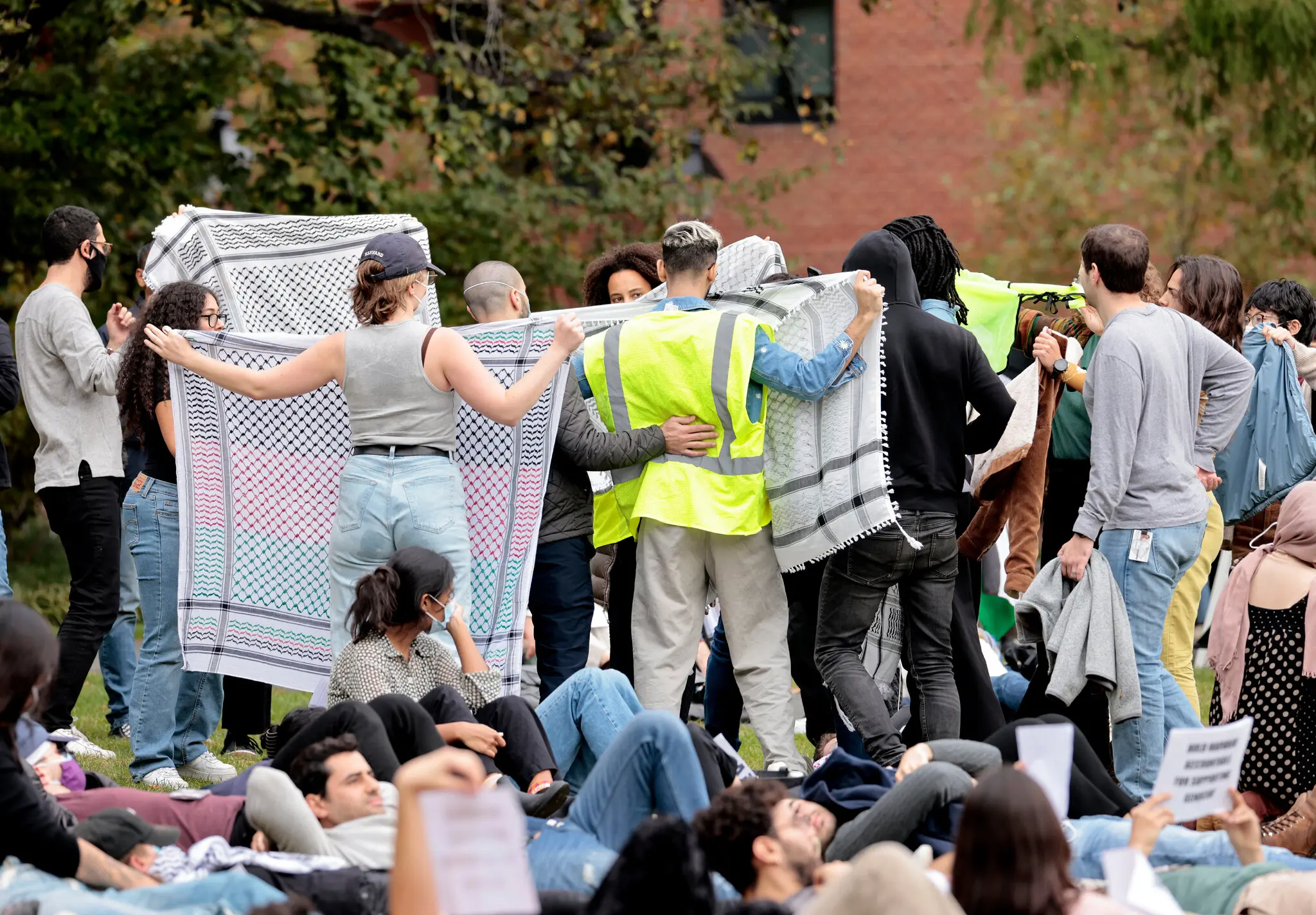
Segev’s allegations stemmed from an incident in October 2023, during a “die-in” demonstration staged on the lawn outside Harvard Business School. The protest took place just weeks after the Hamas attack on Israel, at a time when emotions were running high on campuses nationwide. Hundreds of pro-Palestinian students lay on the grass to protest Israel’s military response in Gaza.
According to the lawsuit, Segev—who holds citizenship in the United States, Israel, and Canada—walked through the demonstration while recording with his phone. Video footage shared widely on social media showed that a group of protesters quickly confronted him, shouting “shame,” covering his camera with scarves, and crowding around him. The footage captured a chaotic scene in which Segev was pushed and ultimately escorted away from the area.
The interaction drew national attention, prompting criticism from Republican lawmakers and several high-profile Harvard alumni who questioned the university’s response to the confrontation.
In his complaint, Segev characterized the encounter as a physical attack driven by antisemitism, alleging that he was targeted explicitly because of his Jewish and Israeli identity. He further accused Harvard of neglecting to take meaningful disciplinary action against the students involved and failing to provide him with support or avenues for recourse.
The suit also contended that Harvard carried out what Segev described as a superficial or “sham” investigation into the incident. At the time it was filed, it was one of the last remaining civil cases challenging how Harvard handled pro-Palestinian demonstrations on its campus.
Two protesters involved in the incident were initially charged with misdemeanor assault and a hate crime offense, though prosecutors later dropped both charges.
In his ruling, Judge Stearns acknowledged that the court does not excuse the behavior of students who physically confronted a peer. However, he emphasized that the facts presented did not plausibly establish that their actions were motivated by antisemitism or racial hostility, undermining the central claim of the lawsuit.
Harvard declined to comment on the ruling, and attorneys representing Segev did not immediately respond to requests for a statement.




Leave a Reply