
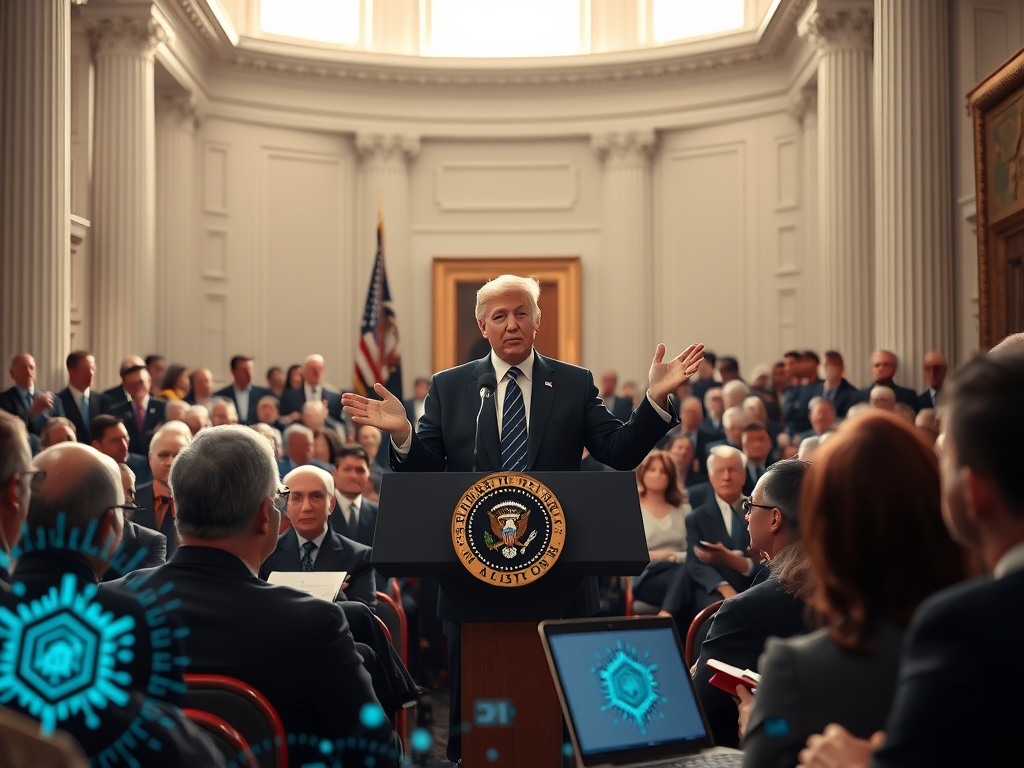

In July, David Sacks, a prominent technology figure within the Trump administration, walked confidently onto the stage of a neoclassical auditorium just steps from the White House. The occasion was a high-profile forum dedicated to the rapidly expanding artificial intelligence sector, an event that brought together senior government officials and top executives from Silicon Valley.
The centerpiece of the gathering was President Trump, who introduced a new “A.I. Action Plan,” a policy blueprint shaped in part by Sacks, who has long been active in the venture capital world. During his nearly hourlong remarks, the president emphasized that artificial intelligence represented one of the most transformative technological shifts in modern history. After the speech, he signed a series of executive orders designed to accelerate the development and deployment of AI technologies nationwide.

Many in the audience—including leaders from Nvidia, AMD, and numerous entrepreneurs connected to Sacks—stood to benefit directly from the administration’s fast-moving approach. Sacks himself was among those positioned to gain from the initiatives he helped design.
Since January, the 53-year-old has held a uniquely influential role as an unpaid special government employee overseeing AI and cryptocurrency policy, while simultaneously maintaining his career as an investor in Silicon Valley. This dual position has enabled him to shape federal policy in ways that often align with the interests of the industry—and, in some cases, with his own extensive investment portfolio.
Sacks pushed to remove regulatory burdens for AI companies and facilitated unprecedented White House access for industry leaders. These efforts helped position major firms like Nvidia to secure tens of billions of dollars in potential new sales. At times, he also advanced positions that conflicted with national security advice, raising concerns among some administration officials.
His financial disclosures show at least 708 investments, including 449 with direct or indirect ties to artificial intelligence. While many of those companies describe themselves as AI-focused, Sacks listed hundreds under generic labels such as software or hardware. His involvement has also boosted the popularity of his weekly podcast, “All-In,” which he co-hosts with other well-known tech investors.

The ethical tensions surrounding his role came into sharp focus during the July AI summit. Early planning documents indicated that Sacks initially sought for the “All-In” podcast to serve as the event’s exclusive host, with proposed sponsorship packages costing up to $1 million each for premium access to private sessions. Concerned that the arrangement blurred the boundary between government activities and private business interests, White House Chief of Staff Susie Wiles intervened, ensuring the event had additional institutional partners.
Critics, including former Trump adviser Steve Bannon, argued that Sacks represented a broader problem of blurred lines between political authority and Silicon Valley influence. The White House, however, defended Sacks, describing his expertise as essential to America’s technological competitiveness.
Sacks arrived at the center of national technological policymaking after a long trajectory through Silicon Valley. A Stanford graduate, he became part of the early PayPal team alongside Peter Thiel and Elon Musk. Following PayPal’s acquisition by eBay in 2002, he launched and invested in numerous ventures, many of them intertwined with his Silicon Valley peers. His venture capital firm, Craft Ventures, founded in 2017, now holds hundreds of investments across the tech sector. He later launched the “All-In” podcast with friends and colleagues.
His political profile rose sharply in 2022, when he began supporting Republican candidates financially. Last year, he hosted a major fundraiser for Trump at his San Francisco home, an event that the former president himself later praised. Shortly after the election, Trump invited Sacks to join the administration, granting him the dual-role arrangement he had requested.

One of Sacks’s most consequential alliances is with Nvidia CEO Jensen Huang. The two men developed a close relationship after Sacks joined the administration. Nvidia sought permission to expand global sales of its AI chips despite concerns that widespread distribution could strengthen China’s technological capabilities. Sacks helped promote the idea that limiting exports would only encourage China to develop competing hardware. Eventually, the administration allowed Nvidia to sell directly to China, a move projected to generate massive revenue.
Sacks also facilitated a major U.S. chip sale to the United Arab Emirates, a deal that sparked concern inside the White House over the potential for sensitive technologies to reach Chinese partners. Even so, the agreement was celebrated in the tech world as a major win.
While Sacks received ethics waivers and claims to have sold more than 99 percent of assets that might raise concerns, he continues to hold hundreds of AI- and crypto-related stakes. Many of the companies in which he maintains positions operate in sectors directly affected by policies he helped craft. For example, the AI Action Plan encourages expanded use of autonomous defense technologies. Sacks has investments in firms such as Anduril, Firestorm Labs, and Swarm Aero, all of which build advanced AI-driven defense tools and have since secured major government contracts.
Sacks has also championed cryptocurrency legislation, including the GENIUS Act, which set regulatory frameworks for stablecoins. The bill’s passage created momentum in the digital asset space. BitGo, a major Craft Ventures investment, quickly positioned itself to benefit and has since filed for a public offering.

Throughout his time in government, new investments involving Craft Ventures have continued to be announced, including funding rounds for AI firms with ties to Sacks. His “All-In” podcast has also flourished, attracting millions of monthly downloads and generating significant revenue through live events and branded merchandise.
The intersection of his government work, business interests, and media presence reached a peak during the July AI forum. Although “All-In” did not serve as the sole host, its presence was highly visible, with Sacks’s co-hosts conducting onstage interviews with top officials and industry leaders.
President Trump, during his keynote address, praised Sacks before signing executive orders aimed at expanding AI research and infrastructure. As the audience applauded, the president handed Sacks the ceremonial pen—an unmistakable symbol of his influence at the center of America’s AI policy agenda.




Leave a Reply