
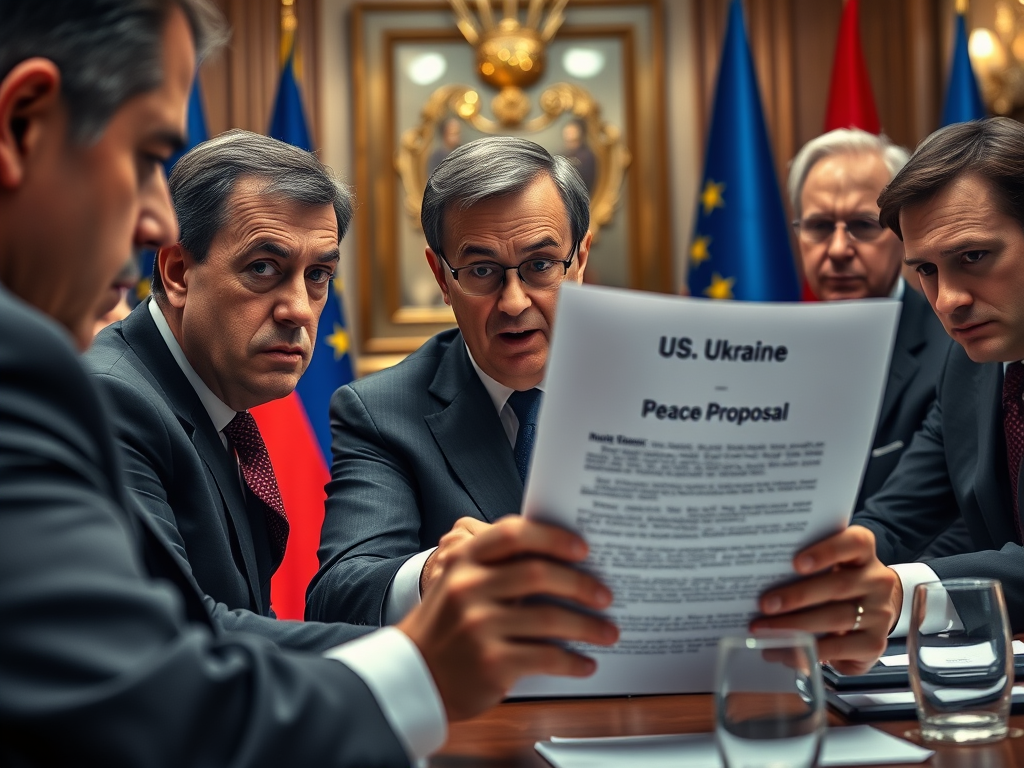

When German Chancellor Friedrich Merz first became aware of the Trump administration’s proposed peace framework for Ukraine last Thursday, he was taken aback not only by the substance of the plan but also by the surprising way he learned of it. Instead of receiving advance notice through diplomatic channels, he discovered the proposal through a news headline. His staff quickly attempted to secure a call with President Trump, eventually managing to speak with him late Friday, according to officials familiar with the episode.
From a European standpoint, the contents of the leaked 28-point proposal were deeply unsettling. The plan, according to reports, would allow Russia to retain more territory than it had managed to seize on the battlefield since the 2022 invasion. It would effectively shield Moscow from significant consequences, and it sought to bar NATO from ever admitting Ukraine into the alliance—directly contradicting longstanding European efforts to support Kyiv’s path toward membership.
European governments had long suspected that Washington was crafting a proposal related to the war. But none anticipated a plan that tilted so heavily toward Russian interests. When the details surfaced, it became clear that Europe had been excluded from key consultations regarding the future of the continent’s most consequential conflict since World War II.
Interviews with 16 officials involved in the diplomatic fallout reveal a portrait of a continent caught between global forces, struggling to maintain influence in decisions overwhelmingly impacting its own security. Most spoke anonymously due to the political sensitivities involved.
In the days that followed the leak, European leaders—Merz among them—moved with urgency to regain footing. They lobbied, negotiated privately, and recalibrated their strategy in hopes of softening what they viewed as the harshest elements of the U.S. proposal. Diplomatic schedules were abruptly reshuffled. Several officials cut short G20 engagements in Johannesburg and boarded the earliest available flights to Geneva, aiming to confront American diplomats directly.
By late Sunday, the coordinated European push had succeeded in blunting parts of the original plan, though many structural issues remained unresolved. Former NATO Secretary General Anders Fogh Rasmussen noted that Europe, after being sidelined, transformed itself “from a coalition of the willing into a coalition of the waiting.” The episode, he suggested, served as a wake-up call. “Europeans now understand they must take on a much larger role.”
Thursday: A Wave of Shock Across Europe
The proposal first reached many European foreign ministers on Thursday morning in Brussels, where they were gathering for a long-scheduled meeting that included discussions on Sudan and Ukraine. Reports from outlets including The Financial Times and Axios caught ministers completely off guard.
The leaked document suggested sweeping restrictions on NATO’s presence in a postwar Ukraine, undermining Anglo-French notions of potentially deploying peacekeepers. It also proposed the release of billions of dollars in frozen Russian assets—funds that many European policymakers hoped to redirect as loans to Ukraine.
“When everyone had arrived, having read the news, the questions began immediately,” Danish Foreign Minister Lars Lokke Rasmussen said with characteristic understatement.
Seeking clarity, the ministers turned to Ukrainian Foreign Minister Andrii Sybiha, who joined the meeting virtually. But Sybiha, too, had limited new information, according to officials in the room.
Back in Berlin, Chancellor Merz abruptly canceled a scheduled visit to an elementary school, choosing instead to address the diplomatic reverberations. His team questioned whether President Trump was even aware of the full implications of the document or whether it reflected broader U.S. policy.

By Friday, any ambiguity began to fade. U.S. Army Secretary Daniel P. Driscoll told attendees at a meeting in Ukraine that European governments were excluded from the talks to avoid having “too many cooks.” Several officials recalled Driscoll’s argument that European policymakers were too emotionally or politically intertwined with Kyiv to evaluate the war objectively.
This created an immediate dilemma for Europe. Rejecting the plan outright could alienate Washington and eliminate their influence over negotiations. But engaging with it risked legitimizing its most problematic components.
Ukrainian President Volodymyr Zelensky acknowledged this tension in a national address. Ukraine, he warned, might soon face a painful decision: “the loss of dignity or the risk of losing a key partner.”
Saturday: Europe Searches for Leverage
During the next 24 hours, European diplomats were in continuous communication, attempting to coordinate their position. By the time European leaders convened at the G20 summit in South Africa on Saturday, they had reached an uncomfortable consensus. To remain relevant in shaping the peace process, they had to engage directly with Washington—and present a unified message.

European Council President António Costa, who convenes discussions among EU heads of state and government, and European Commission President Ursula von der Leyen had just spoken with President Zelensky. They learned that Kyiv was already communicating with Trump’s team and concluded Europe had to act quickly.
Under the bright lights of a makeshift meeting room, leaders began outlining core principles they believed should guide any settlement: Europe’s borders cannot be amended by force, Ukraine must not face restrictions on its defensive capabilities, and NATO must retain control over decisions affecting the alliance. These stances stood in stark contrast to several points in the U.S. draft.
Rather than openly confront Washington, the European leaders opted for strategic diplomacy. They released a statement expressing appreciation for U.S. efforts while carefully positioning the draft agreement as merely a starting point that “would require additional work.”
To influence the upcoming discussions in Geneva, two senior EU diplomats—Bjoern Seibert and Pedro Lourtie—left the meeting within minutes of the statement’s release. They boarded the first flight available from Johannesburg to Switzerland, joining envoys from Britain, France, Germany, and Italy.
Sunday: A Hard-Won Opening in Geneva
On Sunday, Europe remained anxious and uncertain. Representatives from several European nations gathered at Germany’s mission in Geneva, coordinating their approach and comparing notes with Ukrainian officials.
Their persistence finally yielded progress. Late that afternoon, U.S. Secretary of State Marco Rubio met privately with European diplomats. According to officials familiar with the meeting, Rubio indicated that provisions affecting European countries would be removed from ongoing discussions. Issues specific to Europe or NATO would instead be handled separately—a significant shift showing that European concerns had been heard.

Rubio underscored this new tone during a briefing with reporters, calling the proposal “a living, breathing document” and affirming that European governments would have input on matters directly concerning them.
The mood in Brussels brightened slightly. Seibert and Lourtie held a late-night call with ambassadors from the 27-nation bloc, providing an optimistic assessment of the day’s developments.
By Monday, German Foreign Minister Johann Wadephul described the weekend’s diplomacy as a meaningful win for Europe.
Still, the united front began to fray as leaders regrouped. Contentious debates over how to finance Ukraine’s needs in 2026 resurfaced. Doubts persisted about whether the United States would keep Europe consistently informed. Meanwhile, Russia publicly signaled its dissatisfaction with the direction of the talks.
Polish Prime Minister Donald Tusk captured the mood succinctly: “There is little reason for cheerful optimism.” The situation, he added, “is delicate, because nobody wants to discourage the Americans or President Trump from ensuring that the United States remains on our side.”




Leave a Reply