
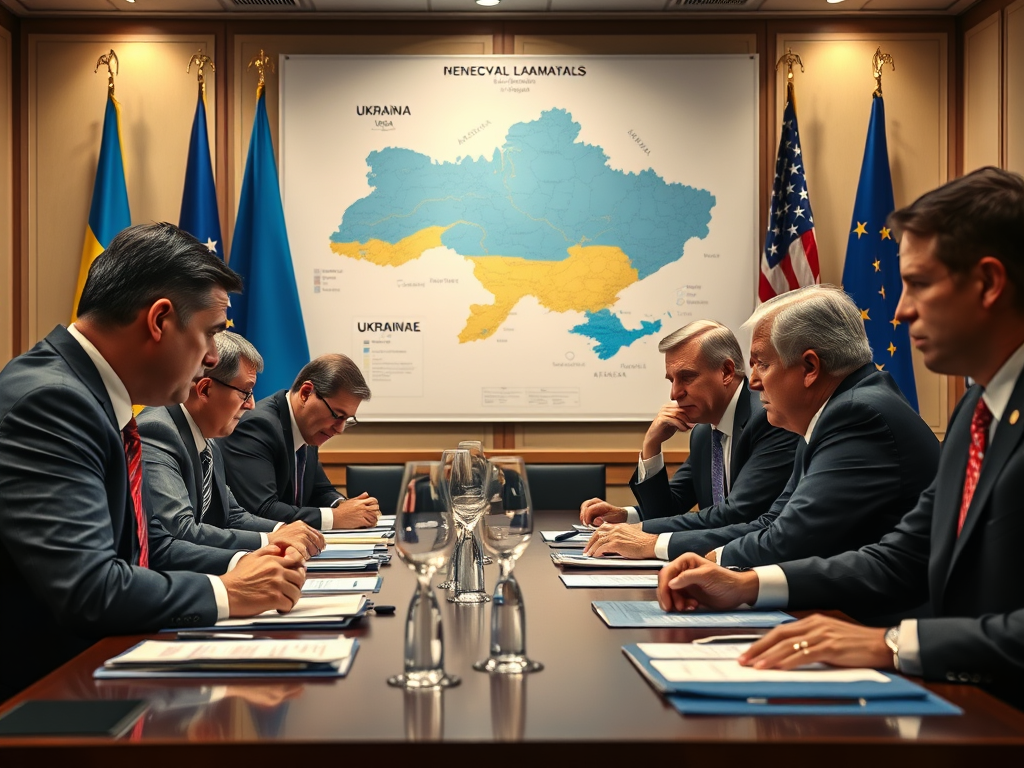

Ukrainian and American officials signaled on Sunday that they had made meaningful progress during high-stakes negotiations over a controversial U.S. proposal intended to end the war with Russia. Their cautiously upbeat assessment contrasted sharply with President Trump’s latest public attack on Kyiv, in which he accused Ukrainian leaders of failing to show gratitude for Washington’s support.
The discussions, held in Geneva, centered on a 28-point peace framework drafted by the United States. The early version of the plan drew backlash across Ukraine, where many viewed its concessions to longstanding Russian demands as a diplomatic surrender. Nevertheless, both delegations reported that the weekend talks helped narrow disagreements.
In a joint statement released after the initial round of negotiations, the United States and Ukraine said they had achieved “substantial progress” and had worked together to refine the structure of the peace framework. The statement emphasized that any eventual agreement must preserve Ukraine’s sovereignty and yield a peace that is both durable and just. Both sides agreed to continue intensive consultations in the days ahead.
Speaking earlier in the day, U.S. officials described a methodical process in which both teams evaluated the proposal item by item. One American participant, Senator Marco Rubio, said negotiators were making steady adjustments and “narrowing the differences,” adding that he was optimistic that the two countries could arrive at a proposal acceptable to both Washington and Kyiv. Rubio noted, however, that Russia would ultimately need to approve any agreement, as no peace initiative could succeed without Moscow’s assent.
Andriy Yermak, who leads Ukraine’s negotiating team, echoed the sentiment of progress. He told reporters that the talks had been constructive and would continue through the upcoming week.
Despite these encouraging statements, a cloud hung over the diplomatic effort due to an extended social media post by President Trump criticizing Ukraine and several European allies who have historically supported Kyiv. Trump accused Ukrainian leaders of showing “zero gratitude” for the assistance they have received and faulted European nations for continuing to purchase Russian energy. He also repeated an assertion he has made before—that the war would never have erupted had Ukraine possessed “strong and proper” leadership.
The president has previously made similar claims, including during a tense meeting with Ukrainian President Volodymyr Zelensky in the Oval Office earlier this year, when he reproached Zelensky for not expressing sufficient appreciation. Since then, Ukrainian officials have gone to lengths to reiterate their thanks for U.S. support.
Zelensky did so again on Sunday, issuing several statements shortly after Trump’s remarks. He welcomed the “substantive conversations” taking place in Geneva and indirectly responded to Trump’s criticism by underscoring that Russia alone bears responsibility for the war. He also repeated Kyiv’s gratitude for the United States and for Trump’s role in ongoing security efforts.
As the U.S.-Ukraine talks advance, European leaders have stepped in to underscore their continued backing of Ukraine and to voice concerns about parts of the American proposal. Several European countries sent representatives to Geneva to engage in the discussions and to ensure that the emerging peace framework aligns with broader European security interests. The joint U.S.-Ukraine statement acknowledged this involvement, noting that both parties would remain in close coordination with European partners as negotiations move forward.
A leaked version of the U.S. peace plan that surfaced online last week heightened European and Ukrainian unease, as it contained provisions that Kyiv has long rejected. These included ceding territory to Russia and imposing strict limits on the size and capability of Ukraine’s armed forces. In response, the leaders of France, Germany, Britain, and several other nations issued a collective call urging adjustments to the most controversial points.
European Commission President Ursula von der Leyen reinforced this position on Sunday. She stated that imposing restrictions on Ukraine’s military capacity would leave the country vulnerable to future aggression and would threaten the stability of Europe as a whole.
So far, the Kremlin has not publicly commented on the Geneva meetings or on the evolving U.S. proposals. American officials have said that preparations are underway for separate U.S.-Russia discussions.
Multiple diplomatic engagements are expected in the week ahead. Turkish President Recep Tayyip Erdogan, who has previously sought to mediate between Kyiv and Moscow, said he plans to speak with Russian President Vladimir Putin about the peace efforts. French President Emmanuel Macron also hinted that a forthcoming meeting involving leaders from Britain, Canada, and other allied nations is scheduled for Tuesday.
President Trump has imposed a Thursday deadline for Ukraine to respond to the peace plan, though he indicated he may extend the date if negotiators continue making productive progress.
Behind the scenes, U.S. and Ukrainian officials had already been informally revisiting portions of the 28-point plan before the Geneva meeting. According to one Western official familiar with the matter, the version currently under discussion now differs significantly from the draft circulated online by a Ukrainian lawmaker. However, uncertainty and confusion persist among some American legislators regarding the origins of the initial proposal. A group of U.S. senators said Senator Rubio told them the document floating online was not the administration’s official plan but rather a list of Russian preferences.
The State Department quickly rejected that claim, calling it “blatantly false.” Rubio also dismissed the senators’ interpretation, clarifying on social media that the peace plan was authored by the United States. He explained that the proposal was informed by input from both Russian and Ukrainian sources, as well as prior diplomatic exchanges with Kyiv.

He stressed that the document should be seen not as a final settlement, but as a “strong framework” to guide ongoing negotiations.
As talks continue this week, officials across capitals—Washington, Kyiv, Brussels, Ankara, and Moscow—are preparing for an intense period of diplomacy. Whether these efforts will bring Ukraine and Russia closer to a negotiated end to the war remains uncertain. But for the moment, both Ukraine and the United States are signaling that progress, however fragile, is finally within reach.




Leave a Reply