
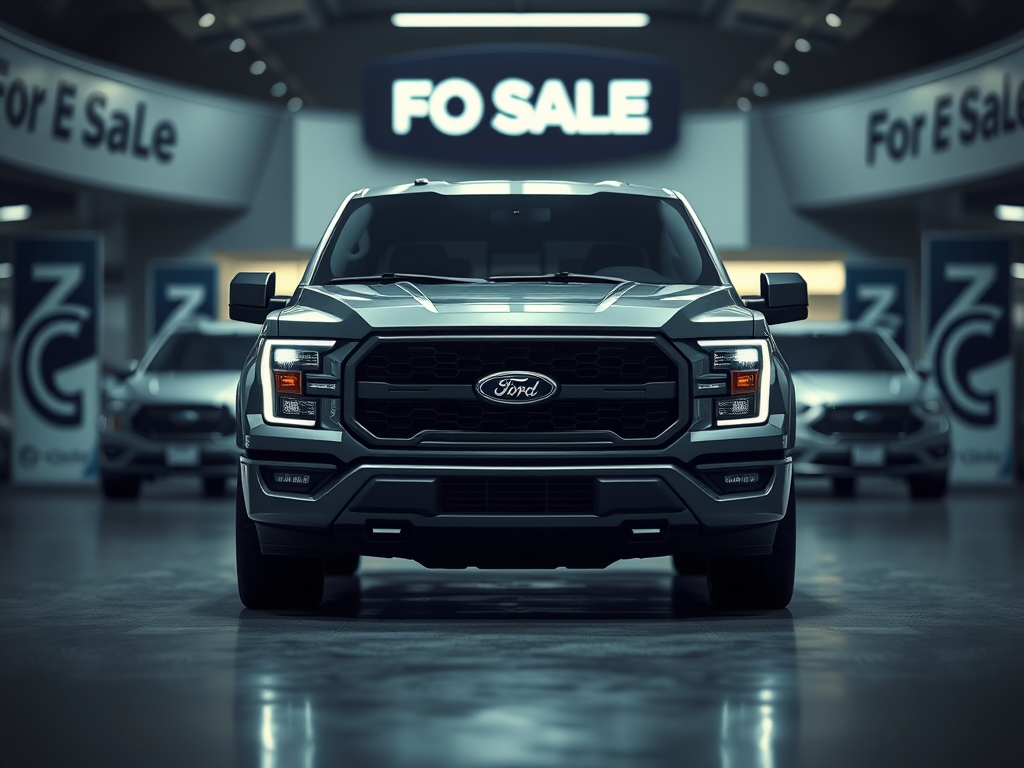

In recent years, Ford Motor Company believed it had a breakthrough product on its hands: the F-150 Lightning, an all-electric version of America’s best-selling pickup. But a rapid shift in U.S. policy and consumer behavior has dramatically altered the electric vehicle landscape, leaving the once-promising model facing an uncertain future.
The turning point came at the end of September, when Congress and President Trump ended federal tax credits for electric vehicle purchases. Without those financial incentives, sales of electric models — especially the larger and more expensive ones — plummeted. The F-150 Lightning, which starts at roughly $55,000 and can surpass $85,000 with premium upgrades, was hit particularly hard.
Ford has since halted production of the Lightning and has not indicated when, or if, it will resume. This pause reflects a broader industry transformation that is reshaping consumer preferences and automaker strategies across the United States.
For much of the past decade, the electric vehicle market was dominated by high-priced luxury models. Vehicles such as the Tesla Model S, the GMC Hummer EV, and the Porsche Taycan often sold for upwards of $80,000, appealing mainly to affluent early adopters. That momentum has sharply reversed. Sales of luxury EVs have stalled, while demand has increased for more affordable options like the Chevrolet Equinox EV and Hyundai Ioniq 5, which start around $35,000.
Dealers have seen the shift firsthand. “When the subsidy went away, the higher-dollar vehicles really began to slow down,” said Tim Hovik, the owner of San Tan Ford in Gilbert, Arizona, which once sold dozens of Lightnings each month.
The slowdown is not limited to Ford. General Motors has suspended production of the Hummer EV and scaled back output of its electric Cadillac models. When its Michigan factory reopens in January, it will operate at half its previous capacity. G.M. Chief Executive Mary T. Barra recently told investors that the true level of EV demand may not become clear until early next year.
Tesla has also reduced production of its higher-end vehicles, including the Model S, Model X, and the Cybertruck. Honda has discontinued the electric Acura ZDX, while Stellantis canceled its electric Ram pickup before it even reached showrooms.
Rivian, another major EV contender known for its premium electric trucks and SUVs, is slowing output as it prepares to introduce a more affordable model expected next year. The company recently laid off about 600 employees and reported a $1.2 billion loss in the third quarter.

European automakers are adjusting their strategies as well, responding to weakening demand and new U.S. import tariffs. Mercedes-Benz has stopped importing several electric sedans and SUVs. Volkswagen has slowed production of the ID.Buzz, its upscale electric van built in Germany. Porsche, meanwhile, paused development on several upcoming electric models and is channeling more investment back into gasoline-powered cars — a pivot that contributed to an operating loss of nearly one billion euros in the third quarter.
Volkswagen and Porsche Chief Executive Oliver Blume acknowledged the shift, noting that demand for “exclusive battery electric cars” has noticeably weakened.
For many traditional automakers, the cooling of the electric luxury market carries a silver lining. Aside from Tesla, most companies have been losing money on EVs, with the biggest losses concentrated in their most expensive models. Lower sales, ironically, may help reduce those financial pressures.
According to J.D. Power, U.S. electric vehicle sales fell about 33 percent in October from a year earlier, totaling 64,500 units. The Lightning’s sales dropped 12 percent to 1,543 units. Acura sold just 25 ZDX SUVs, compared with more than 1,200 in the same month last year.
Jessica Caldwell, vice president of insights at Edmunds, said that while many assumed the luxury EV market would continue to grow, industry shifts had proven otherwise. Leasing incentives, once a major driver of high-end EV purchases, have also weakened. The value of used electric cars has dropped sharply, increasing the cost of new leases and discouraging buyers. At Mr. Hovik’s Ford dealership, roughly 75 percent of EVs were leased, and without strong lease programs, the cost quickly became prohibitive for many customers.
Dealers nationwide are sitting on growing inventories of unsold premium EVs. Mercedes is offering discounts of $10,000 or more on several models and as much as $50,000 off the Maybach EQS, which starts around $180,000. Some of these price cuts attempt to attract buyers who were previously deterred by soaring sticker prices.
The trend toward more affordable EVs has opened the door for cost-conscious consumers. A growing list of electric models now starts below $40,000. Nissan and General Motors recently released new versions of the Leaf and Chevrolet Bolt priced under $30,000, signaling a strategic shift toward accessible electrification.
As for the F-150 Lightning, it debuted in 2022 as a milestone in the EV industry — a fully electric version of the nation’s most popular vehicle. Ford built a dedicated assembly line near Detroit and initially projected annual sales of 150,000 units. Demand was so strong that the company ramped up production in 2023. But rising manufacturing costs forced Ford to raise prices, dimming consumer enthusiasm. The company ultimately sold 33,000 Lightnings in 2024.
A major supply chain issue also influenced Ford’s decision to halt production: a fire at a supplier plant that produced aluminum for the F-150 lineup. With limited aluminum available, Ford prioritized its gasoline-powered models, which continue to sell significantly better.
A Ford spokeswoman said the company has a sufficient inventory of Lightnings while the supplier recovers, and for now, production is focused on gas and hybrid versions of the F-150.
Though Ford has avoided committing to a relaunch of the Lightning, executives have emphasized that new, more affordable electric models are in development. The first will be a smaller electric pickup expected to debut in 2027, with a starting price near $30,000 — a clear reflection of where the EV market is heading.
As the industry recalibrates, it is becoming evident that the future of electric vehicles in the United States will likely be driven not by luxury models, but by practical, cost-effective options that meet the needs of the broader market.




Leave a Reply