
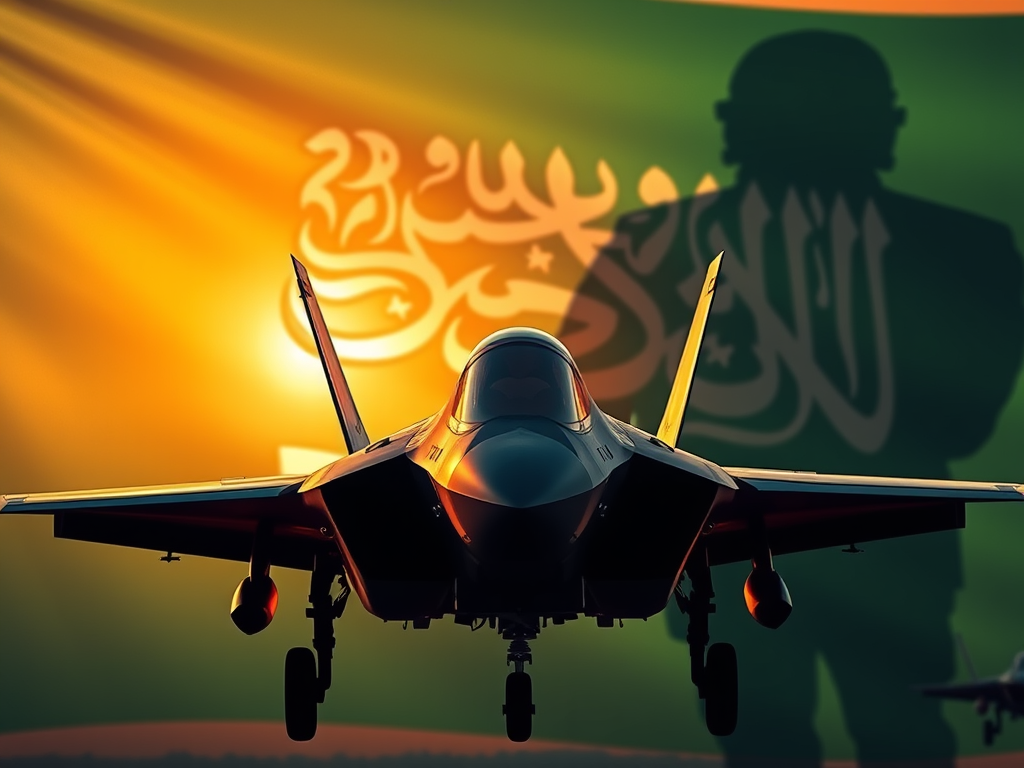

As the Trump administration moves to finalize a deal to sell advanced F-35 fighter jets to Saudi Arabia, a Pentagon intelligence report has raised alarms that China could gain access to the jet’s sensitive technology if the sale proceeds, according to sources familiar with the assessment.
Officials within the Department of Defense have expressed concerns that F-35 technology could be compromised through Chinese espionage or via China’s security partnership with Saudi Arabia, the sources said. These potential risks were outlined in a comprehensive report compiled by the Defense Intelligence Agency, part of the Pentagon.
The proposed agreement would see U.S. defense contractors sell 48 F-35 jets to Saudi Arabia for billions of dollars. Defense Secretary Pete Hegseth was expected to approve the deal before it moved through an interagency review process, the sources indicated.
Crown Prince Mohammed bin Salman, the kingdom’s de facto leader, is scheduled to meet with President Trump at the White House, with the potential F-35 sale and a mutual defense agreement at the top of the agenda. Saudi Arabia is the largest purchaser of American weapons.
Prince Khalid bin Salman, Saudi Arabia’s defense minister, noted on social media that he recently met with Hegseth, Secretary of State Marco Rubio, and Middle East envoy Steve Witkoff. “We reviewed the Saudi-U.S. relationship and explored ways to strengthen our strategic cooperation,” he stated.
The Defense Intelligence Agency declined to comment on its report regarding the F-35 sale, and the Saudi embassy in Washington did not respond to requests for comment. The White House said, “We will not get ahead of the president on conversations that are occurring ahead of time.”
In addition to military concerns, Prince Mohammed and his aides have pressed the United States to advance discussions on assisting Saudi Arabia in developing a civilian nuclear program. U.S. officials are cautious, as such technology could potentially be diverted toward nuclear weapons development.
Efforts by both the Trump and Biden administrations to encourage Saudi Arabia to normalize relations with Israel have yet to succeed. High casualties in the Israel-Hamas conflict and the Israeli government’s far-right policies toward Palestinians make progress unlikely in the near term.
Beyond the risk of Chinese access to F-35 technology, U.S. officials are also weighing the impact of the sale on Israel’s regional military superiority. Israel remains the only country in the Middle East with operational F-35 jets and has used them for airstrikes in Iran in October 2024 and June 2025.
Since the 1973 Arab-Israeli war, U.S. policy has aimed to preserve Israel’s “qualitative military edge.” Previous administrations conducted lengthy, highly classified interagency reviews before approving weapons sales to the region. Congress has emphasized that the United States must ensure Israel can overcome any credible conventional military threat while minimizing damage and casualties.
In 2020, the Trump administration initially approved F-35 sales to the United Arab Emirates as part of the Abraham Accords, which sought normalization with Israel. However, concerns arose over China’s partnership with the UAE and the potential erosion of Israel’s military advantage. The Biden administration suspended the sale in 2021, requesting additional safeguards, including kill switches for the jets, which Emirati officials considered too restrictive, causing the deal to collapse.
Similar concerns are now being raised with Saudi Arabia. U.S. officials are evaluating whether to impose restrictions or safeguards on F-35 technology, although it remains unclear which measures would be formalized in the final agreement.
China and Saudi Arabia maintain some military cooperation. China has assisted Saudi Arabia in developing ballistic missile capabilities, including more advanced models, and in operating these systems. U.S. officials have warned that Saudi Arabia has purchased Chinese missiles capable of longer-range strikes and has acquired the technology to produce components domestically. Satellite imagery has confirmed missile test sites in Saudi Arabia modeled after Chinese designs.
For Saudi Arabia, acquiring the F-35 would represent a significant upgrade in stealth and battlefield awareness, allowing pilots to operate in complex combat scenarios beyond the capabilities of the current fleet, defense analysts said. Gareth Jennings, aviation editor at Janes, a defense intelligence firm, described the F-35 as “the pinnacle of Western combat aviation in both capabilities and prestige.”
The jet’s capabilities were evident during Israel’s 12-day conflict with Iran in June, where the F-35 enabled Israeli forces to target Iranian air defenses, allowing older jets to operate with minimal risk and contributing substantially to Israel’s operational success.
President Trump has frequently highlighted his administration’s arms deals with Saudi Arabia. During his visit to the kingdom in May, the White House announced $600 billion in agreements with Saudi entities, including $142 billion in arms sales, although some commercial projects were already underway before his presidency.




Leave a Reply