
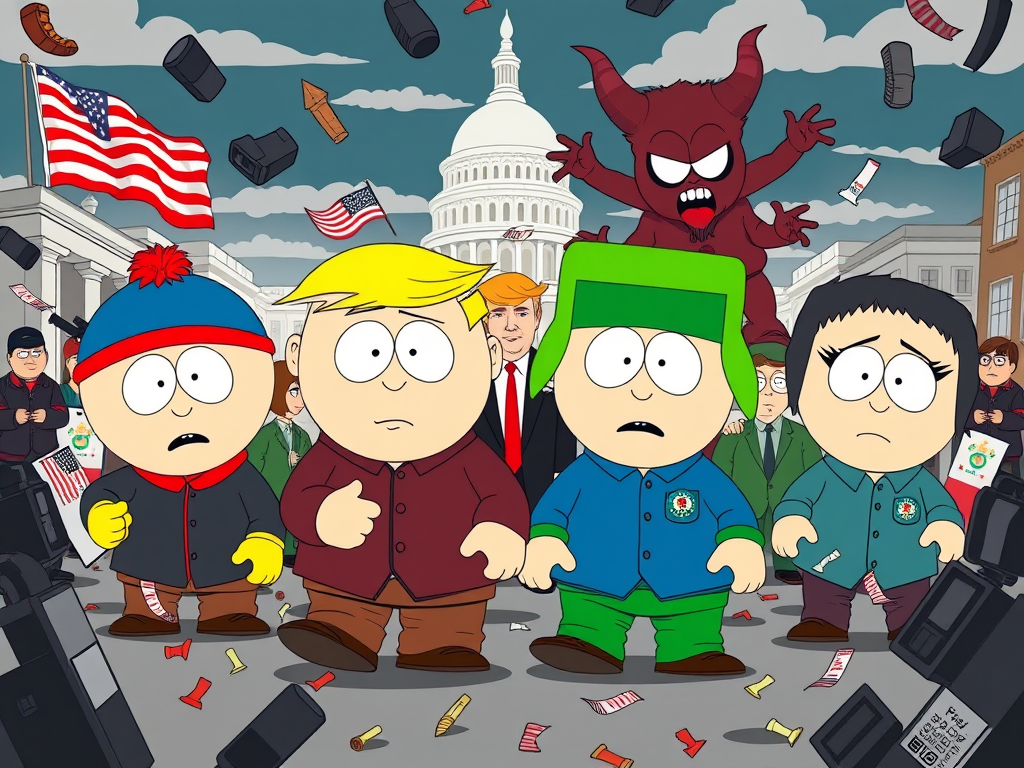

For decades, the animated series “South Park” has thrived on outrageous humor, cultural irreverence, and razor-sharp satire. But as the new season took shape this summer, creators Matt Stone and Trey Parker found themselves drawn into a political landscape that seemed impossible to avoid. With former President Donald Trump dominating headlines, media cycles, and pop-culture conversations, the pair saw little choice but to make politics — and particularly the MAGA movement — central to the show’s direction.
As Parker put it recently, it was not that the series suddenly shifted toward political commentary; rather, the political world had fully merged with mainstream culture. And in the creators’ world, cultural flashpoints — especially uncomfortable ones — are irresistible targets.
Stone echoed that sentiment, noting that the tension and newly-formed taboos around criticizing the Trump era felt like creative fuel. Where many felt reluctant to speak out, he and Parker instinctively leaned in. That impulse guided the tone of the season, leading to an unapologetically direct lampooning of Trump and his circle — a bold direction for a show originally known for kids causing absurd trouble in small-town Colorado.
The result? A surge in viewership and a renewed cultural footprint. According to Nielsen data, ratings in the past four months have more than doubled compared to 2023 — the last time the show aired new episodes. Online fan chatter resurged, media outlets tracked episode scheduling shifts, and “South Park” once again became a consistent reference point in late-night discussions and social commentary.
This burst of attention coincided with major shake-ups in the media world. Paramount, the parent company of Comedy Central, underwent ownership changes that many observers believed were friendly toward Trump’s camp. During the same period, the industry saw surprising moves such as the cancellation of Stephen Colbert’s late-night program and a temporary halt to Jimmy Kimmel’s show, reportedly influenced by pressure linked to Trump administration figures. In such an environment, “South Park’s” renewed political energy landed like a cultural lightning strike.
Doug Herzog, a former Viacom executive, said the timing produced an ideal storm. With the political climate intensifying and entertainment companies making dramatic programming decisions, “South Park” stepped into the vacuum in a way only it could.
Despite the new-season energy, the familiar faces of Cartman, Stan, Kyle, and Kenny remain, continuing to stumble across — and crash directly into — the chaos spilling out of Washington, D.C. One central storyline this season involves a devilish twist: Trump expecting a baby with cartoon Satan, a callback to classic seasons where villains like Saddam Hussein shared screen space with the underworld.

The political satire emerged almost spontaneously. Parker and Stone originally didn’t plan for the season to revolve entirely around Trump, they said. But as they developed the first episodes, they realized the storyline offered a comedic vein too rich to ignore. Their creative philosophy — start with an idea and let the narrative grow organically — guided them deeper into political territory.
Behind the scenes, the pair were simultaneously finalizing a massive five-year, $1.25-billion deal with Paramount. Rumors swirled that the merger between Paramount and Skydance — which required approval from the Trump administration — was delaying the agreement. Feeling constrained by speculation, the creators decided to assert their independence from potential political influence by tackling Trump directly in the season’s opening episode. The episode launched shortly after their contract was signed, delivering biting satire aimed not only at the former president but also at Paramount’s leadership and the broader entertainment industry.
Some critics questioned whether the show’s political edge signaled a long-term ideological shift. Historically, “South Park” has been known as an equal-opportunity offender, merciless toward both left and right. The creators insist that remains true. In recent years, they poked fun at progressive movements, and now the pendulum has swung toward conservative politics — not out of allegiance, but simply because, in their eyes, the most extreme voices are currently dominating public discourse.

To Parker and Stone, political life has spilled so far into entertainment, online discourse, and everyday culture that escaping it would be both unrealistic and comedically limiting. The internet, podcasting platforms, TikTok feeds, and livestreams continually amplify political commentary, making it difficult for satire to remain purely fictional. As Parker described it, government — and reactions to government — feels omnipresent, no matter where one looks.
“South Park” remains as fast-paced in production as ever. Episodes addressing real-time news events — including recent White House developments and a federal government shutdown — aired almost immediately after the headlines broke. This responsiveness has long been a signature of the show, but the stakes feel higher now in an environment where politics shifts at breakneck speed.
Interestingly, despite speculation that Paramount’s new leadership or Skydance’s influence might limit political themes, Stone said the studio has not interfered. Instead, executives have allowed the writers to pursue their ideas freely.
Audience response has been polarized — in true “South Park” fashion. Stone, speaking from New York, described being stopped frequently by people praising the new episodes, many of whom would not normally count themselves as fans. Parker, meanwhile, noted that in his Colorado bubble, fans frequently ask when the show will return to the old dynamic and lighten up on politics.

Both men laugh about the divide, joking that the show has entered a “disco era,” unexpected and flamboyant but entirely fitting for the moment. They predict that eventually they will tire of Washington, Trump-related humor, and political characters, but for now, the storyline still offers creative momentum.
And one thing they seem certain about: political cycles may change, but “South Park” will outlast them.
In Parker’s words, the show simply needs to follow this path for the moment. The cultural energy, the taboos, and the audience attention are all here — and as long as politics continues to bleed into entertainment, “South Park” intends to meet the moment the only way it knows how: by laughing at everything, loudly and without hesitation.




Leave a Reply