
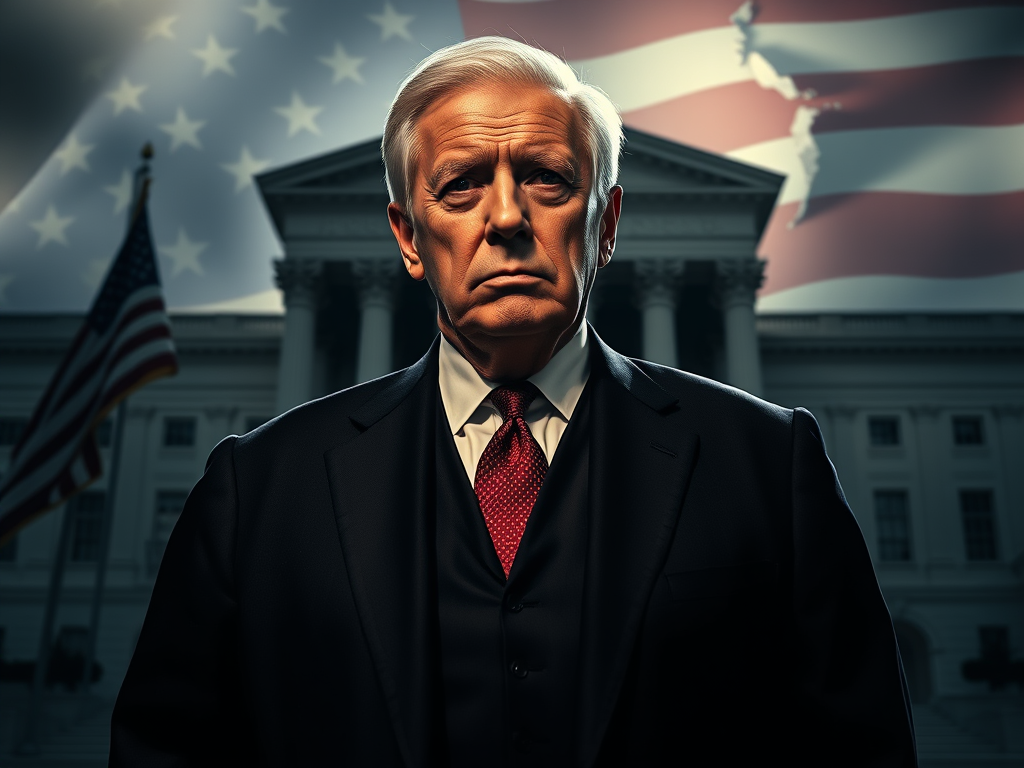

A former federal judge has delivered a stark public warning about the future of American democracy, saying he left the judiciary so he could freely voice his concerns about President Donald Trump’s approach to power and the rule of law. In a deeply personal essay published Sunday, Mark L. Wolf argued that the United States is facing an “existential threat” to its democratic foundations, accusing the president of weaponizing the legal system to advance partisan interests and punish opponents.
Wolf, 78, is no newcomer to the federal system. Appointed by President Ronald Reagan and a longtime Justice Department official who served during the Ford administration, he wrote that President Trump’s actions contradict the principles he spent more than five decades defending in public service. According to Wolf, the administration’s behavior threatens the independence of the judiciary, a cornerstone of democratic institutions.
His piece was released just days after the Federal District Court for Massachusetts announced his departure from his senior-status role, a form of semi-retirement he entered in 2014. Wolf explained that stepping down completely was essential for him to speak without restraints — both on his own behalf and on behalf of judges still serving on the bench who feel unable to comment publicly.
“I hope to be a spokesperson for embattled judges who, bound by the judicial code of conduct, cannot speak candidly to the American people,” Wolf said in a phone interview. He suggested that many judges have watched recent events with alarm but have remained silent due to professional restrictions that prohibit political statements or comments that could undermine confidence in judicial impartiality.
Over the last several years, the judiciary has frequently been at the center of political conflict. Lower courts have blocked a number of Trump administration initiatives, prompting harsh backlash from administration officials and conservative allies, who have accused judges of partisan interference. Some have even suggested impeaching federal judges who stand in the administration’s way.
At the same time, emergency decisions issued by the Supreme Court — often without full written opinions and part of what has become known as the “shadow docket” — have repeatedly reversed or sidelined lower court rulings. These fast-tracked decisions have amplified tensions between the judiciary and the executive branch. In response to a New York Times survey, dozens of federal judges, including some appointed by Trump, expressed concern about the growing use of emergency rulings and their impact on legal norms.
Wolf himself addressed these worries in his essay, noting that several judges have quietly raised similar objections behind closed doors, fearing potential consequences if they speak out publicly. His departure from the bench, he said, allows him to say openly what many feel privately.
The reaction from the White House was swift and sharp. A spokesperson criticized judges who “inject their own personal agenda into the law,” insisting that such individuals should not serve on the bench. Trump-aligned legal voices echoed this sentiment, arguing that jurists who take public political positions should resign — and in Wolf’s case, encouraging others who hold similar views to follow suit.
Wolf’s long legal career has made him a notable voice on matters of judicial ethics and government accountability. As chief judge in Massachusetts, he presided over extensive hearings on the FBI’s ties to Boston mob figure James “Whitey” Bulger, leading to a sweeping 661-page opinion and a subsequent congressional investigation in 2003. More recently, in 2023, he raised concerns in Senate testimony about the judiciary’s handling of ethics matters involving Supreme Court Justice Clarence Thomas and undisclosed luxury gifts.
Wolf referenced the judicial code of conduct in his article, which requires federal judges to maintain public confidence in judicial impartiality. Some lawmakers have seized on this point; last week, Senator Charles Grassley and Representative Jim Jordan asked Chief Justice John Roberts to investigate judges who spoke to the press about Supreme Court emergency rulings, claiming they may have violated the code. Wolf dismissed such efforts as attempts to intimidate judges and stifle necessary dialogue about the judiciary’s independence.
The core of Wolf’s critique is that presidential power, under Trump, has expanded in dangerous ways — with attempts to assert unilateral authority over government spending, immigration enforcement, and military actions. He drew explicit parallels to the Watergate era, noting that unlike President Nixon, whose abuses of power were largely covert, Trump has acted openly and repeatedly.
The former judge pointed to a social media post in which Trump urged the attorney general to prosecute figures including former FBI Director James Comey, Congressman Adam Schiff, and New York Attorney General Letitia James. Those calls were followed by indictments and ongoing investigations targeting several high-profile critics and former officials. To Wolf, this represents a shift from isolated political retaliation to a systematic campaign against perceived enemies of the president — a pattern he considers deeply corrosive to democratic norms.
“Americans proudly say that we live in the longest-lived democracy in the world,” Wolf remarked. “But that should teach us that all the others failed.” His message suggested that complacency, rather than dramatic upheaval, is the greatest danger to democratic stability.
Wolf’s decision to break tradition and speak publicly highlights the profound tension facing the judiciary in a polarized era. Judges are expected to remain neutral arbiters, yet their rulings increasingly place them at the center of political storms. Many legal scholars argue that judicial silence, once considered a safeguard of impartiality, may be ill-suited to moments when democratic structures are under stress.
Yet the opposing view — expressed forcefully by the White House and Trump supporters — is that public interventions like Wolf’s undermine confidence in judicial neutrality and blur the line between law and politics. In their framing, judges commenting on political matters validate accusations that the judiciary has become an arena for partisan agendas rather than a constitutional check on executive power.
Wolf’s essay adds to a growing chorus of former officials, legal experts, and public figures expressing concern about the balance of power in the federal government and the future of the rule of law. His warning underscores a broader national debate about the limits of presidential power, the independence of the courts, and the obligations of those entrusted with safeguarding democratic institutions.
By walking away from the bench to speak openly, Wolf has chosen a path few federal judges have taken. Whether others will follow — or whether his message will resonate beyond legal circles — remains to be seen. But his central claim is clear: democracy relies not only on institutions and written rules, but on the willingness of individuals within the system to defend them when they are threatened.
In Wolf’s view, this moment calls for vigilance, resolve, and transparency. And while he may no longer wear the judicial robe, he appears determined to continue advocating for the principles he believes are at stake.




Leave a Reply