
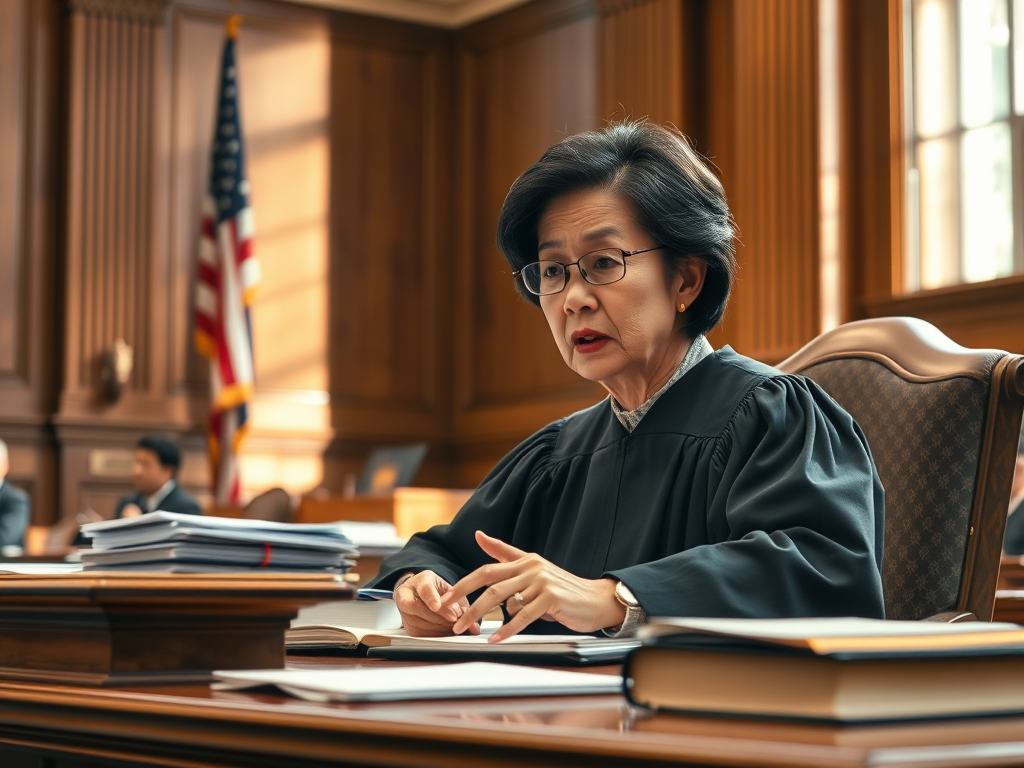

A federal judge in San Francisco sharply criticized the Trump administration on Thursday over what she described as an aggressive campaign targeting the University of California system. The judge warned that the administration’s escalating threats and investigations were already eroding academic freedom and could cause lasting harm to higher education.
Judge Rita F. Lin of the U.S. District Court for the Northern District of California stopped short of immediately ordering federal officials to halt their actions. But only minutes into the hearing, her frustration was clear. With noticeable anger in her voice, she characterized the administration’s tactics as potentially unlawful and warned of their sweeping consequences.
According to filings cited by Judge Lin, faculty members at the University of California have already begun adjusting their teaching and research decisions, fearing that topics perceived as too progressive or controversial might trigger retaliation in the form of rejected research grants or blocked federal funding.
“They have changed what they are going to teach, they have changed what they are going to research,” Judge Lin said, describing the chilling effect. She called it a textbook First Amendment violation, adding that the administration appeared to be pursuing exactly the result it had signaled for months.
The White House did not issue an immediate response to the judge’s remarks.
The University of California, a system of 10 campuses with roughly 560,000 students and employees, receives more than $17 billion in federal funding annually. Federal scrutiny intensified earlier this year, but the magnitude of the challenge became especially clear in August. At that time, the Justice Department demanded that the University of California, Los Angeles (UCLA) pay more than $1 billion to resolve a civil rights inquiry.
UC President James B. Milliken said such a financial demand would devastate the university system and cause immense harm to its students and the state of California.
In September, several labor and academic organizations — including the American Association of University Professors — filed suit to block what they described as coercive tactics designed to punish political expression on campus. Their lawsuit accused the Trump administration of leveraging federal funding as a weapon to retaliate against individuals associated with the University of California who exercised free speech rights.
Thursday’s hearing centered on whether Judge Lin should grant a preliminary injunction to pause the administration’s efforts while the legal fight continues. Although she signaled that a ruling would not be issued until at least late next week, her pointed questioning suggested deep skepticism toward the government’s approach.
Addressing Justice Department attorney Abhishek Kambli, Judge Lin pressed the government on whether it had complied with required civil rights procedures before attempting to block research funding. Kambli acknowledged that the administration did not follow conventional procedures but maintained that other legal authorities justified the administration’s actions.
Judge Lin’s concerns echo those raised by another federal judge in Boston, who ruled in September that the administration’s attempt to cut research funding at Harvard University was unlawful. The administration has vowed to challenge that ruling but has yet to file an appeal. Nonetheless, the government began reinstating Harvard’s grants shortly after the decision.
Judge Lin herself has already intervened once in a related case, ordering the Trump administration to release hundreds of millions of dollars in frozen research grants tied to the University of California. The UC system did not participate in that lawsuit, nor in the case at issue this week, but it continues to negotiate with federal officials behind the scenes in pursuit of a settlement.
Negotiations have unfolded mostly out of public view. The university system fought a public records request seeking the terms of the government’s settlement offer to UCLA, taking the battle to the California Supreme Court — but ultimately losing. The proposed deal included not only the billion-dollar payment but also provisions intended to limit the admission of students whom the government considered likely to promote anti-American, anti-Western, or antisemitic viewpoints.
During Thursday’s hearing, Kambli stated that the University of California had rejected the government’s initial settlement proposal and that no agreement appeared imminent.
In a statement released after the hearing, University of California leadership emphasized its commitment to research and innovation, saying the institution remains focused on advancing medical breakthroughs, fostering economic competitiveness, and serving the public good.
Connie K. Chan, who represented the academic and labor organizations seeking court intervention, said her clients were not trying to prevent UC from voluntarily negotiating a resolution with Washington. However, she argued that no negotiation could truly be voluntary so long as the university remained under the shadow of legal and financial threats.
“As long as these coercive threats hang over the UC system,” she said, “and as long as the federal government continues to use unsubstantiated investigations and funding threats as leverage, there can be no free and voluntary negotiation.”
The standoff underscores a broader national debate over academic freedom, campus speech, and the role of federal funding. While the Trump administration argues that its actions are necessary to combat campus antisemitism, critics contend that the government is attempting to silence certain viewpoints and pressure universities into reshaping academic priorities to match political expectations.
For now, the University of California remains in limbo — navigating legal battles, federal pressure, and intense public scrutiny — while awaiting Judge Lin’s forthcoming decision. The outcome could have ripple effects across American higher education, reshaping the balance between political authority and academic independence for years to come.




Leave a Reply