
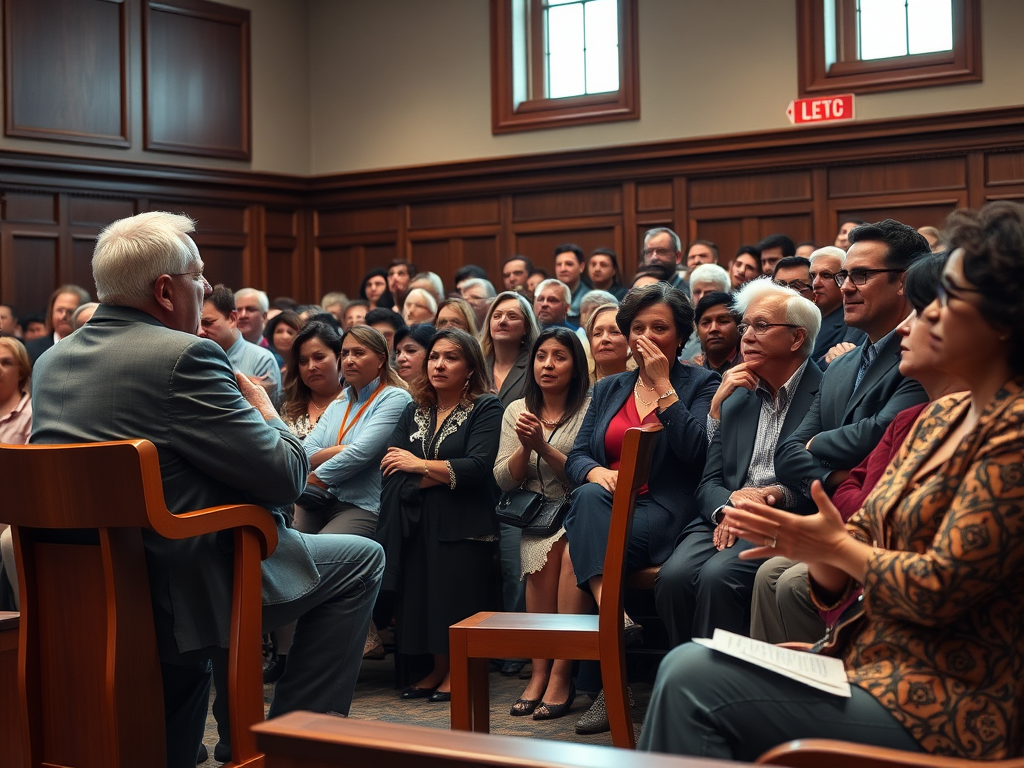

For nearly two hours on Saturday, Indiana State Senator Greg Goode sat on a tall wooden chair in Terre Haute’s city council chambers, listening patiently as a steady stream of residents voiced their opposition to a proposal that would redraw the state’s congressional districts in favor of Republicans.
No one spoke in support of the plan. Out of nearly 200 people who attended the meeting, only six expressed approval on a sign-up sheet, according to Goode. The senator had organized the listening session himself, hoping to gauge public opinion on a proposal that has divided even members of his own party.
As Republicans and Democrats across the United States rush to redraw electoral maps outside the traditional ten-year census cycle—often with minimal debate or bipartisan input—Goode’s public forum stood out as an exception. Here was a Republican lawmaker openly admitting uncertainty about how he would vote and asking for input from a largely left-leaning audience that questioned not just the redistricting effort but the broader direction of the country.
“A fascist government has decided that they’re going to tell even the smallest district who’s in charge,” said Terre Haute resident Thomas Baer, 68, urging Goode to “say no to this blatant power grab.”
A Divided State Faces Political Pressure
In several states, redistricting has moved swiftly with little pushback from the ruling party. Yet in Indiana, where Republicans dominate politics, the outcome remains uncertain. President Trump and his allies have spent months lobbying legislators to approve a new congressional map that could increase GOP representation, but support among state lawmakers is not guaranteed.
More than sixty people took turns addressing Goode on Saturday, some after waiting in the cold outside the city hall to enter the crowded chamber. The atmosphere remained calm and respectful, though emotions occasionally ran high.
“Changing the rules in the middle of the game is not what Hoosiers do,” one man told Goode. “This is about ethics, representation, and democracy itself,” another woman said. A third speaker went further, calling the redistricting effort “nothing more than stealing,” and questioning whether Goode’s listening session was “just for show or for real substance.”
Redistricting is normally conducted at the start of each decade following new census data. However, since Texas Republicans—acting at former President Trump’s urging—redrew their map earlier this year to target five Democratic-held seats, both parties have scrambled to adjust boundaries in states they control.
Republican-led Missouri and North Carolina have already approved new maps, while Democratic-controlled Virginia and California are advancing their own plans. California voters are set to decide this week on a measure that could give Democrats an edge in several districts.
Political Stakes Rise in Indiana
In Indiana, which Trump carried by 19 percentage points in the last election, Republicans already hold seven of nine congressional seats. Some lawmakers, however, have expressed hesitation about pushing for a map that could make the balance 8–1 or even 9–0.
The debate intensified last week when Governor Mike Braun called a special legislative session to consider redistricting. Yet within minutes of the announcement, a Senate Republican spokesperson admitted that “the votes still aren’t there,” signaling that the legislature might convene only to fail to pass a map. Although the session was scheduled to begin Monday, many lawmakers appear inclined to delay.
Republican leaders, including members of Indiana’s congressional delegation, have largely rallied behind the redistricting effort, arguing it would “protect Hoosiers from efforts in other states that seek to diminish their voice in Washington.” Still, uncertainty lingers about the final vote count in the state Senate—where Goode’s stance could prove decisive.

Listening Before Deciding
Speaking to reporters after the meeting, Goode said he had not yet seen a finalized version of the proposed map and had no plans to announce his position before the legislative session. “It’s been overwhelming that folks here are not for it,” he said. “That’s why you take everything in, process it, and keep listening.”
Goode joined the Indiana Senate in 2023 after being selected by local Republicans to fill a vacant seat representing a district about 75 miles southwest of Indianapolis. The area, once politically mixed, is now reliably conservative. Terre Haute—the largest city in the district, home to about 58,000 residents, Indiana State University, and a federal prison—has become a symbolic battleground in the state’s political transformation.
In recent months, Goode has criticized what he calls bullying tactics from activists. On social media, he posted about “those trying to pressure me on redistricting,” alongside a photo of Robert F. Kennedy and a reflection on “political heroes who stood up for the greater good.”

Echoes of History and Civic Duty
Saturday’s event reflected that same tone of reflection and civic engagement. At the entrance table, Goode placed a copy of Norman Rockwell’s “Freedom of Speech,” the famous painting celebrating citizens’ right to express themselves. He thanked Terre Haute’s Democratic mayor for opening City Hall on short notice, and in his opening remarks invoked both Robert F. Kennedy and Martin Luther King Jr.
“I believe in looking to the past—at the challenging times our country has faced—and trying to rise to the occasion,” Goode told the audience.
His remarks drew quiet nods, though skepticism remained. Many residents viewed the event as a rare opportunity to voice dissent in a state where Republicans hold overwhelming power.
National Influence and Local Decisions
The Trump campaign and its allies have made Indiana a focal point in their broader strategy to solidify Republican control of the U.S. House. Goode acknowledged meeting with Vice President JD Vance in Indianapolis, as well as participating in calls with Trump and attending meetings in Washington. While he expressed gratitude for their outreach, he insisted that he did not feel pressured by the White House.
Local Republican lawmakers, however, have been flooded with emails from conservative activists urging them to back the plan. Some have even received threats of primary challenges if they refuse to support redistricting. Goode, who faces re-election next year, represents a district where Democrats did not field a candidate in the previous cycle—underscoring both his political strength and the shrinking competition in Indiana politics.
Vigo County, where Terre Haute is located, once held national attention as a political bellwether. From 1956 through 2016, it voted for every presidential winner before turning decisively Republican in 2020, giving Trump an 18-point margin.
Yet many residents at Saturday’s meeting said they still saw Indiana as more politically diverse than the numbers suggest.
“Participation is important,” said 76-year-old William Carper, an independent voter who opposes redistricting. “If you don’t speak up,” he added, “people will never hear your voice.”

Democracy in Action
As the session concluded, Goode thanked the crowd for attending and promised to remain open-minded. “I’m going to continue to listen,” he said, encouraging constituents to stay in contact. Later that day, in a text message to reporters, he reflected on the turnout. “I’m grateful that so many people took the time to respectfully voice their opinions,” he wrote. “I was moved.”
Whether Goode ultimately sides with his party or the voters who spoke against redistricting remains to be seen. But for now, his willingness to listen—rather than simply vote along party lines—has made him an unusual figure in an era of deep political polarization.
As one attendee put it while leaving City Hall, “At least today, democracy felt like it was still alive in Indiana.”




Leave a Reply