
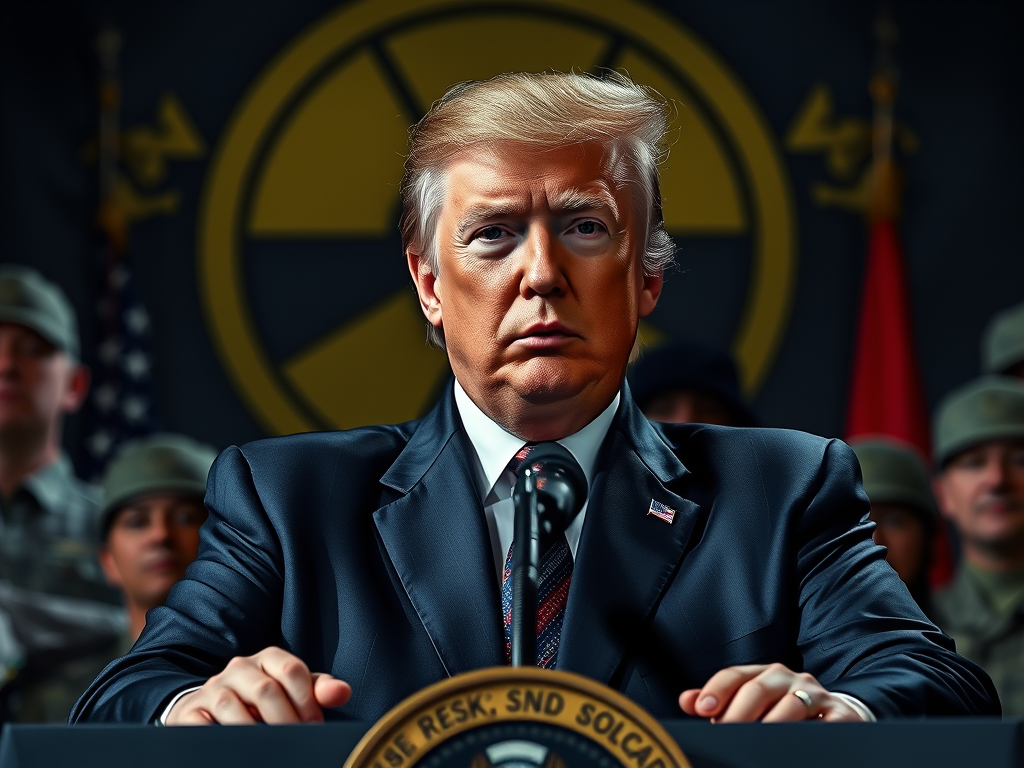

President Trump’s surprising announcement on Thursday, declaring that he had ordered the U.S. military to resume nuclear testing, sparked widespread concern over a possible return to the tense days of the Cold War. During that era, the United States, the Soviet Union, and China frequently conducted nuclear detonations—first in the atmosphere and in space, later underground—creating a climate of constant threat, mutual suspicion, and the looming specter of mutually assured destruction.
The end of that period was marked by the mid-1990s adoption of the Comprehensive Nuclear-Test-Ban Treaty (CTBT), an international effort aimed at halting nuclear proliferation by banning explosive tests. Although the treaty represented a major step toward curbing the arms race, it never formally came into force, as insufficient nations ratified it. Its goal was simple: to prevent new testing from fueling the cycle of nuclear escalation.
Trump’s statement has reignited debate among national security experts about whether the United States should break with the long-standing tradition of observing the treaty. Some of his former aides argue that adhering to it limits America’s ability to demonstrate “peace through strength.” On Air Force One, returning from a summit in Korea, the president told reporters that he had made the decision because other countries were allegedly conducting nuclear tests.
“We’ve halted it years—many years—ago,” Trump said, referencing the last U.S. nuclear test in 1992 under the George H.W. Bush administration. “But with others doing testing, I think it is appropriate that we do also.”
However, the factual basis of this justification is questionable. In reality, North Korea is the only country that has tested nuclear explosives in the past 25 years, and its last detonation occurred in September 2017. Russia has not conducted any nuclear explosions since the final days of the Soviet Union, 35 years ago. Trump may have confused nuclear detonations with Russia’s recent claims of testing exotic delivery systems for nuclear weapons, including a nuclear-powered cruise missile and an undersea torpedo named Poseidon, both designed to evade U.S. missile defenses.
Trump explicitly excluded China from his list of testing nations, noting that Beijing’s last nuclear explosion was nearly three decades ago. Still, intelligence reports suggest that China has maintained preparations at its Lop Nur site, the same location where Mao Zedong first demonstrated China’s nuclear capabilities in the 1960s, in case the nation decides to resume testing.
Trump’s senior official overseeing nuclear testing, Brandon Williams, a former one-term congressman from New York, had previously expressed skepticism about the need for renewed U.S. testing. During his April confirmation hearing, Williams said, “I would not advise testing, and I think we should rely on the scientific information,” referring to data derived from supercomputer simulations. Yet he acknowledged that the ultimate decision was “above my pay grade.”
Apparently, the decision was made directly by Trump. Just before meeting Chinese President Xi Jinping in South Korea, he posted on social media that he had ordered the “Department of War”—his term for the Defense Department—to immediately resume nuclear testing. He qualified that the testing would occur “on an equal basis” with rival nations, a statement that left many in the national security community puzzled. (It was also confusing because the Energy Department, not the Pentagon, manages nuclear tests.)
Trump offered no detailed rationale for resuming testing other than his claim that other countries were doing so. He also asserted that the U.S. possesses more nuclear weapons than any other nation, which is inaccurate; Russia’s stockpile exceeds America’s, although many of those weapons are smaller battlefield devices, some of which U.S. officials feared could be deployed against Ukraine. Trump described China as a “distant third” in nuclear capability, which is technically correct, but Chinese stockpiles are growing rapidly. Pentagon assessments during the Biden administration projected that China would have around 1,000 deployed nuclear weapons by 2030 and could approach parity with the United States and Russia by 2035.
Vice President JD Vance defended the decision in remarks to reporters, emphasizing the importance of ensuring that the U.S. nuclear arsenal functions properly. “To be clear,” Vance said, “we know that it does work properly, but you got to keep on top of it over time, and the president just wants to make sure that we do that.” Notably, he made no mention of testing to match other nations.
Many analysts warn that if the United States resumes testing, it could effectively signal permission for other countries to follow suit—potentially reigniting a global arms race. The timing is sensitive, coming just 100 days before the expiration of the last arms control agreement between the U.S. and Russia, which limits the size of their nuclear arsenals.
Experts note that both Russia and China could quickly conduct nuclear detonations at their underground test sites if needed. In contrast, the U.S. test site, a vast expanse in Nevada larger than Rhode Island, has seen little preparation for a renewed testing program. During Trump’s first term, discussions were underway to accelerate U.S. testing capabilities, including reducing preparation time for a nuclear test from several years to as few as six months. Nuclear experts criticized these plans as unrealistic, citing the degraded state of the Nevada site and missing equipment.
Nevertheless, Project 2025, the 2023 blueprint for Trump’s presidency, called for immediate test readiness, allowing the president maximum flexibility to respond to adversary actions. In 2024, Robert C. O’Brien, Trump’s former national security adviser, reinforced the idea in Foreign Affairs that Washington should test new nuclear weapons to verify their reliability and safety, although his argument appeared more political than scientific—intended to demonstrate American resolve to rising powers rather than address a technical need.
Opponents argue that resuming nuclear tests would provoke an arms race and undermine decades of arms control progress. Directors of the national laboratories responsible for the U.S. atomic arsenal have repeatedly testified to Congress that new detonations are unnecessary. Today, the United States relies on advanced scientific methods to ensure the arsenal’s effectiveness, including supercomputers, the world’s most powerful X-ray systems, and stadium-sized laser arrays. No other country has such extensive nonnuclear testing capabilities.
Historically, underground nuclear tests allowed scientists to identify flaws in prototypes and refine weapon designs. During the Cold War, China conducted 45 tests at Lop Nur, France carried out 210, Russia 715, and the United States 1,030. These tests gradually ceased toward the end of the Cold War, and the 1996 global test ban formalized the moratorium. The treaty was designed to limit the costly nuclear arms race, but as a largely voluntary agreement, it never fully constrained global powers.
Siegfried S. Hecker, former director of Los Alamos National Laboratory, has long argued that the test ban benefits the U.S. by preventing treaty-abiding rivals from catching up in advanced nuclear technology. “Yes, we can learn things by nuclear testing,” Hecker said, “but when you look at the big picture, we have much more to lose by going back to testing than we have to gain.”
The disparities in testing history continue to give Washington a strategic edge, maintaining an advantage over other nuclear powers and limiting the diversity and lethality of their arsenals. As the debate over Trump’s order unfolds, the world watches with unease, wary of a potential revival of the high-stakes brinkmanship that defined the nuclear age.




Leave a Reply