
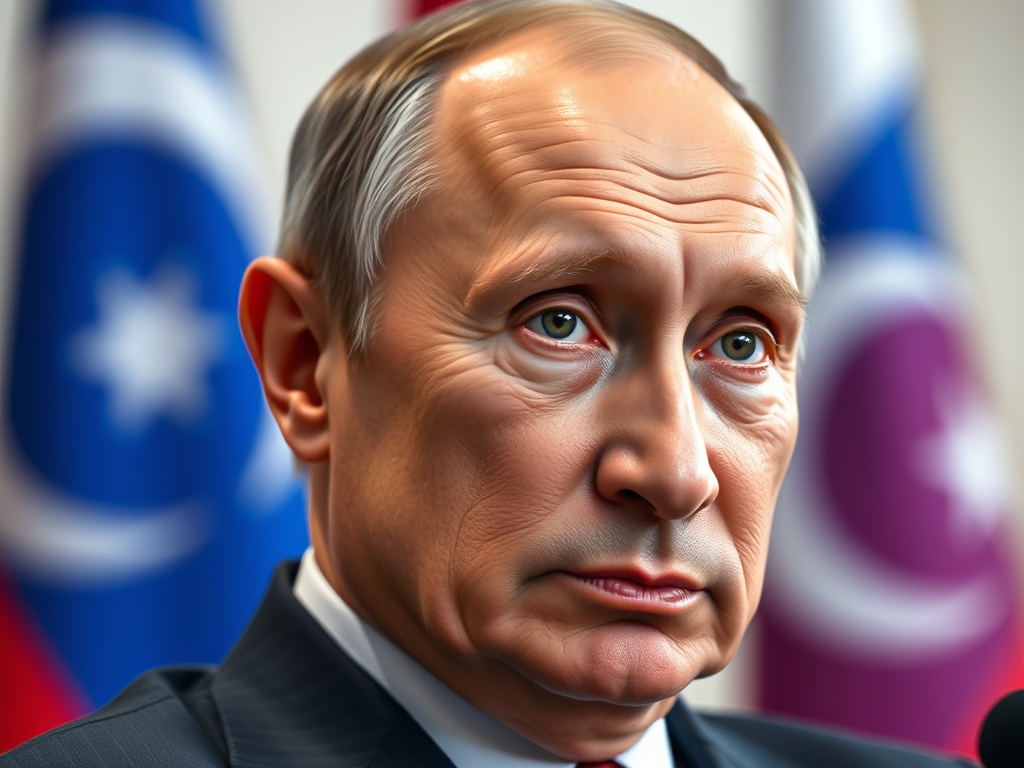

In a rare and unexpected admission, President Vladimir V. Putin acknowledged Russia’s responsibility for the tragic downing of an Azerbaijani passenger jet that crashed near the Caspian Sea last December. The statement, made during a regional summit in Tajikistan on Thursday, marks Moscow’s first public acceptance of fault in the incident that left 38 people dead and strained relations between two former Soviet allies.
The crash, which occurred on Christmas Day, involved an Embraer 190 aircraft operated by Azerbaijan Airlines. The jet, carrying 62 passengers and five crew members, was en route from Baku, Azerbaijan’s capital, to Grozny, the capital of Russia’s Chechen Republic. Moments before the plane disappeared from radar, reports indicated that Russian air defense systems near Grozny had engaged aerial targets—believed to be Ukrainian drones—flying close to Russian airspace. Soon after, debris from the Azerbaijani airliner was found scattered along the Caspian coastline.
Initial investigations pointed toward an accidental shootdown by Russian forces. However, Moscow’s immediate response was one of denial. Russian officials dismissed claims of involvement and implied that Azerbaijan’s air traffic control might have played a role. The Kremlin’s evasive stance fueled outrage across Azerbaijan, where citizens and lawmakers demanded accountability and justice for the victims.
Just three days after the crash, Putin extended a brief apology to Azerbaijani President Ilham Aliyev, calling the incident a “terrible tragedy.” Yet, at that time, he carefully avoided acknowledging Russia’s responsibility. That changed on Thursday when Putin met Aliyev face-to-face for the first time since the incident. During their talks in Dushanbe, Tajikistan, Putin directly accepted that Russian air defense missiles were responsible for the jet’s destruction. According to the Kremlin’s official transcript, Putin explained that two missiles fired at Ukrainian drones had detonated near the aircraft, causing it to break apart midair.
Putin described the event as “a tragic and unintended mistake,” adding that Russia had a “moral and legal duty” to provide a transparent account and offer compensation. “It is our obligation to conduct a thorough investigation and determine the true causes of this disaster,” he said. The Russian president also confirmed that the government would carry out a “legal assessment” to determine reparations for the victims’ families.
This public acknowledgment represents a significant shift for Putin, who seldom admits errors by Russian military forces. Historically, Moscow has been known for denying responsibility in similar aviation tragedies. Notably, Russia has never accepted accountability for the 2014 downing of Malaysia Airlines Flight MH17 over eastern Ukraine, which killed 298 people. Multiple international investigations concluded that a Russian missile system was responsible, but the Kremlin continues to reject those findings to this day.
The Azerbaijani crash reignited longstanding tensions between Moscow and Baku. Many in Azerbaijan view Russia as an overbearing power that has treated their nation as a subordinate partner since the collapse of the Soviet Union. Following the crash, Azerbaijani lawmakers, political analysts, and state media accused Moscow of “neo-imperialist behavior,” arguing that Russia’s initial denial revealed a lack of respect toward Azerbaijan’s sovereignty. Some members of Azerbaijan’s Parliament even proposed severing diplomatic and military cooperation with Russia.
President Aliyev’s own rhetoric has hardened over the past year. Once a close ally of Moscow, Aliyev has increasingly distanced himself from the Kremlin’s orbit. In the weeks following the crash, he voiced support for Ukraine’s struggle against Russian aggression and openly condemned what he described as the Soviet Union’s “occupation” of Azerbaijan—a pointed remark aimed at Russia’s self-perception as the successor to Soviet power. Such comments underscored a growing political realignment in the Caucasus, as Azerbaijan seeks to balance its relations between East and West.
Analysts suggest that Putin’s public apology is a calculated move to prevent a deeper diplomatic rupture. Azerbaijan has emerged as a strategically important energy partner for Europe, particularly as Western nations look to reduce dependence on Russian oil and gas. Maintaining stable relations with Baku is therefore critical for Moscow, especially amid its ongoing geopolitical isolation due to the war in Ukraine.
Still, many in Azerbaijan remain skeptical about the sincerity of Russia’s acknowledgment. Some see the move as a political maneuver rather than a genuine act of accountability. Families of the victims have called for an international investigation to ensure impartiality, emphasizing that Russia’s internal inquiries cannot be trusted. Others argue that financial compensation alone cannot repair the damage done to bilateral trust.
The tragic incident also highlights broader challenges in regional airspace security amid escalating military tensions. The Russian-Ukrainian conflict has turned skies across Eastern Europe and the Caucasus into potential zones of danger, where misidentifications can have devastating consequences. Aviation experts have urged Russia to implement stricter protocols to prevent similar tragedies, warning that the risk of accidental strikes remains high as long as drone activity continues near civilian flight paths.
Despite Thursday’s admission, the road to reconciliation remains uncertain. Aliyev’s government has yet to respond publicly to Putin’s remarks, though diplomatic sources indicate that discussions over reparations and joint investigations are underway. Whether these talks can restore confidence between the two nations will depend largely on Russia’s follow-through.
For Putin, acknowledging responsibility for the downing of the Azerbaijani jet may be a rare moment of contrition, but it also underscores the immense pressure facing the Kremlin both domestically and internationally. The admission signals a recognition that denial and deflection—long hallmarks of Russia’s crisis management—can no longer sustain its regional relationships.
As both nations mourn the lives lost, the tragedy stands as a stark reminder of how quickly political and military miscalculations can unravel years of fragile diplomacy. Whether this new openness from Moscow leads to genuine accountability or remains another carefully managed gesture will become clear only in the months ahead.




Leave a Reply