
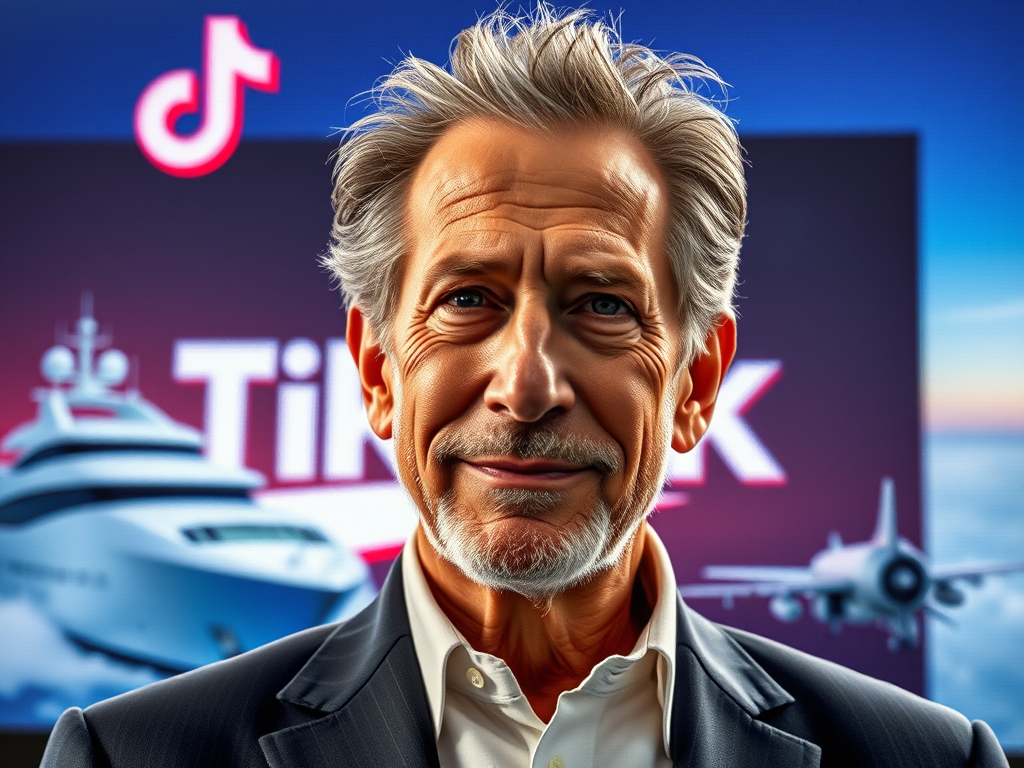

When Larry Ellison turned 80 in 2024, many assumed the legendary Oracle founder would begin to wind down his high-profile lifestyle. For decades, Ellison embodied Silicon Valley extravagance—whether racing yachts across oceans, piloting fighter jets for mock dogfights, or buying up prime real estate. The expectation was that the next phase of his life would focus less on adventure and more on cementing his legacy through philanthropy.
But Ellison has surprised the business world yet again. Instead of retreating, the billionaire has embarked on one of the most ambitious transformations of his career: stepping into the role of media mogul. And this time, his influence could rival or even surpass that of historical media titans like William Randolph Hearst and Joseph Pulitzer.
Oracle, TikTok, and the Quest for Influence
The catalyst for Ellison’s new empire is none other than TikTok, the wildly popular short-video platform with over 170 million U.S. users. After Congress forced ByteDance, TikTok’s Chinese parent company, to divest for national security reasons, Ellison and Oracle emerged as central players in the American reimagining of the app.
Oracle, the company Ellison co-founded in 1977 and still dominates as chief technology officer, already serves as TikTok’s data storage partner through its cloud business. Now, with this new arrangement, Oracle could gain a direct foothold in consumer-facing media—a dramatic shift for a company historically focused on enterprise software. Ellison, who controls more than 40% of Oracle stock, is positioned to wield enormous influence over the platform’s future.
The ownership structure of the new TikTok remains unclear, but one certainty is political alignment. Reports suggest that investors will likely be allies of President Donald Trump. The Murdoch family, owners of Fox News, have been floated as probable partners. Trump himself has hinted that Ellison or Elon Musk would be his preferred buyers.
For Ellison, TikTok represents both a risky leap into consumer entertainment and a potential jackpot. His last major attempt at consumer tech—the 1990s-era network computer—flopped. But TikTok offers something different: a ready-made platform with deep cultural relevance among younger audiences.

A Family Expanding Into Media
Ellison isn’t the only family member reshaping the media landscape. His son, David Ellison, head of Skydance Media, has already made headlines with an $8 billion acquisition of Paramount and CBS. Now, David is reportedly preparing an even bolder bid for Warner Bros. Discovery, which owns CNN and Warner Bros. Studios.
The prospect of one family controlling TikTok, CBS, CNN, and potentially Warner Bros. marks a profound shift in American media. In the past, ownership was often fragmented, tied to specific regions or platforms. The Chandler family dominated Los Angeles journalism through the LA Times, while Rupert Murdoch built Fox News and The Wall Street Journal with distinct editorial voices. Ellison’s empire, by contrast, spans television, film, and digital platforms simultaneously, with the potential to establish a unified editorial influence.
As media historian Michael Socolow noted, “What makes these deals different is that they are across multiple platforms. To have the opportunity to establish an editorial line across TikTok, CBS News, and CNN—that’s a new world.”

Wealth Beyond Limits
Ellison’s financial capacity makes these ventures feasible. In 2024, his Oracle holdings briefly surged by $100 billion in value in a single day, making him the world’s richest person for a short time. According to Bloomberg, his net worth now hovers around $367 billion, putting him second only to Elon Musk.
Unlike other moguls, Ellison doesn’t face the typical financial constraints that limit expansion. Where others might struggle to finance acquisitions or manage debt, Ellison’s immense personal fortune allows him to buy, restructure, and invest with unprecedented freedom.
The Long Shadow of Oracle
Ellison’s rise to this position has been anything but straightforward. He co-founded Software Development Laboratories in 1977, later renamed Oracle, with a focus on database technology. While he was never the most technically gifted of Silicon Valley’s pioneers, his relentless salesmanship kept the company alive through several near-bankruptcies. Oracle not only survived but thrived, becoming a cornerstone of global enterprise computing.
Alongside his business achievements, Ellison cultivated an image as Silicon Valley’s most flamboyant billionaire. Multiple marriages, lavish properties, and the near-complete ownership of the Hawaiian island of Lanai became part of his mythology. He even purchased a retired Italian Navy fighter jet, reportedly engaging in mock battles with his son.
Ellison himself once joked in an interview, “Of course, it’s a low bar. I didn’t just bite the head off a small animal before the meeting,” acknowledging his reputation as an eccentric figure.


A Complicated Relationship With Philanthropy
Despite his growing involvement in media, Ellison continues to dabble in philanthropy—though with mixed results. In recent years, his focus has shifted to the Ellison Institute of Technology (EIT), a sprawling research and innovation center linked to the University of Oxford. Ellison has promised to dedicate much of his fortune to its mission of advancing life sciences and commercializing new technologies.
But the project has not been without turmoil. Leadership disputes, shifting priorities, and Ellison’s famously hands-on management style have created instability. In 2024, John Bell, a prominent scientist who initially lent credibility to EIT, abruptly resigned, calling the project “very challenging.” Shortly afterward, Santa Ono, former president of the University of Michigan, was brought in with a more senior role, sparking questions about Ellison’s long-term strategy.
These challenges echo Ellison’s history of sudden shifts in philanthropic direction. His charitable efforts often start with bold ambition but falter due to disagreements with staff or changes in his personal vision. Even so, British scientists like Bell have acknowledged the significance of Ellison’s investment, noting that few individuals in the U.K. have attempted anything comparable.

Building a Legacy Through Media
Taken together, Ellison’s latest moves suggest that his legacy may not lie solely in technology or philanthropy, but increasingly in media power. For decades, software defined his career. Now, in his ninth decade, Ellison appears determined to shape public opinion and cultural narratives through ownership of platforms that reach hundreds of millions of people daily.
This shift underscores broader trends in the digital age, where traditional barriers to media consolidation are dissolving. Television, film, and digital platforms are no longer separate silos—they are interconnected networks influencing politics, culture, and business on a global scale. For Ellison, owning such platforms is not just an investment; it is a path to long-lasting influence.
Whether this strategy succeeds remains to be seen. Regulatory scrutiny could intensify, competition is fierce, and the volatile nature of media makes it a risky industry even for billionaires. But if Ellison’s track record shows anything, it’s that he thrives in spaces others find too unpredictable.
Conclusion
Larry Ellison’s story has always been one of reinvention—from relentless salesman to tech pioneer, from playboy billionaire to reluctant philanthropist. Now, as he embraces the role of media baron, he is entering uncharted territory. By combining his immense fortune, family involvement, and deep political connections, Ellison may succeed in reshaping the U.S. media landscape in ways unmatched since the heyday of Hearst and Murdoch.
At 81, Ellison could have chosen to retreat to his Hawaiian island, surrounded by yachts and luxury. Instead, he is betting that the next great act of his life will not be about software or philanthropy, but about controlling the stories and platforms that define the future.




Leave a Reply