
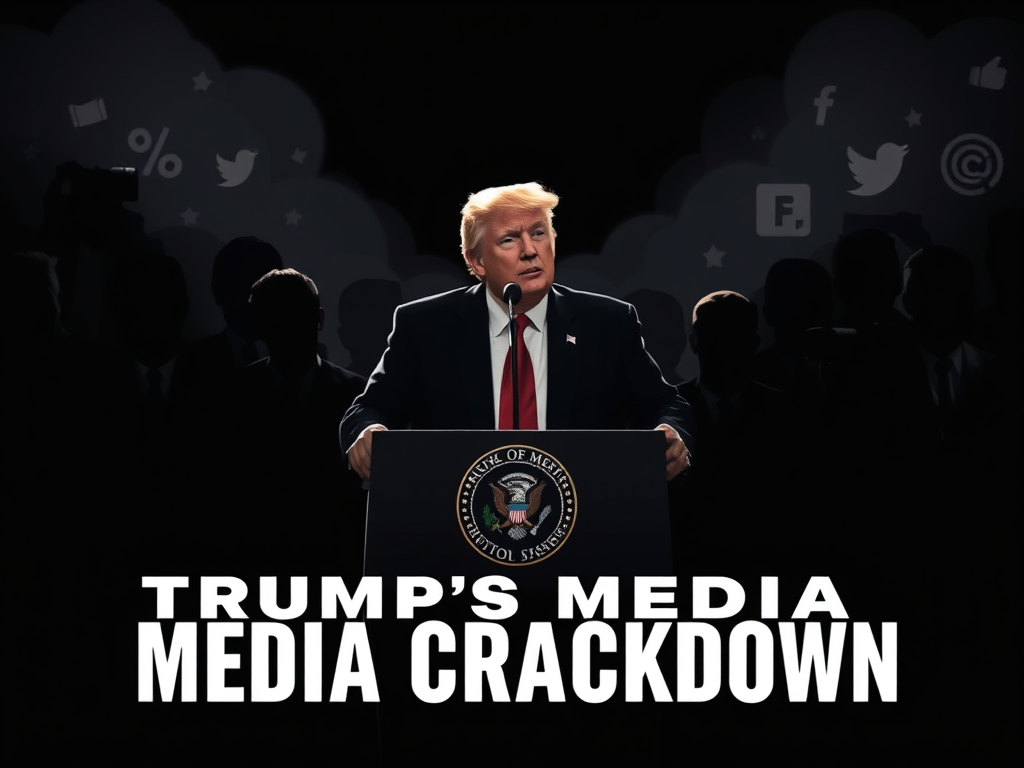

When President Donald Trump delivered his second inaugural address in January, his message was clear and bold. Standing before a cheering crowd, he promised to “immediately stop all government censorship and bring back free speech to America.” His words echoed the refrain that had energized his supporters throughout his political rise: a defense of free expression and a rejection of what he called “cancel culture,” which he argued was “the very definition of totalitarianism.”
That promise resonated deeply, especially with those who had watched major social media platforms ban Trump and his allies in the aftermath of the January 6, 2021 Capitol riots. To his base, he was not only a politician but a victim of silencing — a figure who could restore what they viewed as a fundamental American right.
Yet only months into his second term, the landscape looks very different. Instead of easing restrictions, Trump’s administration has launched one of the most sweeping government crackdowns on the press in modern American history. Using lawsuits, regulatory pressure, and public attacks, the president has sought to weaken or silence media outlets and figures who criticize him.
The Jimmy Kimmel Suspension
The latest flashpoint came this week with ABC’s decision to “indefinitely” suspend Jimmy Kimmel’s late-night talk show. The move followed comments Kimmel made regarding the assassination of conservative activist Charlie Kirk. Rather than defending the host’s right to speak, President Trump celebrated the suspension, posting on Truth Social that it was “Great News for America.” He went further, suggesting that networks employing critical voices should lose their broadcast licenses altogether.
The Kimmel case is not an isolated incident. It highlights the effectiveness of Trump’s broader strategy against the media, a campaign that has already resulted in multimillion-dollar legal settlements from CBS and ABC. Under White House pressure, CBS News has agreed to adjust its approach to political interviews, while Paramount Skydance, CBS’s parent company, recently created an ombudsman role — filled by a conservative policy veteran — to handle complaints about coverage.
An Unprecedented Crackdown
Media scholars say this campaign has no modern parallel. Victor Pickard, a professor of media policy at the University of Pennsylvania, called it “certainly unprecedented in modern American history.” He noted that never before had an administration leveraged so many tools simultaneously to challenge the nation’s major news organizations.
What made the Kimmel suspension particularly striking, Pickard added, was its timing. It followed comments from Brendan Carr, Trump’s handpicked chairman of the Federal Communications Commission (FCC). Carr strongly hinted that the FCC could punish local stations that carried Kimmel’s show. Shortly after his remarks, Nexstar Media Group — one of the largest station owners in the country — announced it would preempt Kimmel’s program. ABC quickly followed with its nationwide suspension.
Observers could not help but see echoes of the Nixon era. Richard Nixon’s administration had once floated threats to revoke broadcast licenses as a way to keep networks in line. Though Nixon’s plan fizzled amid Watergate, the tactic has returned, this time with more immediate consequences.

The Role of the FCC
Carr’s comments carry significant weight because broadcast stations in the United States depend on FCC licenses to operate. He emphasized that license holders are obligated to serve the “public interest, convenience, and necessity.” Historically, conservatives opposed this type of government oversight, which was curtailed in the 1980s when the Reagan administration ended the Fairness Doctrine. That policy had required broadcasters to provide balanced coverage of controversial issues.
Now, under Trump, the FCC is taking a different stance. Carr told Fox News host Sean Hannity that the agency was “going to enforce the public interest obligation” and warned broadcasters that if they disagreed, they could “turn their license in.” His shift highlights a dramatic reversal: the same conservatives who once championed deregulation are now advocating for tighter government scrutiny, as long as it benefits their political agenda.
A Double Standard on Free Speech
The irony is difficult to ignore. Trump has long decried content moderation on social media platforms, framing it as censorship aimed at silencing him and his supporters. He and his allies regularly argue that platforms like Facebook and Twitter unfairly restricted their posts about COVID-19, elections, and other controversial topics. Yet while condemning social media companies, Trump has shown no hesitation in using government power to punish journalists, comedians, and commentators who displease him.
This double standard raises questions about the true nature of his free speech agenda. Critics argue that his focus is not on protecting free expression broadly but on amplifying voices aligned with his political movement while undermining dissenting perspectives.

Legal Battles and Political Pressure
Trump’s approach extends beyond regulatory threats. He has pursued a series of lawsuits against major media outlets, including CBS, ABC, and The New York Times. Although many legal experts initially dismissed these suits as long shots, the recent settlements have emboldened the president. In his latest filing against the Times, Trump cited the earlier cases as proof that his claims are “highly meritorious.”
Meanwhile, allies within his administration have reinforced the pressure. Vice President JD Vance has argued that individuals celebrating Kirk’s death may have First Amendment protections but should still face professional consequences, such as losing jobs or federal funding. Attorney General Pam Bondi added fuel to the fire, initially stating that the Justice Department would “absolutely target” those spreading hate speech. Although she later clarified that she meant incitements to violence, the chilling effect on free expression remains clear.
Trump himself has been more blunt. When pressed by ABC correspondent Jonathan Karl about Bondi’s remarks, the president said: “She’ll probably go after people like you, because you treat me so unfairly.” He suggested that ABC might itself face regulatory consequences. Days later, he escalated further, calling Kimmel a “whack job” and openly endorsing the idea of revoking broadcast licenses for late-night hosts critical of him.
Historical Parallels and Modern Consequences
The United States has witnessed political clashes with the media before, from Nixon’s secret plots to Reagan’s deregulatory push. But what distinguishes the Trump administration’s approach is the speed and scale of its actions. Within months, long-established practices of press independence are being challenged by lawsuits, regulatory threats, and corporate settlements.
The chilling effect is already visible. Networks and their affiliates are weighing whether airing controversial programming could put their licenses at risk. Journalists and comedians are wondering if their criticism might trigger legal or political retaliation. And the broader public is left questioning whether the government is defending free speech or narrowing it to fit partisan interests.

Conclusion: A Fragile Future for Free Speech
Trump’s campaign against the media is reshaping the American conversation about free speech. What began as a rallying cry to protect expression from censorship has turned into a powerful effort to suppress dissenting voices. Supporters view it as long-overdue pushback against biased coverage, while critics warn it represents a dangerous slide toward authoritarian control of the press.
As lawsuits move forward and the FCC asserts its authority, the stakes are high. The balance between government oversight and press freedom is once again being tested, perhaps more severely than at any point since Watergate. Whether Trump’s strategy strengthens his political movement or undermines the democratic principles of free expression remains an open question — one with profound consequences for the future of American democracy.




Leave a Reply