
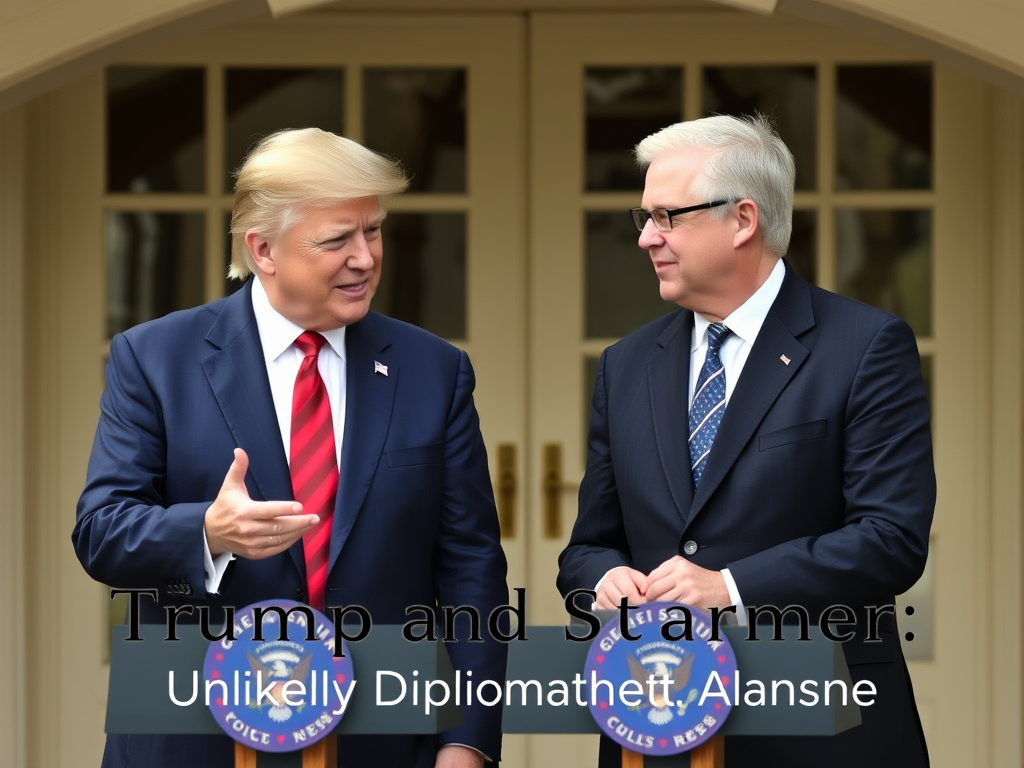

President Donald Trump concluded his state visit to the United Kingdom on Thursday with a carefully staged joint press conference alongside British Prime Minister Keir Starmer. The two leaders used the occasion to highlight areas of partnership while acknowledging their policy rift over the recognition of Palestinian statehood.
What stood out was the surprisingly warm rapport between the American president and Britain’s center-left leader. Trump, a right-wing populist who built his political career on nationalism and sharp rhetoric, and Starmer, a former human rights lawyer who heads the Labour Party, would not seem natural allies. Yet their interactions during the visit revealed a personal friendliness that contrasted with their political differences.
Throughout the press conference at Chequers, the prime minister’s official countryside residence, Trump frequently gestured toward Starmer, even patting his shoulder at times. Starmer, for his part, moderated his words carefully, repeatedly emphasizing common ground and avoiding public confrontation over deeper disagreements. It was a performance in diplomacy designed to reassure allies that the so-called “special relationship” between Washington and London remained intact despite ideological divides.
Starmer’s Diplomatic Goal: Ukraine and Gaza at the Forefront
For Starmer, the priority of the two-day state visit was clear: he hoped to nudge Trump toward a tougher stance on Russian President Vladimir Putin and to secure support for addressing the humanitarian crisis in Gaza. According to the prime minister, the two leaders spent nearly an hour in private conversations about global conflicts, a substantial portion of which focused on Ukraine and the Middle East.
British officials viewed this private dialogue as the most valuable aspect of Trump’s visit. With Russia’s ongoing invasion of Ukraine and escalating violence in Gaza, London sought to ensure that Washington remained a reliable partner in navigating these crises. However, the outcome of those talks was uncertain.
Trump remarked that Putin had “let me down,” but he sidestepped detailed questions about concrete steps he might take to exert pressure on Moscow or expand support for Kyiv. Starmer, who has repeatedly described Russian aggression as a direct threat to Europe, looked on as Trump played down the urgency.
“The Russia situation, I hope we’re going to have some good news for you coming up,” Trump told reporters, before adding that it “doesn’t affect the United States” and suggesting it did not impact Britain significantly either. The comment underscored the gap in perception: where Britain views Russia as a pressing danger to European stability, Trump framed it as a distant issue.
On Gaza, Starmer stressed unity. “We are working together to end the humanitarian catastrophe in the Middle East,” he declared, underscoring Britain’s commitment to humanitarian action. But when asked directly about Britain’s move to recognize Palestinian statehood, Trump openly voiced disagreement. “I have a disagreement with the prime minister on that score,” he admitted, though he softened the comment by describing it as “one of our few disagreements.”
Trump chose instead to focus on Israel, emphasizing the trauma of the October 7, 2023 Hamas-led attack that killed about 1,200 Israelis and left 250 hostages. He spoke at length about Israeli suffering while omitting mention of Palestinian casualties in Gaza, where health officials report more than 60,000 deaths since Israel’s intensified offensive. “People forget about Oct. 7,” Trump said firmly. “I can’t forget about it.”
Ceremony, Controversy, and Politics at Home
Beyond policy, the trip carried heavy symbolism. On Wednesday, King Charles III and Queen Camilla hosted a lavish state dinner at Windsor Castle, where Trump praised the royal family in glowing terms. The grandeur of the evening contrasted with Thursday’s more substantive meetings at Chequers, where policy and press scrutiny dominated.
Even while abroad, Trump could not fully avoid American political controversies. He criticized President Joe Biden several times during the press conference, highlighting the partisan divisions awaiting him back home. Meanwhile, the ghost of Jeffrey Epstein briefly resurfaced when activists projected images of Trump and Epstein onto Windsor Castle during the visit. Asked about the matter, Trump deflected the question, keen to avoid a headline-grabbing scandal overshadowing the diplomatic agenda.

A Technology Partnership: AI and Innovation at the Core
One tangible outcome from the state visit was the signing of a new U.S.–UK technology partnership agreement. Trump and Starmer both promoted the deal as a step toward ensuring that the two nations remain global leaders in artificial intelligence, digital security, and other high-tech industries.
The announcement reflected a shared vision that goes beyond defense and foreign policy. With AI shaping the future of economics, national security, and daily life, the agreement was positioned as a cornerstone of transatlantic cooperation. Both governments emphasized that close collaboration on emerging technologies would help set global standards while fostering innovation.
The Special Relationship Reaffirmed
Starmer opened the press conference with remarks that sought to capture the essence of the U.S.–UK alliance. He described it as a “unique bond” forged in shared values and tested by history. “We are united in defense and security — yes, absolutely — but we’re also united in the pursuit of peace,” he said.
He went further, invoking the image of British and American men and women working side by side to “change the path of history” and defend freedom, democracy, and the rule of law. His language reflected Britain’s long-standing approach to maintaining harmony with U.S. administrations, even when policy differences are sharp.
For Starmer, the success of the visit lay not in dramatic breakthroughs but in ensuring there was no rupture in the relationship. The visit’s smooth execution, with no major public disputes, likely brought relief to his team. But the underlying questions about U.S. commitment to Ukraine, Gaza, and Europe’s security remain unresolved.

Looking Ahead: Diplomacy, Disagreements, and Global Stakes
Trump’s visit to Britain highlighted both the strengths and the challenges of the transatlantic relationship. On one hand, the symbolism of unity — from royal dinners to joint speeches — reinforced the enduring partnership. On the other, differences on foreign policy, particularly Russia and Palestine, hinted at the fragile balance required to maintain alignment.
For Starmer, cultivating personal warmth with Trump may help Britain amplify its voice in Washington, particularly as global crises intensify. For Trump, the trip offered a brief respite from domestic pressures while allowing him to project statesmanship on the international stage.
The new technology partnership signaled that, despite divergences on geopolitical strategy, both nations see the future of global leadership in innovation and AI. Yet the fundamental test of the special relationship will rest not on ceremonial agreements but on how Washington and London navigate the conflicts in Ukraine and Gaza in the months ahead.
As the visit concluded, what remained most evident was the effort — by both Trump and Starmer — to present a united front. Whether that unity can withstand the weight of global conflicts and domestic politics remains an open question.




Leave a Reply