
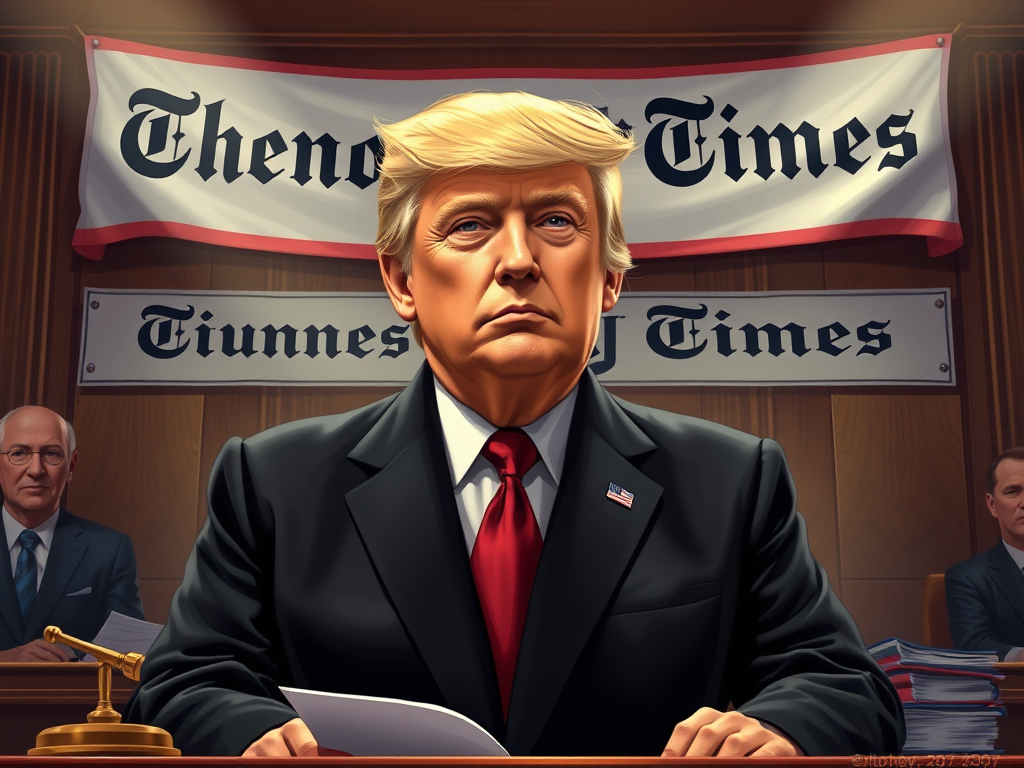

Former U.S. President Donald Trump has once again taken legal action against one of the nation’s most influential media outlets. On Monday, Trump filed a lawsuit in the U.S. District Court for the Middle District of Florida, accusing The New York Times and four of its reporters of defaming him through a series of articles and a book that he claims were strategically released to damage his reputation and political prospects ahead of the 2024 presidential election.
Trump’s Allegations of Media Bias
The complaint argues that The New York Times and its journalists—Susanne Craig, Russ Buettner, Peter Baker, and Michael S. Schmidt—along with Penguin Random House, acted with “actual malice” in their coverage. According to Trump, the disputed articles and the book “Lucky Loser: How Donald Trump Squandered His Father’s Fortune and Created the Illusion of Success,” were designed to discredit him as both a businessman and a political leader. He claims the publications resulted in “enormous” financial harm and reputational damage to his personal, professional, and political life.
Trump is seeking at least $15 billion in damages, an amount that underscores the magnitude of his accusations against the media organizations. His legal team insists that the timing of the articles and the book release—just before the 2024 election season—was not coincidental, but rather an intentional move to inflict maximum electoral harm.
Response From The New York Times and Penguin Random House
Unsurprisingly, the lawsuit has drawn strong pushback from the defendants. A spokesperson for The Times described the suit as meritless, emphasizing that the publication intends to continue its tradition of independent reporting. “This lawsuit lacks any legitimate legal claims and is an attempt to stifle and discourage journalists from pursuing the truth,” the spokesperson stated. “We will not bow to intimidation tactics. Our duty is to the American people, and we will continue reporting without fear or favor.”
A.G. Sulzberger, the publisher of The Times, echoed this sentiment in an internal note to staff. He called the lawsuit “frivolous” and expressed concern about what he views as a broader campaign by Trump to discredit the press. “Everyone, regardless of political affiliation, should be troubled by the growing anti-press movement led by the former president,” Sulzberger wrote.
Penguin Random House also dismissed the claims. A company spokeswoman reaffirmed support for the authors and emphasized the importance of defending free expression. “This lawsuit is without merit. We stand by our book and its authors, and we will continue to defend the values of the First Amendment, which are fundamental to our mission as a publisher,” she said.

Trump’s History of Media Lawsuits
This case is only the latest in a series of defamation lawsuits Trump has pursued against major media companies. In July, Trump reached a $16 million settlement with Paramount, the parent company of CBS, over the editing of a segment on 60 Minutes. In 2023, he settled another defamation suit against ABC News for $15 million plus $1 million in legal fees after anchor George Stephanopoulos made remarks Trump’s lawyers argued were defamatory.
Trump has also gone after The Wall Street Journal. In July 2024, he filed suit over an article alleging that he once sent a lewd birthday greeting to financier Jeffrey Epstein. He has repeatedly threatened legal action against The New York Times as well, including for stories published in 2024 related to the Epstein case. However, Monday’s lawsuit does not include those articles.
The Core of Trump’s Complaint
At the center of Trump’s new lawsuit are three specific Times articles that he alleges form part of a long-standing pattern of “falsehoods and defamation.”
- Craig and Buettner’s Book and Adapted Article: The first example is an article adapted from “Lucky Loser,” which argues that Trump’s rise to fame was largely due to producers of the reality TV show The Apprentice. Trump contends that the book and article unfairly minimize his business accomplishments, portraying him as someone who squandered his father’s fortune and relied on television for credibility.
- Peter Baker’s Article on Accusations: Another piece cited is an October 2024 article by Peter Baker, which compiled anecdotes from “Lucky Loser” and Mary Trump’s memoir. The story highlighted how no other major presidential candidate had faced so many allegations of misconduct.
- Michael Schmidt’s Article Featuring John Kelly: Trump also took issue with an October 2024 article by Michael Schmidt, which was based on interviews with John F. Kelly, his former chief of staff. Kelly warned that Trump might rule like a dictator if reelected and confirmed previous reports that Trump had disparaged fallen U.S. soldiers as “suckers” and “losers.” Trump strongly denies making those remarks.
The complaint further criticized The Times editorial board for endorsing Kamala Harris in September 2024, calling the endorsement “deranged.”
Previous Legal Battles Against The Times
This is not the first time Trump has sued The New York Times. In 2021, he filed a lawsuit over investigative reporting into his finances and tax records. That case, also involving Craig and Buettner, was dismissed in 2023, and Trump was ordered to cover the newspaper’s legal expenses. Additionally, his 2020 re-election campaign sued the paper for libel over an opinion essay about Trump and Russia, but that case was dismissed in 2021.
The recurring pattern highlights Trump’s ongoing strategy of challenging the press through litigation, even when many of these efforts fail in court.
The Broader Context
Beyond the specifics of this lawsuit, the case underscores Trump’s longstanding contentious relationship with the media. Since his first presidential campaign, Trump has accused journalists of bias and often referred to mainstream outlets as “fake news.” For his supporters, these lawsuits reinforce his narrative that he is a victim of systematic media hostility. For his critics, they represent attempts to silence investigative reporting and weaken First Amendment protections.
On Monday evening, Trump posted on social media that he was “proud” to hold The New York Times accountable for what he described as decades of lies against him, his family, and his businesses. He pointed to his previous legal victories against Paramount and ABC as evidence that his claims could succeed.
The lawsuit has been assigned to Judge Steven D. Merryday, a George H.W. Bush appointee. The proceedings will likely test the boundaries between press freedom and defamation law in the United States, particularly as they intersect with political campaigns.

Looking Ahead
As the 2024 election season intensifies, Trump’s lawsuit against The New York Times could become a focal point in debates about media credibility, political accountability, and freedom of expression. If successful, the $15 billion claim would represent one of the largest defamation awards in American legal history.
Regardless of the outcome, the case illustrates how Trump continues to blend legal strategies with political messaging. His supporters may view the lawsuit as proof of his willingness to fight powerful institutions, while critics see it as yet another attempt to intimidate the press.
What remains clear is that this lawsuit adds another chapter to the turbulent relationship between Donald Trump and the American media. The result may not only impact Trump’s reputation but could also influence how media organizations approach coverage of political figures in an era where lawsuits are increasingly being used as weapons in the battle over public opinion.




Leave a Reply