
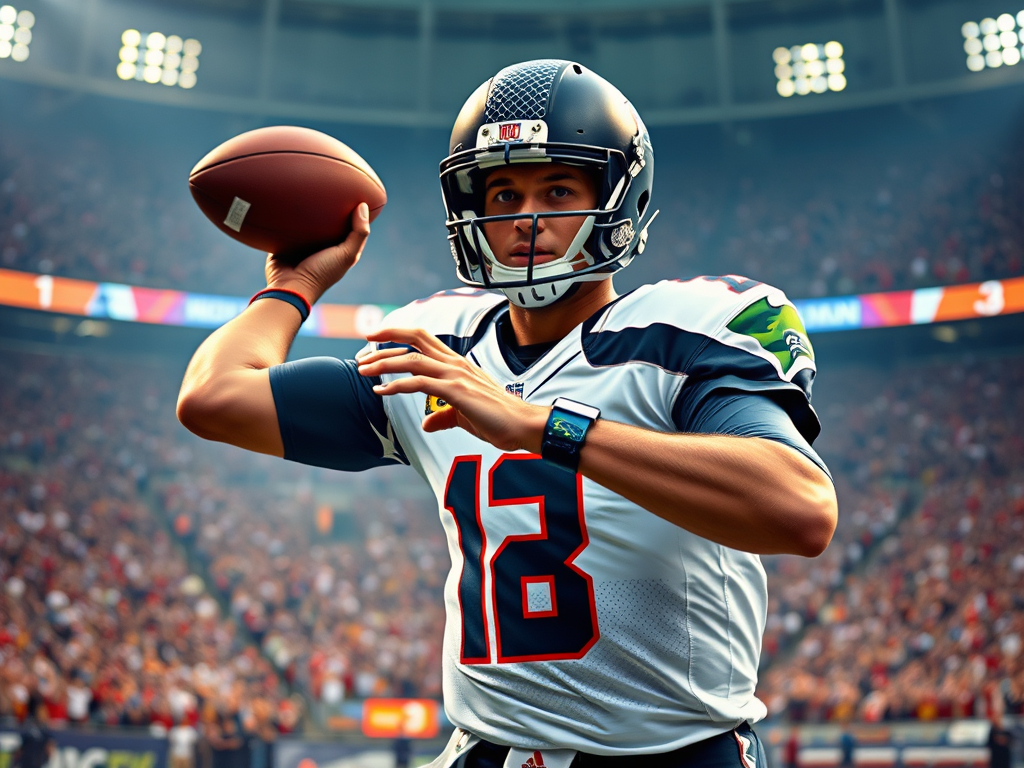

EAST RUTHERFORD, N.J. — When Russell Wilson first stepped onto an NFL field, few believed he would rewrite the record books. At 5-foot-11, his frame was considered too small for a league that prized towering quarterbacks with rocket arms. Scouts looked at him and saw a future second baseman, not a Super Bowl champion. Built compact and stocky, he resembled the kind of baseball player who would dive into a double play, not a man destined to take snaps under center.
In fact, baseball nearly claimed him. The Colorado Rockies drafted Wilson in 2010, projecting him as a reliable middle infielder. But two years later, Wilson made a career-altering decision: instead of chasing a baseball dream, he entered the NFL Draft. Chosen in the third round by the Seattle Seahawks, he earned a modest rookie salary of $390,000. At the time, the team had just invested $10 million in free-agent quarterback Matt Flynn. Almost everyone assumed Flynn would start. Wilson proved them all wrong.
By his second season, he had already become the shortest quarterback ever to win a Super Bowl. In doing so, he shattered one of football’s most persistent myths: that only tall quarterbacks could succeed at the highest level. Wilson beat Peyton Manning and the Denver Broncos in a dominant Super Bowl XLVIII performance, hoisting the Lombardi Trophy at MetLife Stadium. A year later, he nearly repeated the feat, only to be denied by Tom Brady and the New England Patriots in a heartbreaking goal-line interception.
Those moments cemented Wilson as a household name, and for nearly a decade he was among the NFL’s elite. He won more games in his first nine seasons than legends like Brady and Manning. His combination of precision passing, improvisation, and leadership made him one of the most dangerous players in the league. Yet now, at 36, Wilson stands on the edge of what may be his final NFL start, wearing the jersey of the New York Giants — a team historically dominated by their rivals, the Dallas Cowboys.
A Career of Highs and Lows
Wilson’s early career was nothing short of remarkable. He posted nine consecutive winning seasons, eight of them with double-digit victories, guiding the Seahawks to multiple playoff appearances. At that stage, he looked like a guaranteed future Hall of Famer, a lock for Canton, Ohio.
But the last four years have been far more turbulent. His relationship with longtime Seattle coach Pete Carroll soured, leading to a blockbuster trade to the Denver Broncos in 2022. That move, intended to spark another championship run, quickly turned into a nightmare. Denver gave Wilson extraordinary privileges — including his own office at the facility and the ability to hire personal staff — but his on-field performance never matched the hype. He publicly declared his ambition to win “three or four more Super Bowls,” yet the Broncos went just 11-19 across two seasons. After clashing with coaches and struggling to regain his form, Wilson was released.
He then landed in Pittsburgh, but the rebound was short-lived. Despite his experience, he lost five straight games to close out the season, including a playoff defeat to Baltimore. Reports of tension with offensive coordinator Arthur Smith surfaced, and by offseason’s end, his time there was over. The Giants picked him up on a one-year, $10.5 million contract — a move born less from conviction and more from necessity after Aaron Rodgers turned down the opportunity to play in New York.
The Public Image Problem
Wilson’s decline has not only been about physical ability. His relentless optimism, once seen as a strength, began to alienate fans and teammates when paired with disappointing results. Critics accused him of being overly scripted, too polished, almost political in his public persona. Stories circulated of awkward interactions — like when Marshawn Lynch recalled receiving a call from Wilson with his number blocked — fueling perceptions of inauthenticity.
Yet labeling Wilson as fake has always been an oversimplification. He is, after all, a recipient of the Walter Payton NFL Man of the Year Award and the Bart Starr Award, honors given to players recognized for character and leadership. Those accolades suggest that his contributions off the field are as genuine as they are impactful.
Statistically, Wilson’s accomplishments also demand respect. Drafted behind quarterbacks like Brandon Weeden and Brock Osweiler, he defied the odds to become a 10-time Pro Bowler. His career passer rating of 99.5 still ranks among the top five in NFL history, ahead of Brady and Manning. He also once held a 10-0 record against quarterbacks who had won Super Bowls — a testament to his ability to rise to the occasion.
Facing the Final Curtain
Despite those achievements, reality is closing in. Giants fans are eager to see Jaxson Dart, the confident rookie out of Ole Miss, take over. Head coach Brian Daboll, under pressure to deliver results, must weigh loyalty to a veteran against the future of the franchise. Wilson himself seems aware of what’s at stake.
“I think that you embrace challenge; I don’t think I’ve run from challenges,” he said this week. “I don’t think I’ve run from anything.”
He hasn’t. But his body may no longer allow him to perform at the level required. Against Dallas, Wilson has one last chance to remind the football world of who he once was — the undersized quarterback who never blinked in the face of doubt, the player who could silence critics with a single throw. A win against the Cowboys, ending their eight-game streak over the Giants, would be a fitting farewell at MetLife, the same stadium where he first reached football’s summit.
A Legacy That Lasts
Whenever his final snap comes, Wilson’s place in history is secure. He is the second Black quarterback to win a Super Bowl, following Doug Williams, and the first Black quarterback to start a season for the New York Giants. Beyond the statistics and accolades, his career has been a story of perseverance, belief, and resilience.
Wilson once declared, “My confidence never blinks.” It’s a phrase that perfectly encapsulates his journey. He was too short, too unconventional, too optimistic — and yet he won at the highest level. He inspired smaller quarterbacks, young Black athletes, and countless fans who saw in him a symbol of possibility.
Football is often described as a game of giants, but Wilson proved there is room for those who don’t fit the mold. He showed that success comes not just from size or strength, but from vision, determination, and heart.
As the end approaches, one can only hope that Wilson has one more moment left in him — one more game that reminds us why he was special. Before he leaves the stage, it would be fitting to let Russ cook one last time.




Leave a Reply