
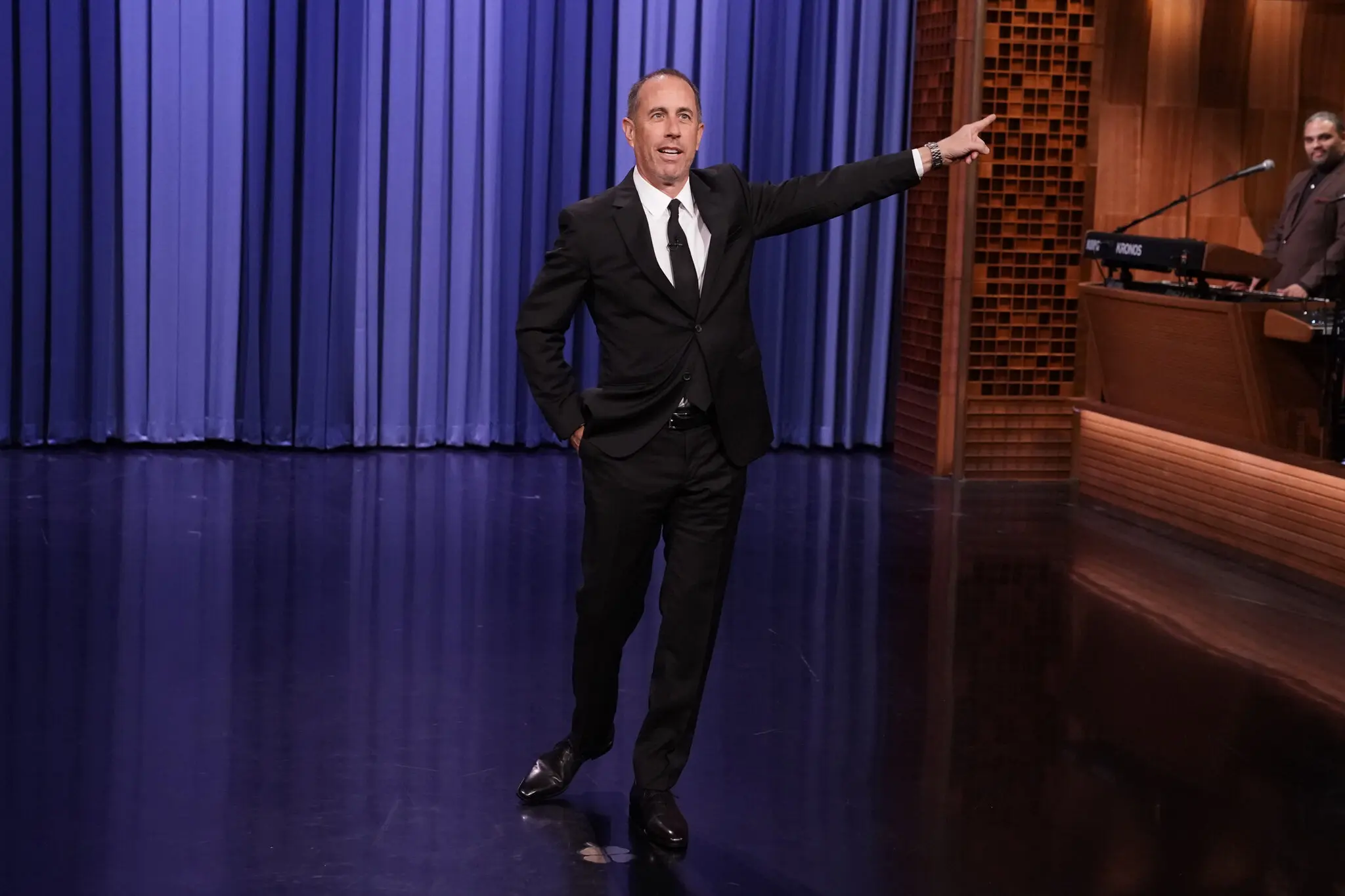

Comedian Jerry Seinfeld, best known for his legendary 1990s sitcom Seinfeld, has once again found himself at the center of controversy after making provocative remarks at Duke University earlier this week. During a surprise appearance on campus, Seinfeld described the “Free Palestine” movement as antisemitic and drew a shocking comparison between the movement and the Ku Klux Klan. His comments, widely reported by student journalists and confirmed through audio recordings, have triggered a heated wave of debate both online and within the Duke community.
Seinfeld’s Remarks and Controversial Comparison
According to The Duke Chronicle, Seinfeld told the audience that supporters of the “Free Palestine” movement often mask their true beliefs. “Just say you don’t like Jews,” he remarked bluntly, suggesting that the slogan itself conceals antisemitic intent.
Seinfeld elaborated further by comparing the movement to the Ku Klux Klan, the white supremacist group historically associated with violent racism and antisemitism. “When the Klan says, ‘We don’t like Blacks, we don’t like Jews,’ at least that’s honest,” he continued. “With ‘Free Palestine,’ you’re not admitting what you really mean.”
The comparison stunned many in attendance and has since drawn widespread criticism for equating a human rights movement with one of the most notorious hate groups in American history. While an audio recording confirmed his remarks, Seinfeld’s representatives declined to comment further when reached by reporters later in the week.
Context: The Event and Omer Shem Tov’s Story
Seinfeld’s controversial comments came during an event featuring Omer Shem Tov, a former Israeli hostage abducted during the Hamas-led assault on southern Israel on October 7, 2023. The attack killed around 1,200 people and sparked the ongoing Israel-Gaza war, which health authorities in Gaza say has now claimed more than 64,000 lives.
Shem Tov, one of about 250 people kidnapped during the attack on a music festival, endured over 500 days in captivity before his release in February 2025 as part of a cease-fire agreement. The Duke University event was originally framed as an opportunity for Shem Tov to share his spiritual journey and reflections on survival. Seinfeld’s presence was unannounced, reportedly to keep the focus on Shem Tov’s experience.
Duke University’s Response
Following the backlash, Duke University issued a statement emphasizing that outside speakers’ remarks are not vetted or endorsed by the institution. “Universities are places where diverse perspectives on difficult and sensitive subjects are explored in a safe and respectful environment,” a university spokesperson said.
The spokesperson clarified that Seinfeld’s appearance was not advertised beforehand precisely so the discussion could highlight Shem Tov’s personal narrative rather than turn into a public spectacle. Still, many students criticized the university for giving a platform to what they described as inflammatory rhetoric.
Student Reactions and Organized Criticism
Seinfeld’s comments immediately ignited frustration among several student organizations. In a joint statement released on social media, groups including Duke Students for Justice in Palestine (SJP), the Muslim Student Association, Sunrise Duke, and the Duke Jewish Solidarity Movement condemned his remarks.
The statement argued that equating “Free Palestine” with white supremacist ideology was not only misleading but also deeply offensive. “Suggesting that advocating for Palestinian freedom is the same as espousing hate ignores the reality of a struggle for basic human rights,” the student groups wrote. “It vilifies students who speak out for justice and dignity.”
The groups further emphasized that the remarks created a hostile environment for Muslim, Arab, Palestinian, and allied students, many of whom reported feeling unsafe and unsupported on their own campus.
In a separate joint release, Duke SJP and the Jewish Solidarity Movement described the event as “platforming pro-Israel narratives under the guise of neutrality” and accused Seinfeld of promoting “a false and dangerous binary” that oversimplifies the complex realities of the Israel-Palestine conflict.
Seinfeld’s History of Outspoken Support for Israel
This is not the first time Jerry Seinfeld has expressed strong opinions about Israel and its critics. Over the years, he has been vocal about his Jewish identity and has consistently defended Israel during times of international scrutiny.
In 2023, Seinfeld signed a public letter backing Israel during the early days of the conflict. He also posted heartfelt messages on social media reaffirming his commitment to the country. His position has sometimes drawn criticism, particularly on U.S. college campuses, where student activism in support of Palestinian rights has grown louder.
At Duke’s 2024 commencement ceremony, where Seinfeld received an honorary degree and delivered the keynote address, dozens of graduating students staged a walkout. Chanting “Free, free Palestine,” the demonstrators left the arena as Seinfeld looked on, visibly uncomfortable but attempting to maintain composure.
Why His Comments Sparked Such Intense Backlash
Observers note that Seinfeld’s decision to compare the “Free Palestine” movement to the Ku Klux Klan struck a particularly raw nerve. Critics argue that while antisemitism is a real and serious issue, equating a political movement with one of America’s most violent racist organizations risks trivializing both struggles.
For Palestinian rights advocates, the comments reduce a decades-long humanitarian issue to mere hatred, ignoring calls for sovereignty, freedom, and dignity. For others, the remarks underscored broader concerns about freedom of expression on U.S. campuses and the challenges of navigating highly polarized debates around Israel and Palestine.
Broader Implications for Universities
The controversy also highlights the difficult role universities play in hosting dialogue on divisive issues. On one hand, institutions like Duke champion free speech and open debate. On the other, they must also protect the wellbeing of their diverse student populations.
When a high-profile figure like Jerry Seinfeld uses such provocative language, it raises questions about whether certain remarks cross the line from free expression into fostering hostility. Student activists argue that inviting speakers with polarizing perspectives without adequate context or moderation risks alienating vulnerable communities.
The Continuing Debate
The fallout from Seinfeld’s remarks shows no sign of slowing down. Social media has amplified both support and criticism, with hashtags connected to the controversy trending across platforms. Some defenders argue that Seinfeld was merely exposing what he sees as antisemitism disguised as political activism. Others counter that such comparisons only inflame divisions and silence legitimate discourse.
For Duke, the episode adds to a growing list of flashpoints as universities nationwide grapple with how to manage conversations around the Israel-Gaza conflict. From protests to walkouts to guest speaker controversies, campuses have become battlegrounds for broader debates about human rights, free speech, and political responsibility.
Conclusion
Jerry Seinfeld’s surprise appearance at Duke University, intended to highlight the harrowing story of former hostage Omer Shem Tov, instead turned into a national controversy after the comedian’s inflammatory comments about the “Free Palestine” movement. By likening it to the Ku Klux Klan, Seinfeld reignited long-standing tensions about antisemitism, Palestinian advocacy, and the role of universities in facilitating dialogue on such contentious issues.
While the debate over Seinfeld’s words will continue, the incident underscores the challenges of balancing free speech with respect, as well as the complexity of discussing one of the most deeply polarizing conflicts in modern history. What is clear is that both supporters and critics of his remarks see the issue as far larger than a single university event, reflecting a broader struggle over narratives, justice, and identity in the United States and beyond.




Leave a Reply