
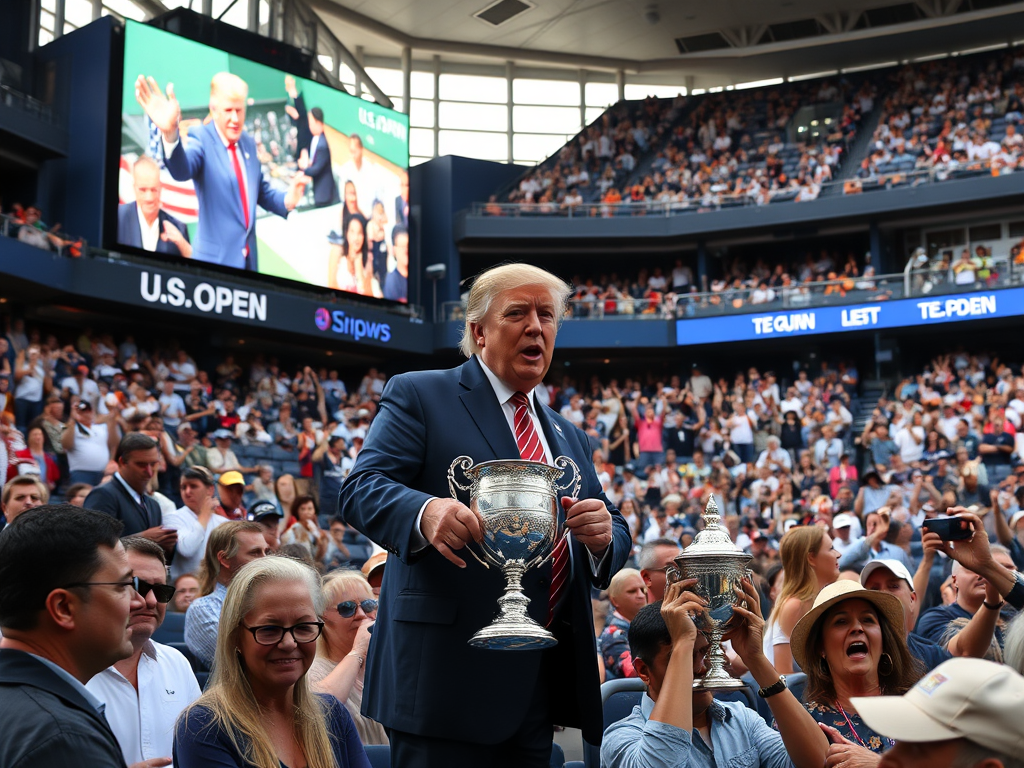

FLUSHING MEADOWS, N.Y. — Former U.S. President Donald Trump made his first appearance at the U.S. Open in nearly ten years, drawing both loud boos and pockets of cheers from fans. His arrival at the Billie Jean King National Tennis Center added a political layer to the final Grand Slam of the season, where Spain’s Carlos Alcaraz ultimately claimed victory over Italy’s Jannik Sinner.
Trump, seated just a few feet away from the glittering silver trophy that would soon belong to Alcaraz, was not an official guest of honor but an attention-grabbing spectator. With his trademark entourage, Secret Service detail, and press pool, his presence introduced logistical complications, heightened security, and moments of drama that extended well beyond the tennis court.
A Divisive Welcome in Arthur Ashe Stadium
The former president was first shown on the massive video boards in Arthur Ashe Stadium after the opening set, when the crowd erupted in a mixture of jeers and applause. Trump responded with a nod and mouthed the words “thank you” as the sound alternated between boos and cheers. At other points in the evening, he acknowledged fans directly, pointing and smiling at those who called out to him or tried to capture selfies from nearby seats.
When Trump entered the Rolex suite before the start of the match, he was greeted with another wave of noise from the gradually filling stands. Flanked by Jean-Frederic Dufour, the chief executive of Rolex, he saluted during the playing of the national anthem. When cameras panned back to him, the reaction from the audience was so loud it briefly drowned out the performance.
Television viewers, however, saw little of these moments. Organizers sought to minimize coverage of Trump’s attendance, and broadcasters avoided dwelling on crowd reactions, focusing instead on gameplay.

Political Allies in the Stands
Trump was accompanied by a host of high-profile figures from his circle. Nameplates marked seats for senior adviser Jared Kushner, attorney general Pam Bondi, press secretary Karoline Leavitt, Middle East envoy Steve Witkoff, Treasury secretary Scott Bessent, and chief of staff Susie Wiles. The display underscored the extent to which Trump, even as a private citizen, commands a government-like entourage at public events.
Before arriving in Queens, Trump posted on Truth Social about flying above the stadium in his plane. In typical fashion, his posts also drifted into unrelated topics, touching on wind energy and conflicts in the Middle East. Hours earlier in Washington, he told reporters his comments about using the military to “clean up” Chicago were not intended as a threat.
Crowds, Delays, and Airport-Style Security
The presence of a former president transformed the final into a high-security affair. Secret Service agents in tactical gear patrolled the grounds, while fans endured airport-style checkpoints that caused long delays. Arthur Ashe Stadium, which holds 24,000 spectators, became gridlocked as fans tried to make their way inside.
The bottleneck was so severe that organizers delayed the start of the championship match by half an hour, throwing off the pre-match routines of both players. Even after play began, fans continued trickling into their seats well past the first set, greeted by commemorative blue U.S. Open hats as they finally cleared security.
Tension Between Sport and Politics
Although Trump’s visibility was intentionally downplayed by broadcasters, his presence remained impossible to ignore inside the stadium. Fans crowded the edges of his suite between sets, straining for a glimpse or a wave. Chair umpire James Keothavong even asked spectators to return to their seats as they leaned over the railings, eager to catch the former president’s attention.
Still, the players themselves kept their focus on the court. Alcaraz and Sinner did not acknowledge Trump during or after the match. After securing his victory, Alcaraz celebrated with his team and the crowd, climbing into the stands to greet his coaches and family. He briefly walked toward Trump’s section but turned away before reaching it, choosing instead to embrace his supporters.
Trump, despite sitting near the Tiffany-designed championship trophy for much of the night, played no role in the award ceremony. Unlike his earlier appearances at sporting events—such as presenting the trophy to Chelsea after its Club World Cup win—he remained a spectator here.
Broadcasting Decisions and Media Control
A memo from the United States Tennis Association (USTA), later reviewed by The Athletic, revealed that organizers had instructed broadcasters to avoid highlighting Trump’s presence. “We ask all broadcasters to refrain from showcasing any disruptions or reactions in response to the President’s attendance in any capacity,” the USTA stated.
While ABC and ESPN, both owned by Disney, did not publicly comment, insiders confirmed that production teams intended to treat Trump as they would any other high-profile attendee while keeping the focus squarely on tennis. As a result, the loudest crowd reactions to Trump—particularly after the first set—were not aired live, since ABC was on a commercial break at the time.
A Familiar Figure in the Sports World
Trump’s connection to the U.S. Open runs deep. Before entering politics, he regularly attended the tournament for nearly two decades, maintaining his own suite until 2017. His last appearance before this year came in 2015, during a quarterfinal match between Venus and Serena Williams, when he was also met with a chorus of boos.
Since leaving the White House, Trump has continued to use sporting events as highly visible stages. He attended Super Bowl LIX earlier this year, departing at halftime, and has become a vocal supporter of LIV Golf, hosting events at his Miami resort. He also made headlines when he attended a UFC event in New York shortly after securing his second presidential term. Later this year, he is expected to appear at the FIFA World Cup draw in Washington, D.C., alongside FIFA President Gianni Infantino.

Alcaraz Claims Victory
While Trump’s appearance dominated off-court discussion, the night ultimately belonged to Carlos Alcaraz. By defeating Jannik Sinner, the young Spaniard not only captured the final Grand Slam title of the year but also reclaimed the world No. 1 ranking.
Speaking before the match, Alcaraz had described Trump’s attendance as “a privilege,” adding that he would try not to think about it once play began. True to his word, the 21-year-old Spaniard stayed focused, outlasting his Italian rival in four sets to secure his place at the top of men’s tennis.
A Night of Contrasts
The final at Flushing Meadows became more than just a championship tennis match. It highlighted the ongoing intersection of politics, celebrity, and sport in the United States. For some fans, Trump’s appearance added excitement and energy. For others, it was a distraction that complicated what should have been a celebration of athletic excellence.
Yet in the end, the image that defined the evening was not the polarized reaction to Trump, nor the heavy presence of Secret Service agents, but the sight of a smiling Carlos Alcaraz holding the trophy high above his head, proving once again that the U.S. Open is a stage where history is written—on the court, not just in the stands.




Leave a Reply