
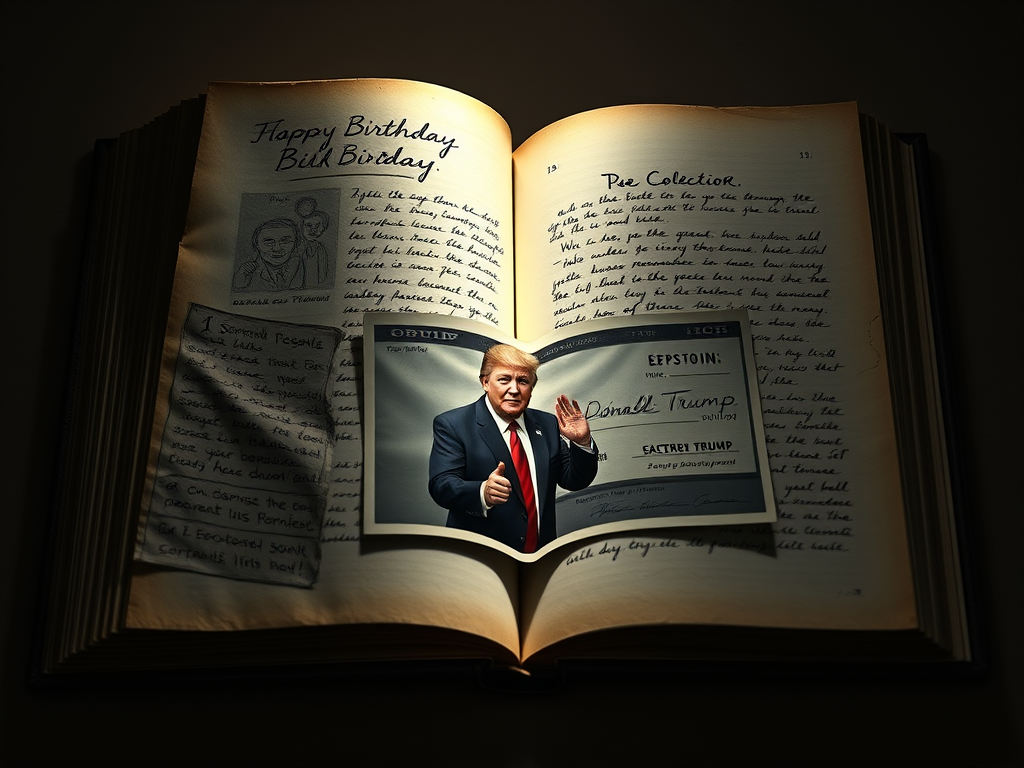

A newly released set of files tied to Jeffrey Epstein has reignited political controversy in Washington, this time involving references to former President Donald J. Trump. Lawmakers on the House Oversight Committee on Monday unveiled a 238-page “birthday book” that Epstein received for his 50th birthday, a volume filled with bizarre jokes, sexual innuendos, and crude illustrations contributed by members of his social circle. While the release drew immediate attention for a sexually suggestive drawing bearing what looked like Trump’s signature, another entry connected to the former president quickly became a point of contention for Democrats and critics alike.
A Page That Raised Eyebrows
One entry, dated from the late 1990s but compiled into the 2003 birthday book, was submitted by Joel Pashcow, a New York real estate executive and member of Trump’s Mar-a-Lago resort in Palm Beach, Florida. The page included a photograph of Pashcow alongside Epstein, an unidentified man, and a young woman whose face was redacted from the record. Pashcow is pictured holding an oversized check that appeared to have been deliberately altered, complete with a counterfeit “DJ TRUMP” signature.
Beneath the photograph was a handwritten note that mocked Epstein’s supposed “early talents with money and women.” The note further claimed—apparently as a joke—that Epstein had “sold” a “fully depreciated” woman to Trump for $22,500. The remark, offensive in tone, made the woman sound like property rather than a person.
Who Was the Woman?
Although her identity was obscured in the Oversight Committee’s public release, sources familiar with the original photo said she was a European socialite in her twenties at the time. Court records and testimony have indicated that she had briefly been romantically linked with both Epstein and Trump during the 1990s. Observers believe the entry was a crude reference to the rivalry between the two men for her affections.
The nature of her relationship with Epstein, however, is ambiguous. Legal filings suggest she may have been among the many women entangled in Epstein’s orbit, though there is no public confirmation of victimization. The New York Times and other outlets withheld her name out of caution.
A lawyer representing the woman clarified that she had known Epstein only in a “professional capacity” while still a student, and she cut off contact with him in 1997. The lawyer added that she had no knowledge of Pashcow’s message in the birthday book or its “derogatory content.”
The House Oversight Committee’s Role
The House Oversight Committee obtained the volume after subpoenaing Epstein’s estate and chose to make its contents public, part of a broader push for transparency about Epstein’s connections. Alongside Pashcow’s entry, the release included a lewd cartoon allegedly drawn by Trump—a claim the White House swiftly denied.
Karoline Leavitt, press secretary for the Trump administration, said the former president had “absolutely nothing” to do with either the crude cartoon or the oversized check seen in the photo. She stressed that Trump neither drew the illustration nor signed the doctored check. Pashcow, now 82, declined to comment, and his lawyer also did not respond to media requests.
Nevertheless, Democrats on the committee amplified the story, posting on X in bold lettering: “NEW PAGE FROM EPSTEIN’S BIRTHDAY BOOK.” The move immediately sparked heated exchanges online, reflecting the charged political atmosphere surrounding anything that ties Trump to Epstein.
The Cartoon That Shocked Lawmakers
Pashcow’s contributions to the book went beyond the doctored check. On the preceding page, he submitted a vulgar cartoon that portrayed Epstein at two moments in time. In the 1983 panel, Epstein was depicted handing balloons to a group of young girls. By 2003, the drawing showed him receiving a naked massage from topless women. Beneath the illustration was the caption: “What a great country!”
For critics of Epstein and his associates, this cartoon underscored how normalized inappropriate jokes about underage girls seemed to be in certain circles during that era. For lawmakers, it further emphasized why the documents had to be released to the public.
Trump and Epstein: A Complicated History
While the revelations in the birthday book do not establish wrongdoing on Trump’s part, they add texture to the long-documented relationship between Trump and Epstein. The two men were known to be friendly during the 1990s and early 2000s, before Epstein’s first conviction for sex crimes in 2008.
Trump himself once described Epstein as a “terrific guy” who “liked beautiful women as much as I do,” though he later distanced himself after Epstein’s criminal charges became public. Visual evidence, including photographs and video, has long confirmed that Trump and Epstein attended some of the same social gatherings during that period.
A visual analysis conducted by The New York Times determined that the oversized check photograph was taken at Mar-a-Lago shortly after it opened as a private club in 1996. The landscaping, palm trees, and thatched hut visible in the background match features documented at the resort in February 1997 by professional tennis photographer Art Seitz.
Connections to the Maxwell Trial
The unnamed woman in the photograph resurfaced in testimony during the criminal trial of Ghislaine Maxwell, Epstein’s longtime associate who is now serving a 20-year sentence for sex trafficking minors. Witnesses in that trial described her as someone close to both men during the 1990s. An employee of Maxwell and Epstein testified that the pair “felt like a couple” at the time, adding another layer of intrigue to her identity.
Joel Pashcow’s Ties to Epstein
Pashcow himself was not a minor figure in Epstein’s network. His name appears in Epstein’s infamous “black book,” a directory of associates, and flight logs reveal that Pashcow traveled on Epstein’s private planes approximately ten times between 1994 and 2001. Despite this, lawyers representing Epstein’s victims have not identified Pashcow in any litigation.
His contributions to the birthday book, however, paint a picture of someone deeply enmeshed in Epstein’s social world—someone who was comfortable enough to create entries that blurred the line between crude humor and offensive commentary.
Renewed Scrutiny and Political Fallout
For Democrats, the resurfacing of this material offers ammunition in highlighting Trump’s past associations, especially at a time when he faces multiple legal challenges unrelated to Epstein. For Republicans, the release is seen as another attempt to weaponize Epstein’s name to damage Trump politically.
Either way, the Oversight Committee’s decision to publish the book has renewed public scrutiny of the high-profile individuals who once surrounded Epstein. With each new document, more questions arise about who knew what, and when.
Conclusion
The Epstein saga continues to cast a long shadow over American politics, celebrity culture, and the blurred intersections of wealth and influence. While the 50th birthday book may at first glance look like an artifact of crude jokes and questionable humor, its resurfacing highlights deeper issues: the normalization of inappropriate behavior in elite circles, the casual objectification of women, and the ways in which Epstein maintained a powerful social network for decades.
For Trump, the latest revelations may not prove direct involvement in Epstein’s crimes, but they add another chapter to the complex history of his past associations. As lawmakers, journalists, and the public continue to sift through the archives of Epstein’s life, the echoes of his network remain impossible to ignore.




Leave a Reply