
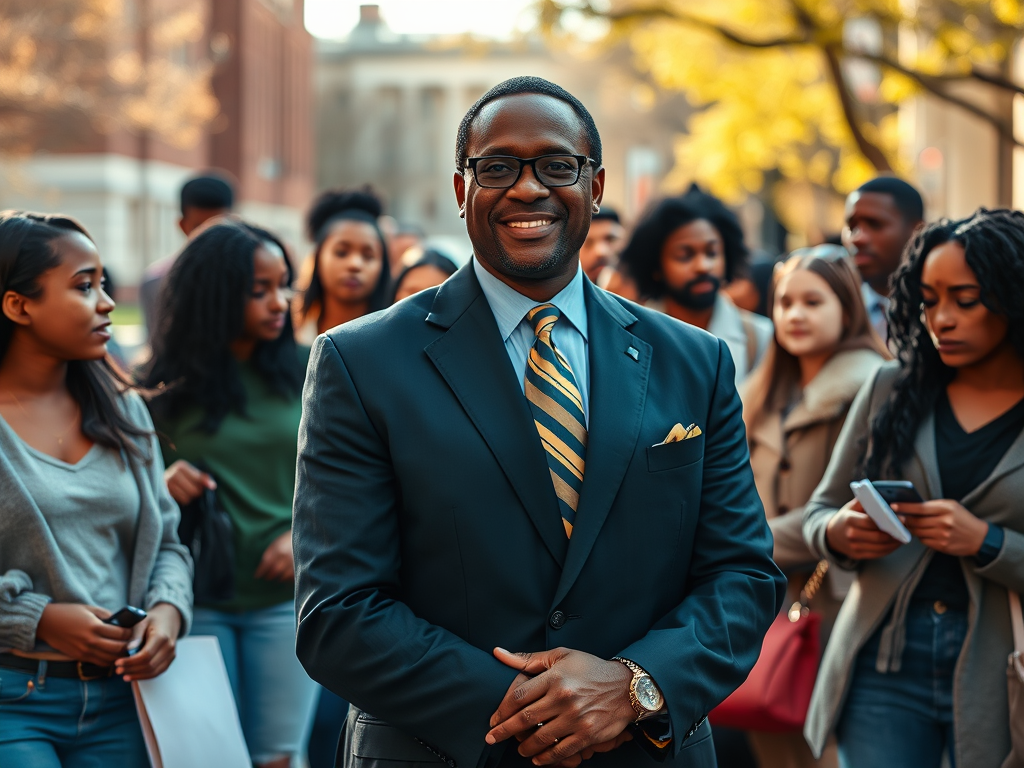

When Gregory N. Washington took office in 2020 as the first Black president of George Mason University, he stepped into a campus already simmering with political and social tension. That year, the United States was grappling with the height of the Black Lives Matter movement, and student activists were questioning the legacy of George Mason himself — a founding father and slaveholder. Demonstrators demanded that the university remove his statue, arguing that it represented a painful contradiction to the school’s diverse community.
Dr. Washington, intent on reducing racial tensions and shaping a more inclusive university culture, now finds himself at the center of a very different storm. Five years later, the Trump administration has accused him of violating the Civil Rights Act by allegedly discriminating against white academics through hiring and promotion practices. This interpretation of the law — historically intended to protect minorities from discrimination — has sparked outrage among critics who argue that the administration is twisting its intent.
To intensify the conflict, federal officials demanded that Dr. Washington issue a public apology for supporting diversity initiatives, framing his leadership as unlawful. He has refused, saying that compliance would damage not only his personal reputation but also the university’s.
“I can’t accept this characterization because it undermines everything we’ve worked toward,” he explained in a recent interview. His resistance places him among a select group of higher education leaders, such as those at Harvard and Princeton, who have publicly challenged the Trump administration’s directives. Unlike many of his peers, however, Washington has been singled out individually, making his situation unusually precarious.
Universities Under Political Pressure
The federal government’s scrutiny of George Mason fits into a broader national campaign targeting universities. For years, President Trump and his allies have accused higher education institutions of elitism and left-leaning indoctrination. University leaders counter that their campuses are essential to free inquiry, evidence-based research, and democratic dialogue.
George Mason stands apart from the elite Ivy League schools often attacked by critics. As Virginia’s largest public university, it accepts about 90 percent of its applicants and serves a predominantly middle-class student body. It is also recognized as one of the most diverse campuses in the nation.
Despite the broad support Dr. Washington enjoys, he has not been immune to criticism. Faculty members have debated his handling of diversity policies and his management of pro-Palestinian demonstrations. Still, many were surprised when the Department of Education launched its investigation and demanded an apology by September 1.
“This is confusing and frustrating,” Washington admitted. His statement reflects the broader uncertainty felt by university leaders nationwide, as political interference escalates.
Already, federal actions have led to the resignation of prominent university presidents. Just this summer, Northwestern University’s president, Michael Schill, stepped down following intense questioning from Congress and the freezing of nearly $800 million in federal funds. Few leaders, however, have faced the personal spotlight in the way Washington has.

Allegations and Response
Craig Trainor, assistant secretary for civil rights at the Department of Education, intensified the situation by accusing Dr. Washington of leading a “university-wide campaign” to enforce illegal diversity, equity, and inclusion (DEI) policies that discriminated by race. The statement, heavily criticized by faculty, further fueled speculation about his job security, especially as some right-leaning members of the George Mason board reportedly push for his removal.
Washington, however, grounds his resilience in faith. Citing the biblical verse “No weapon formed against me shall prosper,” he has framed his leadership as a journey guided by grace and determination.
His personal story underscores the resilience he speaks of. Born in Harlem to a teenage mother, Washington grew up amid poverty and social challenges. At age 12, he witnessed his first drug deal. By his own account, only a handful of his childhood friends survived without falling victim to prison, addiction, or violence. His family later relocated to Raleigh, North Carolina, where he thrived academically despite being one of few Black students at his high school. He went on to earn three degrees in mechanical engineering from North Carolina State University.
From there, he rose through academia, eventually serving as dean of engineering at the University of California, Irvine. His commitment to expanding opportunities for underrepresented groups was seen as a strength when he was appointed president of George Mason. At the time, Virginia’s Democratic governor, Ralph Northam, was championing the One Virginia Plan, a statewide strategy to advance diversity.
Shortly after arriving at George Mason, Washington established a task force on diversity, declaring his goal to make the university a national model of anti-racism and inclusive excellence.

The Legal and Political Battle
At the heart of the federal complaint are remarks Washington made in 2021, when he suggested that if two candidates were equally qualified, preference could be given to the applicant who contributed to the institution’s diversity. Opponents argue that such statements reflect unlawful favoritism.
Bryan Caplan, a professor of economics at George Mason and a vocal critic, described feeling “thinly veiled pressure” to prioritize minority candidates. He cited diversity training sessions and external oversight on hiring committees. Washington has consistently denied advocating quotas, clarifying that his approach sought to broaden opportunity rather than enforce rigid targets.
Data supports his defense. According to an analysis by Timothy Gibson, president of the George Mason chapter of the American Association of University Professors, faculty demographics have remained largely stable since 2015. About 63 percent of the full-time faculty are white, showing little change despite Washington’s initiatives. Gibson and others argue that ideological opposition to DEI is driving the federal complaint, rather than evidence of actual discrimination.
Washington has retained Douglas F. Gansler, former attorney general of Maryland, as his legal counsel. Gansler has accused the administration of “gross mischaracterizations” and emphasized that investigators have failed to identify a single applicant who was denied an opportunity because of race.

Broader Implications for Higher Education
George Mason’s clash with federal authorities reflects a larger battle over the future of DEI in American universities. Virginia has become a central battleground, with conservatives challenging diversity programs at multiple institutions. Earlier this year, Virginia Military Institute’s board declined to renew the contract of its first Black superintendent, Maj. Gen. Cedric T. Wins, accusing him of pushing a “woke” agenda. Similarly, University of Virginia President James E. Ryan resigned under Department of Justice pressure linked to his support for diversity initiatives.
These high-profile departures have emboldened critics who seek to dismantle DEI structures nationwide. Washington’s case, therefore, carries symbolic weight: success or failure in his defense could set precedent for how universities handle diversity moving forward.
Faculty at George Mason largely support him, highlighting his successes in raising enrollment, strengthening finances, and boosting the university’s national ranking. U.S. News & World Report recently placed George Mason at No. 52 among public universities, an improvement credited partly to his leadership.
Still, Washington faces an uphill battle. While he has made adjustments to comply with evolving guidance from Virginia’s Republican governor Glenn Youngkin and the Trump administration, he believes he is being penalized for past decisions that were lawful at the time.
“They are investigating me for actions they now call offenses, even though the rules have changed since then,” he said. “It’s like lowering the speed limit today and charging you for speeding four years ago.”
A Precarious Future
The future of Washington’s presidency remains uncertain. His refusal to apologize and the ongoing investigation have heightened tensions, not only on campus but also in political circles closely tied to George Mason. The university’s proximity to Washington, D.C., and its connections to influential conservative organizations like the Heritage Foundation have further fueled the scrutiny.
With his administration under legal and political siege, Washington has become a symbol of resilience in higher education. His story resonates with many who see the investigation as a test of academic freedom and institutional autonomy in an increasingly polarized nation.
As debates over race, diversity, and fairness continue to divide the country, George Mason University stands at the crossroads of a national reckoning. The outcome of Dr. Washington’s case will not only determine his own legacy but could also shape the trajectory of diversity policies across America’s colleges and universities.




Leave a Reply