
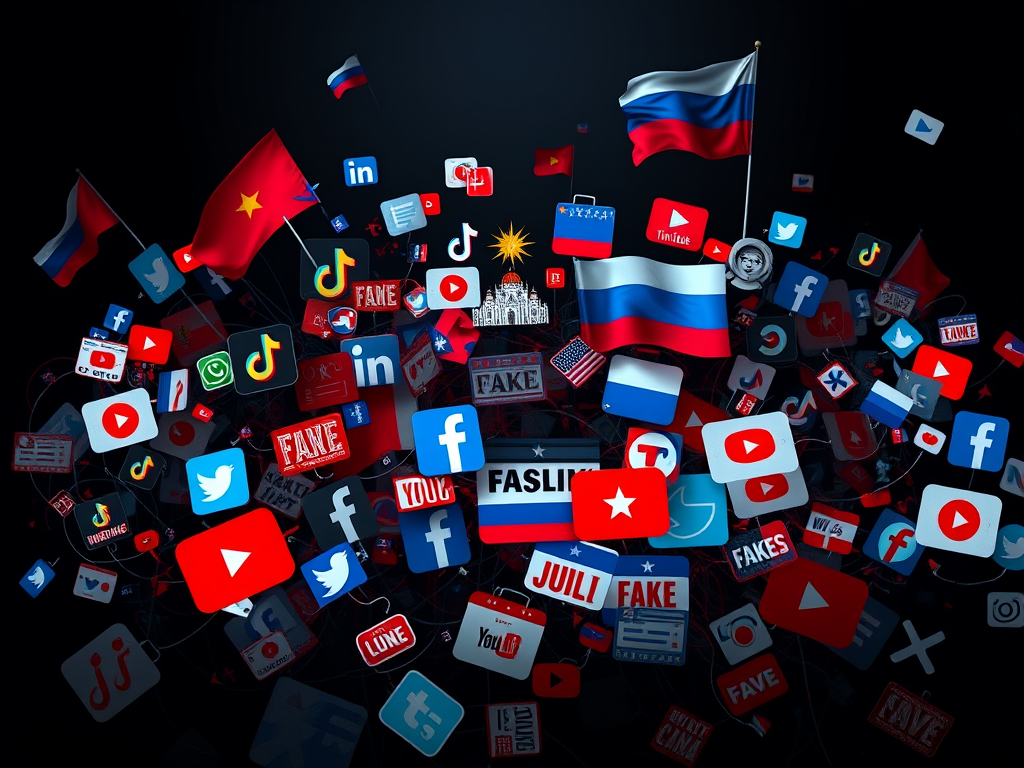

Since Donald Trump’s return to the White House in January, his administration has swiftly rolled back U.S. programs aimed at countering foreign disinformation. Yet while Washington pulls back, Russia has only intensified its efforts. Nowhere is this more visible than in Moldova, a small but strategically important European country that has long tried to escape Moscow’s grip by aligning with the United States and the European Union.
Moldova’s parliamentary elections, scheduled for September 28, are being shaped not only by domestic politics but also by a sophisticated Kremlin-backed disinformation campaign. Researchers and European officials say that Moscow has unleashed one of its most aggressive online operations yet, using fake videos, fabricated news sites, and AI-generated posts distributed through TikTok, Telegram, Facebook, Instagram, and YouTube.
A New Phase of Russian Information Warfare
What is striking is not only the scale of Russia’s disinformation campaign but also the context in which it is unfolding. The Trump administration has cut diplomatic and financial support for Moldova’s defense against foreign influence, even though the Kremlin’s efforts have become more advanced.
One particularly bizarre example involved a fake post impersonating the U.S.-based celebrity magazine OK! that spread a baseless and sensational accusation against Moldovan President Maia Sandu. Such falsehoods are not only aimed at discrediting leaders but also at eroding trust in institutions and dividing the electorate.
Under the Biden administration, American officials had pressured major platforms such as Meta to crack down on troll farms and inauthentic accounts. Today, those efforts have largely ceased. As Thomas O. Melia, a former senior official at the State Department and USAID, put it, “The Russians now are able to basically control the information environment in Moldova in a way that they could only have dreamed a year ago.”

Dismantling U.S. Soft Power
The election in Moldova is not just a local contest; it is an early test of what the world can expect as the Trump administration dismantles America’s post–Cold War democracy-promotion infrastructure. Funding cuts have hit hard, not only slashing direct aid to countries like Moldova but also undermining institutions such as Radio Free Europe and Voice of America—longstanding tools of American influence.
Melia warns that this “reckless destruction of America’s soft power” leaves a vacuum for authoritarian actors, especially Russia, to fill. The White House and State Department have declined to comment on Russia’s active operations in Moldova.
Russia’s Refined Tactics
Despite Trump’s frequent claims that election interference is a hoax, Russia’s covert activities are thoroughly documented. They have shaped elections not only in the United States but also across Europe, including in Germany, Poland, and Romania.
Moldova, bordering Ukraine and long considered geopolitically fragile, has become a testing ground for what analysts call “hybrid warfare.” The Stimson Center, a Washington-based think tank, has described the country as a laboratory for influence operations that could later be deployed across the continent.
The Kremlin’s goal is clear: to keep Moldova within its sphere of influence and undermine its pro-European trajectory. President Vladimir Putin has entrusted Sergei V. Kiriyenko, one of his closest allies, with overseeing the campaign. Meanwhile, American disengagement has emboldened Russian operatives who now act with fewer obstacles.
Coordinated Online Operations
Evidence of these operations is widespread. WatchDog, a Moldovan research consortium, reported in August that over 900 accounts linked to Russia were working in concert on platforms popular in Moldova, many using AI-generated videos to spread falsehoods.
The National Police of Moldova have warned that new TikTok accounts are created daily to manipulate public opinion. In July, the platform shut down a network of 314 accounts with over 100,000 followers, many of which disguised their Russian origin. TikTok has since pledged to install stronger safeguards in cooperation with Moldovan authorities, but the sheer scale of the problem remains daunting.
A covert network known as Matryoshka—named after Russian nesting dolls—has been particularly active. Identified in 2024, it bombards journalists and fact-checkers with alerts about fabricated content while simultaneously seeding disinformation across platforms. A recent report by Check First, a Finnish digital research group, and Reset Tech, an international nonprofit, found that Moldova has become one of Matryoshka’s primary targets this year.
President Sandu Under Fire
Much of the disinformation is aimed at President Maia Sandu, Moldova’s first female leader and a former World Bank adviser. Sandu has warned repeatedly that Russia is backing sympathetic political parties and exploiting figures like Ilan Shor, a fugitive Moldovan businessman now in Moscow, to funnel influence and money into the country.
She told her national security council this summer that the Kremlin’s interference “poses a direct threat to our national security, sovereignty, and our country’s European future.”
Researchers have also noted a misogynistic dimension in the attacks on Sandu, echoing similar patterns in Russia’s campaigns against women leaders abroad. Kristina Wilfore of Reset Tech highlighted that misogyny and homophobia are frequently used as tools to frame Russia as a defender of so-called traditional values—a narrative that resonates with both Putin’s domestic audience and segments of the American right.
A Divided Country
Despite Sandu’s reelection last year, Moldova remains deeply divided. A referendum on EU membership narrowly passed, suggesting that disinformation may have swayed public opinion. In such a polarized environment, shifting even a small portion of voters can change the outcome of an election.
American aid cuts have further weakened Moldova’s resilience. This year, $22 million earmarked for strengthening democratic participation and $32 million for supporting independent media were eliminated. Trump derided these initiatives as “left-wing propaganda operations” and presented the cuts as victories for U.S. taxpayers.
Trump’s Global Tech Battle
Trump’s retrenchment is not limited to foreign aid. His administration has also pushed back against European regulations designed to hold social media companies accountable for harmful content. He has threatened tariffs against countries penalizing tech giants and directed U.S. diplomats to lobby against laws like the EU’s Digital Services Act, which has scrutinized platforms such as Elon Musk’s X.
Ironically, these actions have been used by Russian propagandists to argue that Western support for democracy is itself a form of interference. Valeriu Pasa, chairman of WatchDog, observed, “It is absolutely different if the same narratives are being echoed by U.S. leadership.”
Moldova as a Warning Sign
Moldova’s upcoming election may not dominate international headlines, but it is an early warning of what happens when the U.S. retreats from the information battlefield. Russia has seized the opportunity to expand its influence with fewer obstacles, testing methods that can later destabilize larger and more strategically important states.
The country of 2.4 million people now stands at a crossroads, caught between its European aspirations and Russia’s aggressive hybrid warfare. For Washington, the lesson is clear: disengagement does not bring neutrality. Instead, it leaves vulnerable democracies open to manipulation—and allows Moscow to shape the political realities of entire nations unchallenged.




Leave a Reply