
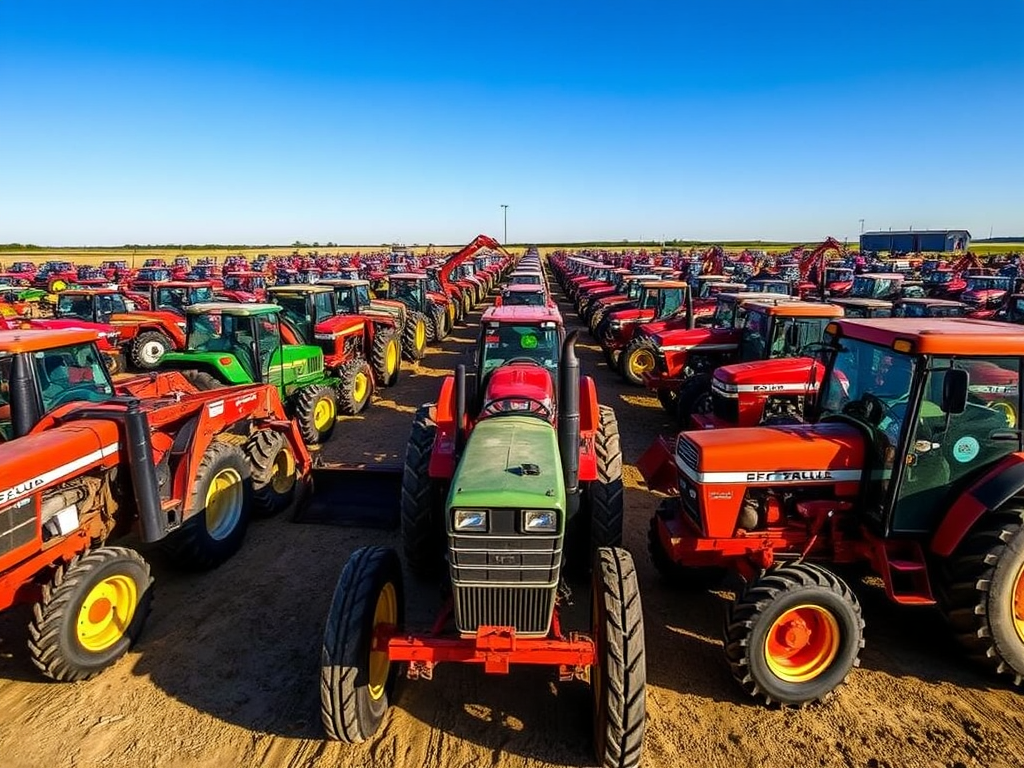

Every day in Tulsa, Oklahoma, rows of tractors fill a sprawling lot at Enlow Tractor Auction, where owner Josh Enlow trades in hundreds of agricultural and construction machines. What was once primarily a marketplace for smaller operations has now become a hub for large-scale farmers and ranchers who once swore by brand-new machines. Rising costs have changed the game, pushing many toward used equipment as a practical alternative.
“The increases in new pricing have definitely driven people back to the used market,” Enlow explained.
His observation reflects a larger shift taking place across U.S. agriculture. According to data from the University of Illinois Extension, the price of new tractors has climbed at least 60 percent over the past eight years. Some high-end models have more than doubled in cost, now commanding $250,000 more than their earlier counterparts.
This sudden affordability gap is reshaping the competitive landscape for major manufacturers, particularly John Deere, the country’s leading supplier of agricultural machinery.

John Deere’s Struggle in a Shifting Market
John Deere, headquartered in Moline, Illinois, has been a symbol of American manufacturing since 1837. Its iconic green-and-yellow tractors and combines are fixtures on farms nationwide. The company employs around 30,000 workers across 60 U.S. facilities, and more than three-quarters of its machines are assembled domestically. Despite this long legacy, John Deere is now grappling with turbulent conditions that have eroded its profitability.
The company posted record earnings two years ago, but circumstances have shifted dramatically. Tariffs introduced during the Trump administration—particularly on steel and aluminum—have significantly raised production costs. By the company’s own estimates, tariffs have already cost John Deere $300 million, with another $300 million in expenses expected before year’s end.
The fallout is visible. Net income in the latest quarterly report dropped 29 percent year-over-year, and last summer John Deere laid off 238 workers across plants in Illinois and Iowa.
Ironically, John Deere represents the kind of industrial strength that political leaders claim they want to expand. But market volatility, policy changes, and unpredictable global trade conditions are leaving the company and its customers caught in uncertainty.

The Impact of Crop Prices and Farmer Behavior
For farmers, the decision to buy new machinery has always hinged on crop prices. When prices rise, farmers reinvest their profits into state-of-the-art equipment. But when prices slump, they hold onto older machines or seek out affordable secondhand alternatives.
Right now, prices are on the downswing. Corn is selling at just half of its mid-2022 highs, while soybean prices have dropped 40 percent in the same period. For many farmers, revenue simply isn’t high enough to justify purchasing brand-new tractors.
John Deere itself has acknowledged the problem. The company expects 2025 sales of large agricultural equipment—its most important revenue driver—to decline by 15 to 20 percent. Analysts predict that weak demand may extend into 2026.

Trade Tensions Add Pressure
The global trade environment has only added more uncertainty. Although U.S. farmers exported $13 billion worth of soybeans to China in 2024, those numbers are now collapsing. After steep U.S. tariffs on Chinese goods were announced, China retaliated with tariffs on American soybeans. The result has been a 51 percent decline in soybean exports to China this year, with no advance purchases scheduled for the upcoming harvest.
That decline translates directly to farm income. According to the Department of Agriculture, growers are expected to earn $3.4 billion less from soybeans than they did last year. Many will lose money on every acre planted, making big-ticket purchases like new tractors nearly impossible to justify.
As Tad DeHaven, a policy expert at the Cato Institute, explained:
“How can companies and farmers plan for the long term when you don’t know what the cost of your inputs will be or what your market will look like in the weeks to come? These businesses are just trying to cut costs and hang on.”
Attempts to Adapt
John Deere’s difficulties didn’t begin with tariffs. In early 2024, dealerships were already overloaded with excess inventory, forcing the company to scale back production and lay off over 2,000 workers. To move products off lots, Deere offered discounted financing to entice buyers. The move was meant as a short-term hit to pave the way for recovery in 2025 and 2026.
At the time, CEO John May insisted that these measures would create a stronger long-term cycle:
“We fundamentally believe that these actions will lead to more favorable cycle dynamics than in previous downturns.”
Yet today, sales remain sluggish, and recovery is proving harder to achieve.
Outlook: Challenges and Opportunities
Despite the current headwinds, not all analysts are pessimistic. Kristen Owen, a managing director at Oppenheimer & Company, believes that 2026 could be a turnaround year. Recently passed tax and spending legislation includes a bonus depreciation rule that allows farmers to receive immediate tax breaks on new equipment purchases. This could boost demand for Deere’s products.
Moreover, Deere has an advantage over global competitors such as Kubota, Fendt, and Mahindra, which rely more heavily on foreign manufacturing. Tariffs on imported machinery may hit those rivals harder, giving John Deere a relative edge in the U.S. market.
Beyond agriculture, Deere’s construction equipment division may also see growth in the coming year, partially offsetting the downturn in farm machinery.
Still, the broader uncertainty remains daunting. Farmers are waiting for clarity on whether China will resume large-scale purchases, whether a new farm bill will provide subsidies, and whether the Federal Reserve will lower interest rates. The volatility of steel prices is yet another factor hanging over the sector.
As Owen puts it, farmers are accustomed to risks like weather, pests, and disease. But what they struggle with most is what she calls “pen-stroke risk”: the possibility that a sudden policy decision can reshape their entire economic outlook overnight.

Farmers Lean on the Used Market
For now, the trend is clear: farmers are keeping older equipment running longer and turning to used machinery dealers like Josh Enlow. The secondhand market is no longer just a niche—it is becoming a crucial part of farm management strategies across the country.
Used tractors and combines may not come with the latest technology, but they are reliable, affordable, and, most importantly, available in a market where brand-new options have become unattainable for many. Repair shops and parts suppliers are also seeing stronger demand as farmers stretch the lifespan of their equipment.
Enlow sums up the sentiment of many in the industry:
“Farmers have always been resourceful. If new prices keep climbing, they’ll figure out a way to make what they already have last.”
Conclusion
The agricultural machinery sector is in the middle of a historic shift. Rising equipment prices, volatile crop markets, tariffs, and shifting global trade policies have combined to create one of the most uncertain environments in decades.
John Deere, the American giant that has dominated the farm equipment industry for nearly two centuries, is now navigating layoffs, shrinking profits, and cautious customers. While tax incentives and potential construction growth may offer some relief, the future of the company—and of American farming—hinges on factors far outside its control.
Until stability returns, the used tractor lot in Tulsa may continue to look more attractive than the gleaming showrooms of new machinery. Farmers, caught between rising costs and unpredictable revenues, are finding that practicality often wins out over prestige.




Leave a Reply