
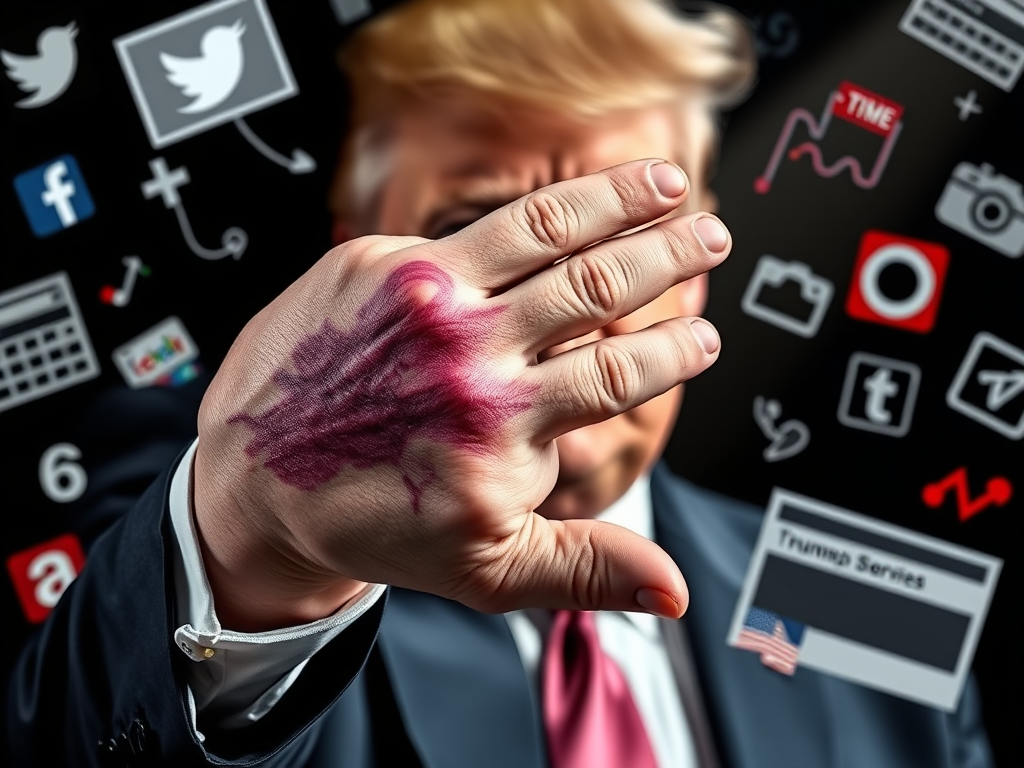

For three consecutive days last week, President Donald Trump had no public events listed on his schedule. At the same time, he was often spotted with a visible purple bruise on his right hand, a mark he occasionally attempted to cover with makeup. Observers also noted swelling around his ankles. At 79 years old, Trump remains the oldest individual ever elected to the presidency, and those signs alone were enough to fuel a frenzy of speculation over the Labor Day holiday weekend.
For a significant portion of hyper-online Americans, the conclusion seemed inevitable: the president was either gravely ill, incapacitated, or possibly even dead.
A Familiar Cycle of Rumors
Speculation over Trump’s health is not new. Throughout his years in national politics, critics have frequently raised questions about his medical condition, and Trump himself has rarely offered clear explanations. Whether dealing with COVID-19, routine procedures, or unexplained absences, he has consistently left the public with more questions than answers. What distinguished this particular moment was the sheer intensity of the conspiracy wave.
On TikTok, influencers with millions of followers suggested that official White House photographs were outdated, arguing that the administration was deliberately recycling old images to hide Trump’s true condition. On Reddit, discussion threads multiplied rapidly, with users offering theories and amateur medical analyses. On X, formerly known as Twitter, anonymous accounts spread unverified reports that gained thousands of shares within hours.
The noise grew so loud that Trump himself had to address the issue during his first public appearance in a week. When asked by a reporter how he discovered he was supposedly dead, Trump initially claimed he had not heard the rumors. But then he launched into a lengthy rebuttal, insisting that he had appeared on multiple media programs, played golf at his Virginia club, and remained highly active on Truth Social, his social media platform.
“I did numerous shows, and I also did a number of Truths — I think very poignant Truths,” Trump told reporters from the Oval Office, noting he had posted more than 90 times over the long weekend. “I was very active.”
Yet in today’s digital climate, even direct reassurances from the president himself are not enough to silence skeptics. When Trump wrote on Sunday that he had “NEVER FELT BETTER IN MY LIFE!” online critics quickly dismissed it as part of a broader cover-up.

Why Presidential Health Sparks Conspiracies
The obsession with a president’s health is not limited to Trump. Americans have a long history of both legitimate concern and wild speculation about the medical condition of their leaders. President Joe Biden’s visible physical decline during his time in office brought constant scrutiny, and Trump made Biden’s fitness for the presidency a cornerstone of his own 2024 campaign.
But the tradition of secrecy goes back much further. Woodrow Wilson was hidden from the public after suffering a stroke. Franklin D. Roosevelt managed to obscure his use of a wheelchair from many Americans. John F. Kennedy’s chronic back pain was largely concealed from public view. The presidency has often been accompanied by selective disclosure, leaving fertile ground for rumors.
In Trump’s case, skepticism has been amplified by past incidents. In 2018, his longtime physician Dr. Harold Bornstein claimed that Trump aides removed all of Trump’s medical records from his Manhattan office without permission. Bornstein later revealed details about Trump’s medications, including statins for cholesterol and finasteride for hair growth, before passing away in 2021.
Unexplained trips to Walter Reed Medical Center in 2019, awkward moments such as struggling to walk down a ramp in 2020, and the secrecy surrounding his COVID-19 diagnosis have only fueled more speculation. Stephanie Grisham, Trump’s former press secretary, later admitted in her memoir that one Walter Reed visit was for a routine colonoscopy, though it was never explained at the time.
“There has always been a cottage industry built on the idea that Trump’s health is about to collapse or his legal problems will bring him down,” said journalist Mike Rothschild, who has studied conspiracy movements extensively.
Trump’s Age and Medical Record
There is, of course, one undeniable fact: Trump is old. Should he complete a second term, he would leave office at age 82, making him older than Biden was when he departed the presidency.
Reports confirm Trump has high cholesterol, for which he takes two medications, Crestor and Zetia. His most recent health disclosure in April, signed by White House physician Dr. Sean Barbabella, showed his LDL cholesterol level had dropped dramatically — from 143 in 2018 to just 51 this year. While Stanford cardiologist Dr. David J. Maron noted such a result was possible, he called it “extraordinary” and suggested it likely involved a combination of higher medication doses and lifestyle changes, though Trump is still known for his fast-food-heavy diet.
Trump also takes daily aspirin, officially to reduce cardiac risk. This has been cited as the cause of the bruising on his right hand, though medical experts caution that aspirin use in people over 70 can sometimes do more harm than good.
Doctors have debated the White House’s explanation for Trump’s swollen ankles. Officials attributed it to chronic venous insufficiency, a condition where veins struggle to push blood back to the heart. While some physicians said that was plausible, others argued that the degree of swelling in both ankles raised questions.
Patterns of Limited Transparency
Despite repeated calls for transparency, Trump’s medical team has rarely engaged directly with the press. His physicians have not taken questions from reporters in years. After the assassination attempt in Butler, Pennsylvania, last summer, no formal health briefing was held.
Instead, the White House communications team has often handled questions about Trump’s condition with broad statements. “He is perfectly fine and has tremendous energy,” press secretary Karoline Leavitt recently declared. “He has been completely transparent about his health with the public, unlike his predecessor.”
The assertion of transparency, however, sits uneasily with Trump’s track record. The American public has often been left piecing together rumors, partial statements, and leaks from former staffers.

The Broader Implications
What this episode underscores is not simply a fascination with Trump’s personal health, but the role of conspiracy theories in American political culture. In an era where information spreads instantly across social media platforms, even small gaps in communication can spark waves of speculation that grow far beyond the facts.
For many citizens, the image of the president is tied to national stability. A visible bruise, a delayed appearance, or an unexplained absence can become a symbol around which conspiracy theories thrive. Trump’s age, diet, and history of secrecy only add fuel to the fire.
Whether or not the concerns are justified, the conversation itself reveals a deep distrust in institutions. Presidents from Wilson to Biden have faced questions about their health, but the social media era amplifies these suspicions to a new level, turning speculation into viral narratives.
In the end, Trump may indeed be “perfectly fine,” as his staff insists. But as long as there are unanswered questions and visible signs of aging, the rumors are unlikely to disappear. For his supporters, the persistence of these rumors is evidence of a hostile media culture. For his critics, it is proof that the president’s health is a legitimate concern.
And for the millions of Americans scrolling through TikTok, Reddit, and X, it is yet another reminder that in politics today, perception often matters more than fact.




Leave a Reply