
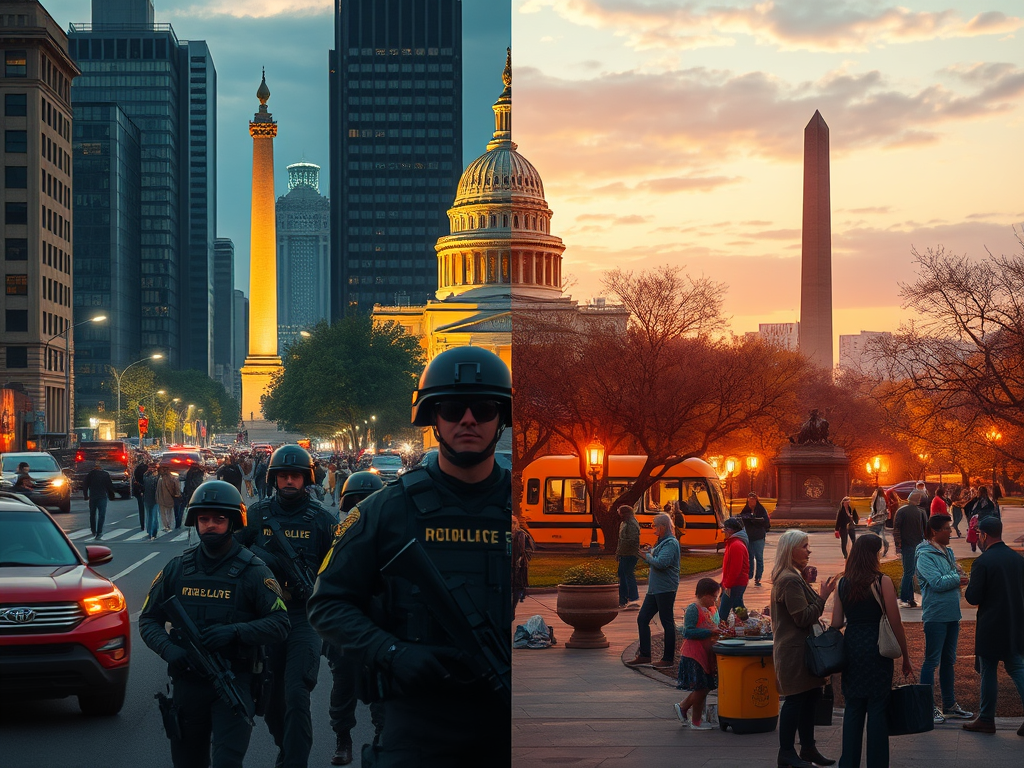

In recent weeks, Washington, D.C. has witnessed a visible decline in reported crime following President Trump’s decision to send hundreds of National Guard troops and federal agents onto the streets. Patrols have increased, enforcement is tighter, and the short-term results appear positive. Yet a critical question remains: will these numbers hold once the troops leave?
Most criminologists, local officials, and policy experts are skeptical. While residents appreciate a temporary sense of safety, the consensus among researchers is that this approach cannot provide a lasting solution to urban crime.
A Show of Force or a Sustainable Strategy?
Local lawmakers have criticized the move, framing the deployment as an unnecessary power grab by the federal government. They argue that a large-scale military presence in a city neighborhood is not sustainable, and certainly not the kind of intervention that addresses underlying social or economic factors fueling violence.
Thomas Abt, director of the Center for the Study and Practice of Violence Reduction, summarized the issue clearly: “Surges may bring crime down temporarily, but they are expensive and resource-heavy. They don’t solve the root problems.”
This tension between immediate results and long-term solutions has become the centerpiece of the debate. While Washington has seen crime numbers dip, the fear is that once the troops are pulled out, crime will rise again — leaving the city right where it started.
Alternative Paths Toward Lasting Crime Reduction
Experts suggest that if the federal government is serious about reducing crime, it should invest in strategies that build lasting resilience in communities rather than focusing only on visible enforcement. Suggestions range from providing more federal funds for police recruitment and training to supporting initiatives that are less directly tied to policing, such as neighborhood beautification and infrastructure upgrades.
Interestingly, President Trump himself has promoted a $2 billion proposal aimed at revitalizing public spaces in the capital. This includes repairing sidewalks, improving parks, and adding new streetlights across the city. While such a plan may sound cosmetic, research strongly supports the idea that well-lit, clean, and active public areas reduce crime.
In cities like Philadelphia and Flint, studies have shown that improved lighting, landscaping of vacant lots, and renovation of abandoned homes significantly lower rates of gun violence. The principle is simple: when communities feel safer in their shared spaces, people spend more time outdoors, neighbors watch out for one another, and criminal behavior becomes less attractive.
This approach draws on concepts related to the “broken windows” theory of the 1990s, though with less emphasis on aggressive policing. Instead, it focuses on environmental design and community pride as crime-prevention tools.

The Role of Federal Support
Jens Ludwig, an economist and director of the University of Chicago Crime Lab, noted that while President Trump’s beautification plan has been met with skepticism, it could have genuine benefits — if it extends beyond the symbolic areas near the White House and National Mall. “If improvements reach the neighborhoods where gun violence is most concentrated, it could help. Just because Trump proposes it does not mean it’s a bad idea,” Ludwig said.
Yet critics point out that the administration’s larger pattern of budget cuts undermines these potential benefits. For example, the Community Oriented Policing Services (COPS) office within the Department of Justice once received over $1 billion annually in grants to support local police hiring and prevention programs. Today, its budget has shrunk to less than half of that, and further cuts are planned, even as violent crime remains a challenge in many U.S. cities.
Peter Moskos, a former police officer and now professor at John Jay College of Criminal Justice, argues that real progress requires a stronger federal role in supporting local police infrastructure. “The federal government could expand grants, build training facilities, and speed up forensic testing,” he explained. “But so far, that hasn’t been a priority.”

Crime as a Political Battleground
President Trump has framed crime in America’s cities as a national crisis, describing urban areas as dangerous “hellscapes” that demand federal intervention. The administration has hinted that Washington may just be the beginning, with Chicago likely the next city to see a similar deployment of federal officers.
Despite the decline in violent crime since the pandemic spike, Trump’s rhetoric resonates with many Americans who believe crime remains too high compared with other developed countries. This political framing ensures crime will stay at the center of the national debate, whether or not military-style surges prove effective.
Mayor Brandon Johnson of Chicago has pushed back strongly against the idea of federal troops patrolling his city. He argues that restoring funding for community violence prevention groups would make a greater impact than militarization. These organizations mentor at-risk youth, mediate neighborhood disputes, and provide resources for mental health and substance abuse treatment. “Sending in the military is not the solution,” Johnson has said.
Risks of Federal Overreach
Law enforcement professionals also warn of unintended consequences. Michel Moore, former Los Angeles police chief, expressed concern that deploying federal agents into city neighborhoods may disrupt existing partnerships between local and federal agencies. These relationships have historically been critical in combating organized crime, terrorism, and other major threats.
By diverting federal officers to street patrols or low-level immigration enforcement, Moore argued, the government risks weakening its capacity to address higher-priority cases. “It’s not in our best interest,” he said. Instead, he urged Washington to increase funding for local technology, staffing, and crime-prevention initiatives.
Focused Deterrence vs. Broad Sweeps
Many criminologists believe that crime prevention works best when it concentrates on the relatively small number of individuals and neighborhoods responsible for most violent incidents. David M. Kennedy, a prominent criminologist at John Jay College, has pioneered what’s known as “focused deterrence.” This strategy involves identifying high-risk individuals, offering them counseling and social services, and simultaneously making clear that serious consequences will follow if they commit violence.

The model requires collaboration between law enforcement, community groups, and social service providers. According to Kennedy, cities that have embraced this method — such as Baltimore and Philadelphia — have seen meaningful reductions in gun violence. However, he warns that recent federal funding cuts to community groups threaten to undermine this progress.
Adam Gelb, president of the Council on Criminal Justice, agreed: “Everything in crime strategy is about focus. But the current deployment in Washington is the opposite — casting a wide net instead of targeting the people and places driving violence.”
Looking Ahead
The debate surrounding Washington’s crime drop highlights a deeper conflict over how America defines public safety. Should short-term troop deployments and shows of force be the primary tool, or should federal and local governments commit to long-term investment in communities, policing infrastructure, and social programs?
Experts and city leaders agree that crime reduction is possible, but not without addressing root causes — from poverty and unemployment to weak community ties and inadequate services. Lighting streets, fixing public spaces, and supporting youth programs may not generate the same headlines as National Guard patrols, but they are strategies backed by decades of research.
Ultimately, the future of Washington’s crime rates will depend not just on the presence of soldiers in uniform but on whether sustainable reforms follow. Without them, experts warn, the city may simply cycle back to the same challenges once the troops go home.




Leave a Reply