
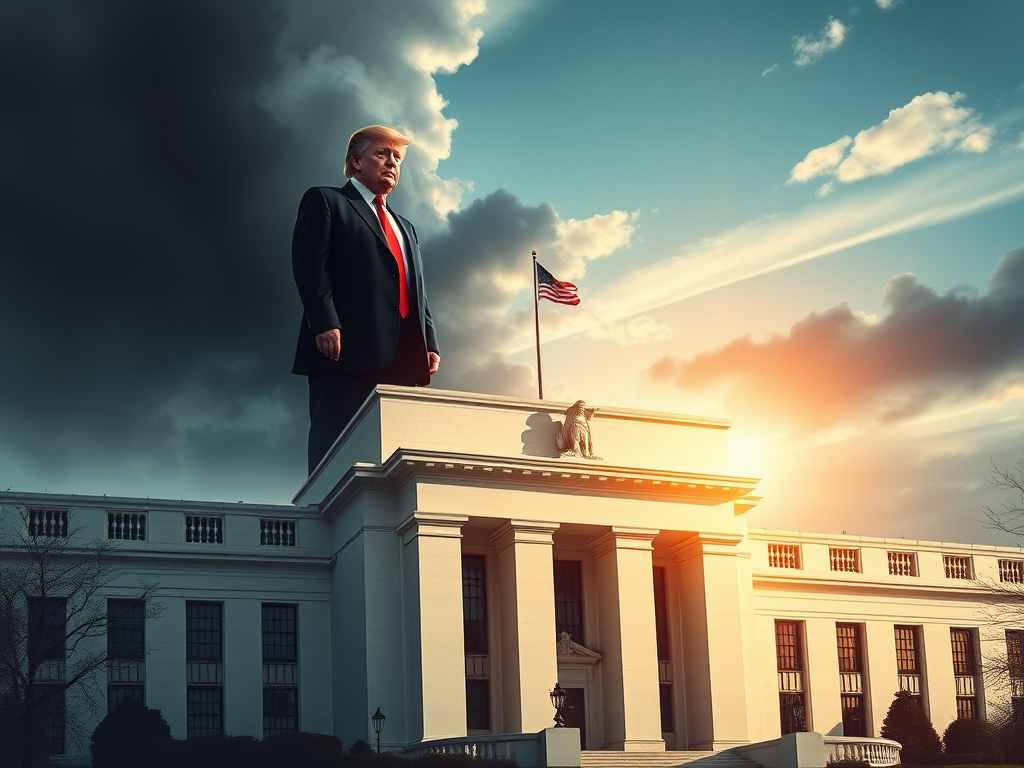

A high-stakes legal battle is unfolding in Washington, one that could redefine the relationship between the White House and the Federal Reserve. At the heart of the controversy is President Donald Trump’s effort to remove a sitting Federal Reserve governor, a move that, if successful, would open the door for the president to exert far greater influence over the nation’s central bank. The implications are profound: decisions about interest rates, bank supervision, and even the independence of monetary policy could tilt sharply in the direction of political priorities rather than economic consensus.
Trump has made little effort to conceal his ambitions. At a recent cabinet meeting, he remarked with enthusiasm about the potential to dominate the Fed’s seven-member Board of Governors. “We’ll have a majority very shortly,” he said confidently, hinting at the possibility of appointing allies who would align with his push for lower borrowing costs and looser regulatory oversight of Wall Street.
A Shift in the Balance of Power
Traditionally, the Federal Reserve has operated as an independent body, shielded from political pressure to preserve stability in monetary policy. But Trump’s strategy suggests a break with that convention. By filling vacant seats with loyalists, he could soon secure a majority bloc on the Board of Governors. That shift would grant him a powerful lever over an institution designed to function without direct presidential influence.
Experts say the ripple effects could extend beyond the boardroom. The Fed also oversees 12 regional banks whose leaders rotate as voting members of the Federal Open Market Committee (FOMC), the body that sets interest rates. Trump’s sway over the governors could indirectly affect these regional banks, whose decisions carry weight in shaping U.S. and global economic policy.
Gary Richardson, an economics professor at the University of California, Irvine, explained, “With four on the board, the president and his administration can have a big influence. It gives them ways to push.”

Early Openings for Trump
The president’s path to this position of strength began with an unexpected resignation. Adriana D. Kugler stepped down months before the end of her term, creating a vacancy. Trump quickly nominated Stephen I. Miran, a close adviser and vocal critic of the Fed, to fill the seat. If confirmed by the Senate, Miran could be in place by the Fed’s next policy meeting, giving Trump another ally in shaping monetary decisions.
Another opportunity may emerge through legal proceedings. Lisa Cook, a current governor, is contesting allegations of mortgage fraud in court. While Cook has not been charged with a crime, Trump has argued that such claims warrant her removal. Under existing law, a president may only dismiss a governor “for cause,” typically interpreted as neglect or misconduct. Cook has filed a lawsuit to challenge Trump’s attempt, asserting that the allegations fall short of this standard. Should the courts side with Trump, he would gain yet another nomination to further consolidate control.
Interest Rates and the Federal Open Market Committee
The central issue driving Trump’s interest in reshaping the Fed is his desire for lower interest rates. Trump has been outspoken in criticizing current Chair Jerome H. Powell, whom he previously elevated to the top position, for keeping rates higher than he prefers. Powell’s term ends in May, and Trump could soon have the chance to appoint a successor more aligned with his vision.
However, controlling interest rates is not straightforward. Decisions rest with the 12-member FOMC, which includes all seven governors plus five rotating regional bank presidents. Even with a board majority, regional presidents provide counterbalance. Yet, recent history shows that dissenting voices on the board can change the tone of policy discussions.
Last month, Christopher J. Waller and Michelle W. Bowman broke from the consensus, voting against holding rates steady. It was the first time since 1993 that two governors simultaneously dissented. If four governors consistently push for policies mirroring Trump’s agenda, the overall debate within the FOMC would shift dramatically, creating uncertainty about the Fed’s policy direction.
Control Beyond Interest Rates
The scope of influence extends well beyond interest rates. Every five years, the Fed’s board votes on whether to reappoint the 12 regional bank presidents. Historically a routine process, the upcoming March deadline now looms as a potential flashpoint. With enough votes, Trump’s appointees could block reappointments and attempt to replace regional leaders, a scenario that former Treasury Secretary Janet L. Yellen warned could destabilize the system.
In fact, precedent already exists. In 2022, Waller and Bowman abstained from voting on the appointment of Austan D. Goolsbee to head the Federal Reserve Bank of Chicago, signaling willingness to challenge the process.
The board also holds power over regulatory decisions affecting the nation’s largest banks, the Fed’s trillion-dollar balance sheet, and the approval of cross-border dollar swap operations that underpin global financial stability. A president-backed majority could move aggressively to reshape rules governing Wall Street, potentially loosening oversight in ways that benefit short-term growth but heighten systemic risks.

Risks to Institutional Independence
Critics argue that the most damaging outcome of Trump’s strategy would be the erosion of the Fed’s independence. For decades, global markets have viewed the U.S. central bank as the “gold standard” of governance, prized for its data-driven decision-making and insulation from political interference.
Janet Yellen expressed concern that Trump-appointed governors might also target the Fed’s staff, replacing career experts with politically aligned figures. “You could see substantial personnel changes at the board,” she warned, “getting rid of people with expertise who have always supported independence and careful analytic and data work.”
Such a purge could undermine the Fed’s capacity to deliver credible policy, leaving investors and international partners doubtful about the reliability of U.S. monetary management. Douglas Rediker, a former U.S. representative at the International Monetary Fund, went further, saying, “All of this is not only unprecedented but also unconstructive. It sends a message that is more akin to a chaotic, dysfunctional system than the prudence and independence markets have always assumed of the Fed.”
A Precarious Future for Monetary Policy
The coming months will reveal how much legal ground Trump can gain in his campaign to reshape the Fed. The lawsuit involving Lisa Cook, the Senate confirmation process for Stephen Miran, and the looming expiration of Powell’s term all serve as critical turning points. Each development could bring Trump closer to consolidating power over the institution at the very heart of the U.S. and global financial system.
If successful, the outcome would mark a watershed moment in American economic governance. The independence of the Federal Reserve has long been considered sacrosanct, ensuring that monetary policy remains driven by economic fundamentals rather than political agendas. Trump’s bid to alter that balance raises the question of whether the United States is entering a new era where central bank decisions are more directly shaped by the Oval Office.
For businesses, investors, and policymakers worldwide, the stakes could not be higher. Interest rates influence everything from mortgage payments to stock market performance and the value of the U.S. dollar. Any sign that political pressure is dictating these decisions risks injecting uncertainty into global markets already contending with inflation, geopolitical tension, and slowing growth.
As the legal and political battles unfold, one truth remains clear: the independence of the Federal Reserve, once taken for granted, now hangs in the balance.




Leave a Reply